
Papers, SFF

Erewhon: 150th Anniversary Edition

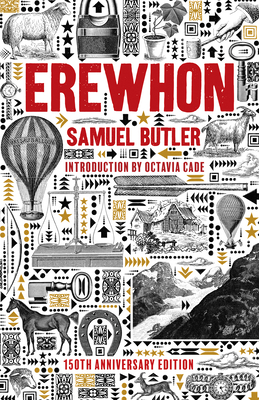
I have a new book out! At least, I have part of a book out. Erewhon Press has just put out the 150th Anniversary Edition of Samuel Butler’s classic utopian text Erewhon, and they very kindly asked me to write the introduction.

Butler came to New Zealand as a young man, and stayed for several years, working on a sheep station and writing articles for the local newspaper, some of which were the germs of what would become Erewhon. Even though he didn’t stay here, the book is very firmly located in the history of New Zealand utopias. Growing up here as I did, and with a long-held love for science fiction, I was aware as a child, albeit dimly, that New Zealand was a place of utopian dreams. (Thank John Wyndham for that. The children of The Chrysalids escaped their fundamentalist community, in the aftermath of atomic war, to come here.)

A lot of the utopian imagery surrounding this country is a product of colonialism. Actually, pretty much all of it is. New Zealand was actively marketed, in earlier times, as a perfect place for British settlers to make a new life. Even over the past few years, as we navigated our way through pandemic, New Zealand was held up as some utopian example of community togetherness.

That utopian perception has always been deeply flawed. We are not a paradise, and we have our own problems, and the creation of a settler utopia bulldozed any Indigenous idea of the same. However, what utopian literature such as Erewhon can do is to critique the idea of paradise. Who is it for? Who is it not for? What issues are there to be overcome? Butler, who was deeply concerned with the idea of a war between humans and machines – and he was at the forefront of genre writing there – decided to explore this. Erewhon was the result, and it is simultaneously confronting and (often) flat-out strange. Some of his ideas are mad. Some are terrible. But they’re worth grappling with, and I’m super pleased to have contributed what I hope is a generally academic, but still readable, introduction.

SFF, Short stories

Border Run

I have a new story out! It came out last month, actually, but I’m still playing catch-up with the blog, so better late than never. “Border Run” is free to read in the September issue of Clarkesworld.

It’s one of a very loosely linked set of stories of mine about life in a world after the ocean ecosystem has almost entirely collapsed. Consequently New Zealand, down at the bottom of the world, has reinvented itself as a place where conservation, particularly marine conservation, is the primary national ethos, and the stories go from there. It’s technically post-apocalypse, I suppose, in that the world these stories take place in is solidly set after global environmental disaster has taken place on an apocalyptic scale, but I wanted it to be an optimistic, cooperative response to apocalypse more than anything else.

That’s less evident in this story, admittedly, as it deals with overfishing. Even now, foreign fishing vessels occasionally turn up in our waters when they shouldn’t, but in a hypothetical world that’s starving due to ecological collapse, such incursions may well be more common. This isn’t a happy story, particularly, but I’m going for thoughtful and nuanced (alongside the killer mermaids) so hopefully that’s worked out to some extent.

SFF, Short stories

Pollen and Salt

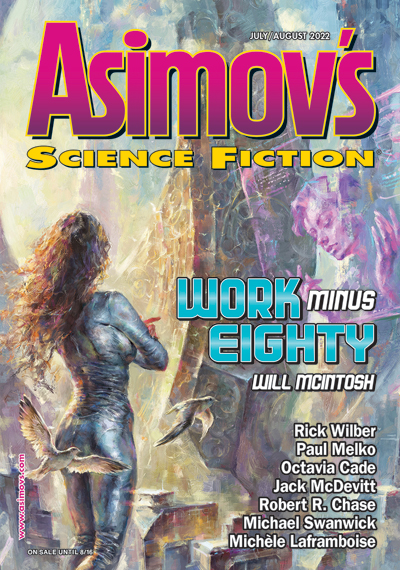
I have a new story out! Well, it came out a couple of months back, but I’m playing catch-up here. “Pollen and Salt” is available in the July/August issue of Asimov’s. I’ve had a few people contact me to say nice things about it, which is lovely, as it’s something of an experiment on my part.

The story, you see, doesn’t have much of a plot. It’s more a mood piece, set in the near-distant future, where a scientist is studying pollen at the edge of a rising ocean – pollen in salt marshes, mud flats, littoral spaces and so forth. The pollen is a record of past vegetation, and as they work the scientist is mourning their partner, who has recently died. It’s a meditation on change, more than anything else, and I was trying to create a story that was sad and quiet and still very aware of the beauty and potential of that new world, even when the parts of it that were loved are gone. Also, there’s a goose.

So, something of an experiment on my part! I don’t know that I’ll write a lot more stories like this in the future, but I worked on this one for several years, and I’m genuinely pleased with the result. If you can, please take a look!


Articles, SFF

To Bear Witness

I have a new article out! To be honest, it came out a couple of months ago but I’m behind on updating this site, so better late than never. “To Bear Witness: The Polar Bear as Refugee in Speculative Fiction” came out in the August issue of Clarkesworld.

I am fascinated by polar bears, mostly because I live on the other side of the world from them and so that fascination is not modified by their actual presence, which must surely be terrifying. And because that fascination is accompanied by a love of dreadful horror films, a fairly wide reading habit, and an awareness of climate change, I’d quietly noted to myself several speculative texts which presented the polar bear in a very specific way. As the climate changes, polar bears migrate, and when that migration puts them in conflict with human activity… well, let’s just say I’m expecting to see more polar bear horror films in the future. And not just horror films: polar bears are a charismatic species, and seeing them and their possible futures popping up in literary fiction and poetry as well as film is likely to be increasingly common.

Anyway, it was a fun little article to write, albeit on something fairly obscure as literary observations go, and it’s free to read so if you like polar bears too it might be worth checking out.

SFF, Short stories

Resist: The Stone Wētā

I have another reprint out! My short story “The Stone Wētā,” which originally appeared in Clarkesworld Magazine, has appeared in an anthology from Lonely Cryptid Media. That anthology is Resist with Every Inch and Every Breath, and it’s edited by Dan Michael Fielding. There’s twelve different stories and poems in the book, or so I understand, and given the theme it’s sure to be an interesting read.

The call for submissions went out a year or two back, when we were all in the beginning stages of pandemic, and one of the potential ways to explore the theme was the impact of politics on science. I’m sure we can all remember (or are even still being exposed to) the anti-science lunacy of certain people, many of whom were in positions of power that their intelligence frankly did not merit. I’ve been interested in the intersection between science and politics for a while now, and so, although it wasn’t about the pandemic itself, I was reminded of this story, which had come out a couple of years earlier.

“The Stone Wētā” was influenced by news stories about scientists preserving climate data across borders, in the face of hostility from anti-science governments. The fear was that the data would be destroyed, or access to it limited, and I’m sorry to say that fears of this type of censorship were not wholly unfounded. Anyway, I sent in the story, and Dan was kind enough to take it, and now you can read it (and eleven others!) in Resist with Every Inch and Every Breath.