SFF, Short stories

You Are My Sunshine and Other Stories

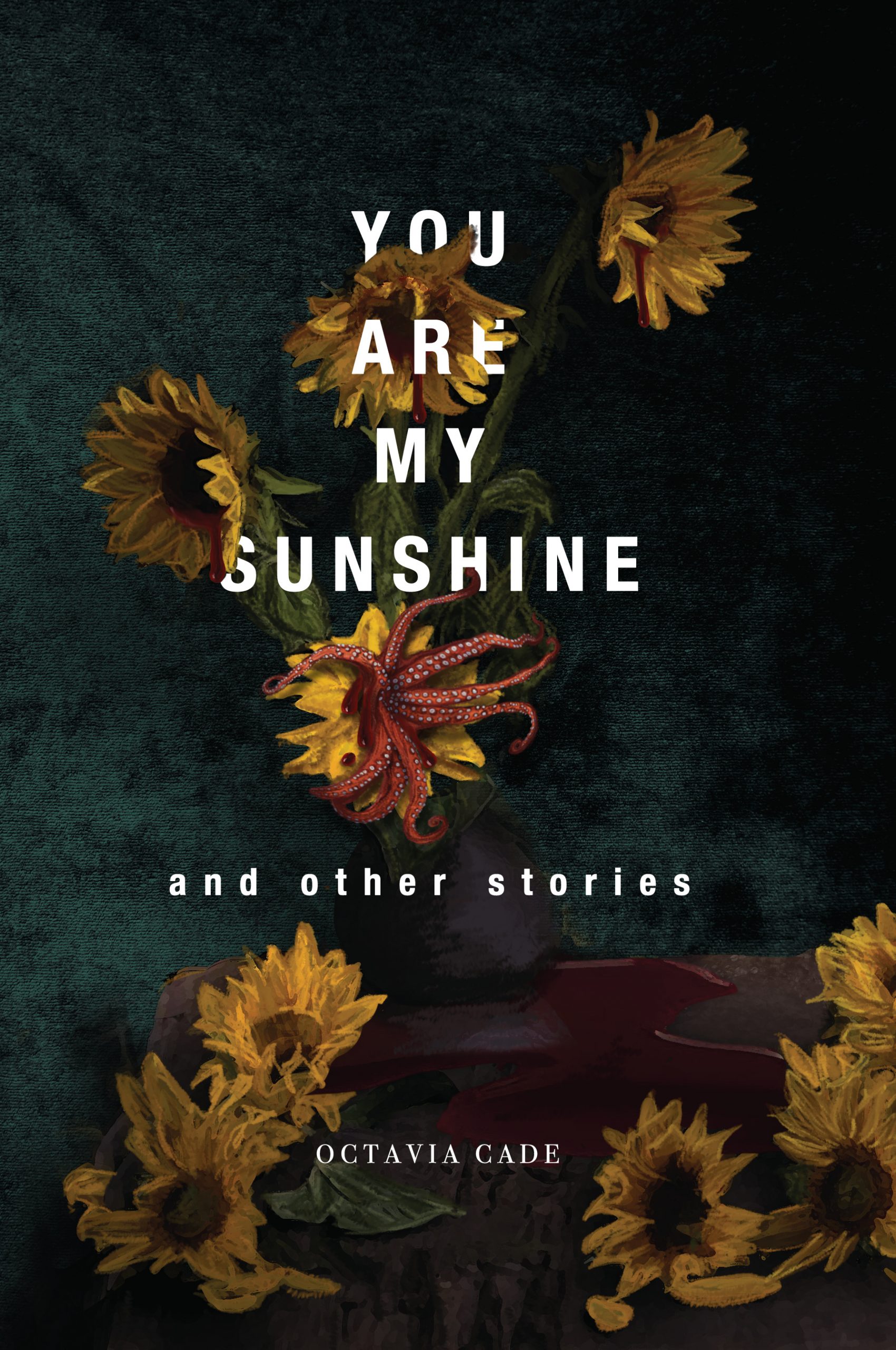
My new collection is out! You Are My Sunshine and Other Stories, published by Stelliform Press, is available now.

It’s a collection of speculative eco-fiction, ranging from eco-horror to solarpunk. Many of the stories have been published before, and you can read them in places like Clarkesworld (“You’re Not the Only One”) or Strange Horizons (“We Feed the Bears of Fire and Ice”). Have a read of either of these to see if you’ll like what’s in the rest of the book!

There’s also a few stories original to the collection, including the title novelette, “You Are My Sunshine.” This is one of my favourites, because it’s just so weird. It’s set in the same world as my Stelliform novella The Impossible Resurrection of Grief, where in the near-future ecological grief at a degrading environment causes a wave of insanity and suicide. Plus, the novella had jellyfish. Lots of jellyfish. There’s no jellyfish in “You Are My Sunshine” – this time it’s starfish. Zombie starfish, which are a real thing. Sea star wasting disease is spread in warming waters, and it causes the poor starfish to disintegrate… but the bits that fall off keep moving. For a while, anyway. If you’re a marine biologist, as main character Cyrus is, that’s pretty disturbing. Also disturbing are the severed human arms that keep appearing on his property, complete with apology notes. It’s bizarre, but I think it’s also a bit funny.

Stelliform has a fantastic range of books, focused on environmental and climate fiction, so if short stories aren’t your thing, take a look at their catalogue and you’re sure to find something appealing!

Horror, Short stories

Inviting the Hollow Bones

I have a new story out! Well, to be perfectly honest, it came out a few months back but I’m playing catch-up here. “Inviting the Hollow Bones” can be read in the anthology The Map of Lost Places, edited by Sheree Renée Thomas & Lesley Conner and published by Apex Books.

I was lucky enough to be invited to contribute to this, and the hook was appealing: write a horror story about a haunting, set in a real place. Somewhere off the beaten track. Naturally I chose something in my own country – a place called Echo Valley, in Fiordland, where a complete mummified skeleton of a bush moa was found several decades back. A bush moa is one of the smaller moa species – nothing like the giant moa, but still interesting. And sadly, still very extinct.

I’ve written ghost stories about birds before – there were ghostly penguins in “Tidemarks” – but the haunting here is less traditionally spectral. A number of artists have been employed to set their own take on the moa in different parts of the national landscape… sculptures that represent this lost element of our ecology. Two of these artists, working together, are placing a sculpture of the moa in Echo Valley.

That sculpture is made of human bones, and it requires a sacrifice…

It’s a creepy little story, but fun to write. I was happy to get it accepted, and while I don’t quite believe in the tales that come out occasionally of moa still surviving in the far reaches of Fiordland, I wish they were true. Wouldn’t that be wonderful? It would be a less bloodthirsty resurrection than this one, that’s for sure.

Horror, SFF, Short stories

The Barrens

I have a new story out! “The Barrens” is available, free to read, in the latest issue of Three-Lobed Burning Eye. It’s great to have a story in there again!

“The Barrens” is a body horror/eco-horror sort of story. A while back I read an article about kina barrens here in New Zealand: “kina” being what we call Evechinus chloroticus, the NZ sea urchin. I do love those spiky creatures! They’re so interesting to look at. They are less interesting, though, when they turn the sea floor into desert. You see, there are lots of kina and they are very hungry, and given that we have stupidly overfished their natural predators – crayfish and snapper – the local sea urchin population has exploded.

You can eat sea urchins too, but we don’t seem to be eating enough of them. Admittedly, I’ve never had a meal of kina myself, so I’m hardly one to talk. I read that article about kina barrens, though, and immediately thought that it would make a great horror story. I don’t know why, but I had a sudden image: people with kina for eyes, sea urchins embedding themselves in sockets. Which is implausible and mostly grotesque but also such a great image, especially when the little horrors burst out.

Hence the body horror. Yeah.

Anyway, I had immense fun writing this story, so please go ahead and take a look at it, as well as all the other fantastic stories in this issue of 3LBE.

Horror, SFF, Short stories

How to Dispose of a Dead Albatross

I have a new story out! “How to Dispose of a Dead Albatross” is free to read at Strange Horizons.

It’s a bit of a weird story. Very experimental, but then it’s part of an experimental project of mine. I’m currently the Robert Burns Fellow at the University of Otago, which basically means I’m the writer in residence there for 2025. One of the projects that I’m working on as part of the Fellowship is a near future science fiction/climate fiction novel called Bloom, in which a toxic algal bloom invades Otago Harbour. Dunedin, you understand, sits on that harbour, so it’s a very local story!

Down near the bottom of New Zealand’s South Island, Dunedin is a great place for wildlife spotting. There are sea lions here, and penguins, and a colony of albatrosses on Taiaroa Head. I’ve been out to see that colony, and the birds are amazing. In the world of Bloom, however, they’re also dead. Poor albatrosses! A lot of the wildlife is dead, in the novel, with the waters choked by algae. And somehow, without my planning it, the novel started to be this exploration of how people might respond to this strange and quietly violent disruption of their environment. “How to Dispose of a Dead Albatross” is actually the first chapter of the novel. It works as a standalone, so when I saw that Strange Horizons was open again for submissions earlier in the year, I sent it along.

I’m so pleased I did!

Articles, Nonfiction, Science

Fact, Fiction, and Feeling

I have a new article out! “Fact, Fiction, and Feeling: Ecological Grief in a Changing World” can be read for free online in the latest issue of Clarkesworld.

A lot of my creative work, over the past several years, has centred around the idea of ecological grief. Climate change and biodiversity loss, as well as other environmental issues, are having increasingly obvious, increasingly visible consequences in the world around us. Often those consequences are marked by absence: species that are disappearing, ecosystems that are altering beyond recognition. When we’re attached to an environment that’s no longer there, or which no longer exists in a way that’s familiar to us… well. It’s a loss, and more and more it’s being recognised as such.

So often, reactions to issues such as climate change are couched in economic or scientific or political terms. These are all valid reactions, but what’s interested me lately is the psychological response: how environmental loss makes us feel. And lately, in both academic and creative literature, that feeling is being explored.

It’s something that I think we’re all going to have to come to terms with eventually.

Articles, Nonfiction, SFF

Unpaid Green

I have a new article out! “Unpaid Green: Voluntary Conservation Work in Speculative Fiction” can be read for free in the latest issue of Journey Planet. The whole issue’s free to read, which is nice – and it’s a special issue on workers’ rights in SFF.

So much of speculative fiction is imagining different ways to live, and that includes work. When we picture what work will be like in the future, for instance, what kind of things are we prioritising? What are we hoping for, and what are we critical of? Can we even picture a working future reliably? What about the growing influence of technology and AI, or of environmental change and resource management?

It’s a fascinating topic to explore, so when I saw the submissions call I thought “I have to come up with something for that!” And given that most of my creative work is near-future science fiction, generally related to climate or to the environment, it’s no surprise where my focus went.

There’s a lot of work to be done building ecological resilience into the systems around us. This might end up being the most important work of the lot, even. A lot of it’s done by volunteers. What does that say about how much we value their work? Something to think about. That’s what my article focuses on, anyway. Please take a look!