Articles, Nonfiction, SFF

Unpaid Green

I have a new article out! “Unpaid Green: Voluntary Conservation Work in Speculative Fiction” can be read for free in the latest issue of Journey Planet. The whole issue’s free to read, which is nice – and it’s a special issue on workers’ rights in SFF.

So much of speculative fiction is imagining different ways to live, and that includes work. When we picture what work will be like in the future, for instance, what kind of things are we prioritising? What are we hoping for, and what are we critical of? Can we even picture a working future reliably? What about the growing influence of technology and AI, or of environmental change and resource management?

It’s a fascinating topic to explore, so when I saw the submissions call I thought “I have to come up with something for that!” And given that most of my creative work is near-future science fiction, generally related to climate or to the environment, it’s no surprise where my focus went.

There’s a lot of work to be done building ecological resilience into the systems around us. This might end up being the most important work of the lot, even. A lot of it’s done by volunteers. What does that say about how much we value their work? Something to think about. That’s what my article focuses on, anyway. Please take a look!

Horror, Papers, Pop culture, SFF

Multiple Mortalities in Pretty Deadly

I have a new paper out! “Deathface Ginny (Kelly Sue DeConnick, 2014–20) – Death and #MeToo” can be read in Death in the 21st Century: A Companion, part of the Genre Fiction and Film Companions series from Peter Lang, edited by Katarzyna Bronk-Bacon and Simon Bacon.

I have to admit, though, I continue to think of this particular chapter by its subtitle: “Multiple Mortalities in Pretty Deadly.” That’s what it was all the time I worked on it, so that’s the way I remember it. You don’t always get to pick your titles, and when the editors have to stick to a particular format – there’s a lot of fascinating case studies in this book, so standardisation helps readers to keep track! – that’s when your original title gets bumped down.

I’m not primarily a comics critic, but very occasionally I do a paper on comics, whenever I find something I just can’t resist writing about. This time round it’s Pretty Deadly by Kelly Sue DeConnick and Emma Ríos, which is a series I’m just fascinated by. It’s kind of weird western/historical, with a number of different reapers wandering around representing different types of death. The art is gorgeous, but what really interests me is how much of a puzzle it is – all these interlocking pieces fitting together in unexpected and thoughtful ways. It’s just a great read, and so when I saw a call for papers that was looking for representations of Death in 21st century pop culture I saw my opportunity and I pounced on it. Not sorry.

Horror, Papers, Pop culture, SFF

Monstrosity, Mutation, and the World without Us

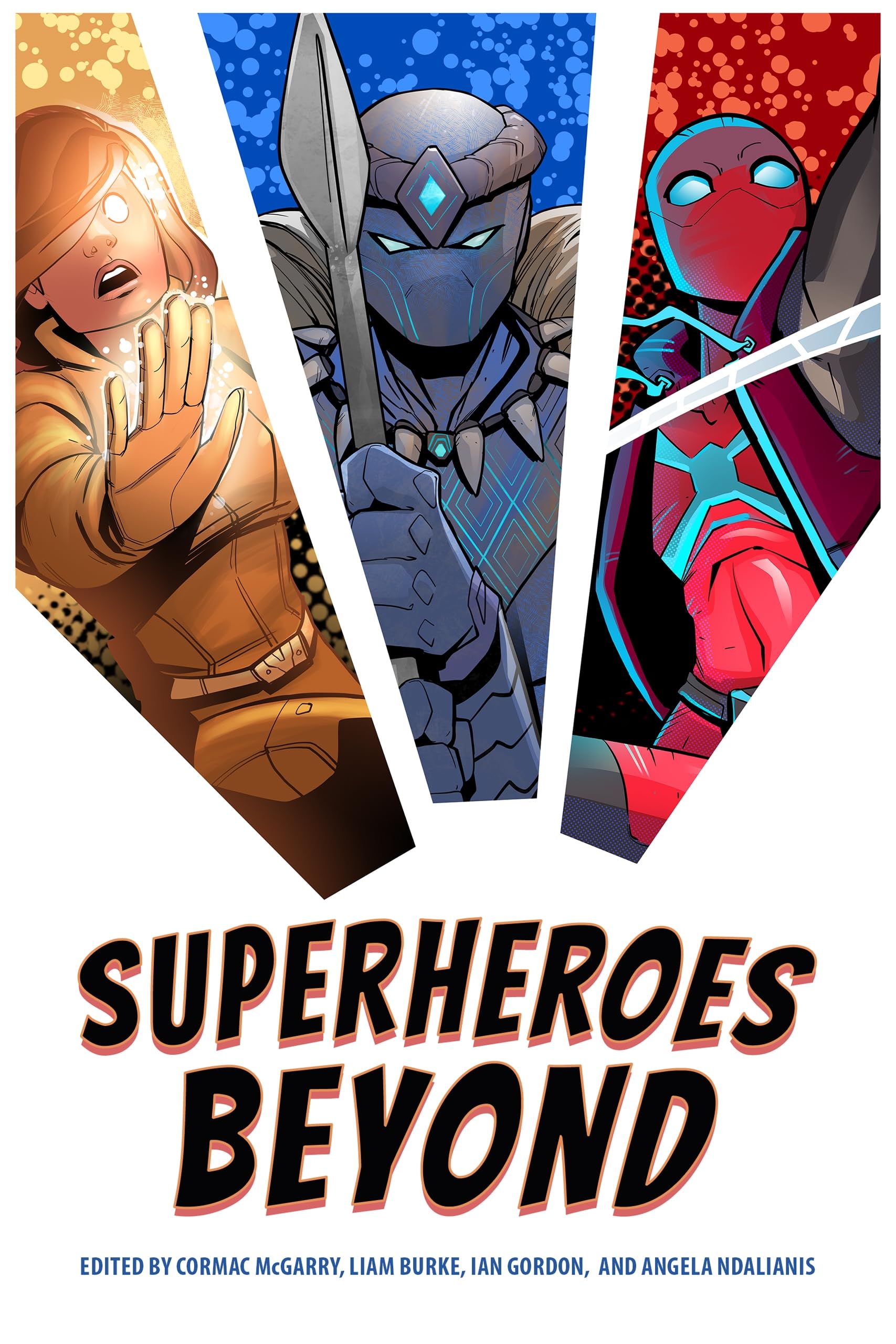
I have a new paper out! “Monstrosity, Mutation, and the World without Us” can be read in Superheroes Beyond, recently published by the University of Mississippi Press.

This paper has been a long time coming. Back in 2018, I presented it at the Superheroes Beyond conference in Melbourne. The city was baking hot – I barely wanted to go outside – but the conference itself was fantastic, focused as it was on how superheroes were presented, in boundary-crossing ways, in popular culture. There was a lot of emphasis on comics, of course, but there were also papers on lots of other media as well, and on superheroes from all around the world. It was honestly one of the most enjoyable conferences I’ve ever been to!

The conference led to a book project. It was not quick. All credit to the editors – Cormac McGarry, Liam Burke, Ian Gordon, and Angela Ndalianis – for keeping the momentum going through the five plus years of the entire book-producing process. I’ve finally got the finished result in my hot little hands and it looks great. I can’t wait to read what everyone else from the conference has written!

My particular paper looked at nonhuman superheroes and eco-horror. There’s some discussion of Swamp Thing, of course, but also mutant bears and Godzilla, and how their creation, their actions (and their reactions) might allow them to be seen through a superhero lens. I’m so glad to see it finally out there!

SFF, Short stories

Year’s Best: Pollen and Salt

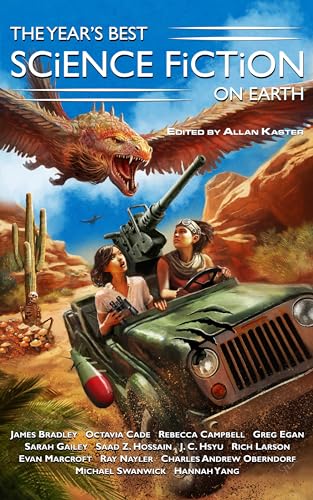
I’m happy to say that one of my climate fiction shorts, “Pollen and Salt,” has been reprinted! You can find it in the inaugural volume of The Year’s Best Science Fiction on Earth, edited by Allan Kaster. I have to admit that even though I basically grew up on Star Trek as the epitome of science fiction, my own scifi is predominantly set here on Earth. It’s not that I don’t still love space travel and alien worlds; it’s just that what’s happening on this world is what I’m most invested in. The changes taking place here, and the changes coming. I’m really pleased to see an anthology that focuses on that, and it’s wonderful to be in it.

I will say, of all the reactions to this particular story, I’m most interested in how people perceive the protagonist. The story’s told by a first person narrator, and they talk about how much they miss their dead spouse, and how affected they are by the changing environment of the salt marsh, but as far as I recall there was no real indication as to the gender of either of the people involved. Every so often a reader reaction or review indicates that they think the protagonist is a man or a woman (I suppose nonbinary would also be a valid interpretation, although I haven’t seen that one yet.) Same with the spouse. Honestly, it doesn’t matter. No matter your gender, you’ll grieve when someone you love dies.

I can’t honestly say that ambiguity was a deliberate choice on my part. I noticed it later, and thought might as well keep it in, but I’m enjoying seeing how people choose to interpret it. I have my own opinion, of course, but there’s no right answer. People can read into it what they want.

Horror, Papers

Forensic and Experimental Estrangement

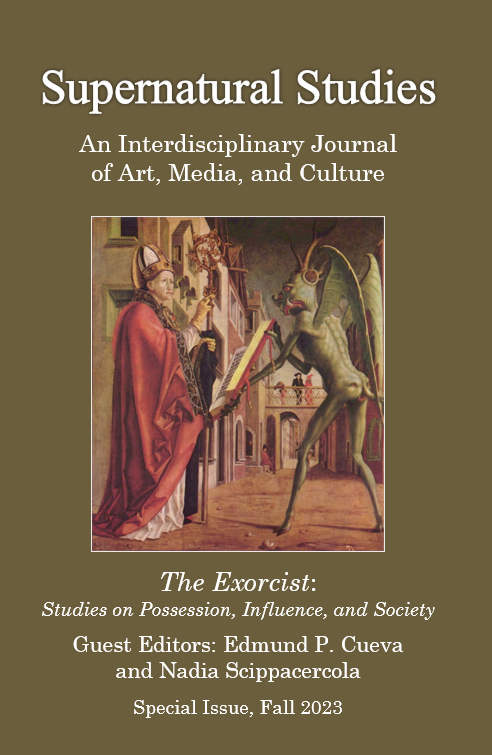
I have a new paper out! “Forensic and Experimental Estrangement: Investigating the Supernatural Body” is free to read in the latest issue of Supernatural Studies. It’s a special issue, devoted to one of my favourite films of all time, The Exorcist. I’ve written a paper on that film before, looking at the archaeological imagery of the film and how it relates to the presentation of medicine therein (that paper can be found in volume 7.1 of Horror Studies), and this new paper is a little related to that.

I happen to love horror films about exorcism and possessed or supernatural bodies, and I note that, in some of them at least, there’s a strong focus on medical examination of the body in question. Sometimes that examination is carried out on a living person, as it is in The Exorcist with little Regan, but sometimes the person is dead, and the examination shifts to autopsy. It almost never goes well.

In this paper, I look at four different films – The Exorcist, The Atticus Institute, The Possession of Hannah Grace, and The Autopsy of Jane Doe. I’m interested in how these films present medical science, both its practice and its efficacy… and, honestly, it’s not exactly a research hardship, sitting on my arse and watching horror films.

I’ll take any excuse for that.