Articles, Nonfiction, Science

Fact, Fiction, and Feeling

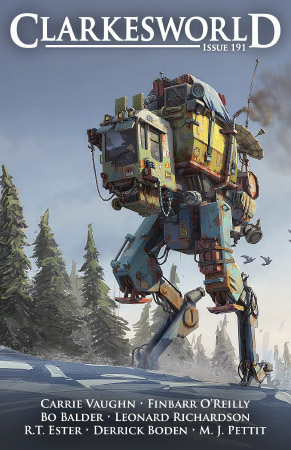
I have a new article out! “Fact, Fiction, and Feeling: Ecological Grief in a Changing World” can be read for free online in the latest issue of Clarkesworld.

A lot of my creative work, over the past several years, has centred around the idea of ecological grief. Climate change and biodiversity loss, as well as other environmental issues, are having increasingly obvious, increasingly visible consequences in the world around us. Often those consequences are marked by absence: species that are disappearing, ecosystems that are altering beyond recognition. When we’re attached to an environment that’s no longer there, or which no longer exists in a way that’s familiar to us… well. It’s a loss, and more and more it’s being recognised as such.

So often, reactions to issues such as climate change are couched in economic or scientific or political terms. These are all valid reactions, but what’s interested me lately is the psychological response: how environmental loss makes us feel. And lately, in both academic and creative literature, that feeling is being explored.

It’s something that I think we’re all going to have to come to terms with eventually.

Articles, Nonfiction, SFF

Unpaid Green

I have a new article out! “Unpaid Green: Voluntary Conservation Work in Speculative Fiction” can be read for free in the latest issue of Journey Planet. The whole issue’s free to read, which is nice – and it’s a special issue on workers’ rights in SFF.

So much of speculative fiction is imagining different ways to live, and that includes work. When we picture what work will be like in the future, for instance, what kind of things are we prioritising? What are we hoping for, and what are we critical of? Can we even picture a working future reliably? What about the growing influence of technology and AI, or of environmental change and resource management?

It’s a fascinating topic to explore, so when I saw the submissions call I thought “I have to come up with something for that!” And given that most of my creative work is near-future science fiction, generally related to climate or to the environment, it’s no surprise where my focus went.

There’s a lot of work to be done building ecological resilience into the systems around us. This might end up being the most important work of the lot, even. A lot of it’s done by volunteers. What does that say about how much we value their work? Something to think about. That’s what my article focuses on, anyway. Please take a look!

Articles, Poetry, SFF, Short stories

Reckoning 7

I have a new book out! Or, more honestly, I am one of a number of people who have contributed to a new book being out. Reckoning, which published creative work on environmental justice, was kind enough to let me sign on as fiction editor for their issue 7, along with Priya Chand (nonfiction editor) and Tim Fab-Eme (poetry editor). Together the three of us, with the help of a number of excellent editorial readers, put together this year’s issue of Reckoning, which we themed around oceans and the global water system.

Each of the several dozen pieces that we picked will be available to read for free online throughout the year. You can see the menu and the publication schedule here. If you’d like to purchase the entire wonderful issue, however, the ebook is available now, and the print release is scheduled for July; details are at the link. There’s over 250 pages of excellent writing there! And that cover, Drua, by Elsie Andrewes, is gorgeous.

Speaking of the fiction writers included in this issue… their work is incredible. From the Great Pacific Garbage Patch to the local swimming hole, from dolphins and sharks and burials at sea, these are hopeful stories of people working to make our watery world a more just and sustainable place. Please take a look.

Articles, SFF

To Bear Witness

I have a new article out! To be honest, it came out a couple of months ago but I’m behind on updating this site, so better late than never. “To Bear Witness: The Polar Bear as Refugee in Speculative Fiction” came out in the August issue of Clarkesworld.

I am fascinated by polar bears, mostly because I live on the other side of the world from them and so that fascination is not modified by their actual presence, which must surely be terrifying. And because that fascination is accompanied by a love of dreadful horror films, a fairly wide reading habit, and an awareness of climate change, I’d quietly noted to myself several speculative texts which presented the polar bear in a very specific way. As the climate changes, polar bears migrate, and when that migration puts them in conflict with human activity… well, let’s just say I’m expecting to see more polar bear horror films in the future. And not just horror films: polar bears are a charismatic species, and seeing them and their possible futures popping up in literary fiction and poetry as well as film is likely to be increasingly common.

Anyway, it was a fun little article to write, albeit on something fairly obscure as literary observations go, and it’s free to read so if you like polar bears too it might be worth checking out.

Articles, Science

Strigops habroptilus

I have a new article out! “Strigops habroptilus – Kākāpō” is in Becoming Feral, a bestiary project from Object-a Creative Studio, supported by The Royal Conservatoire of Scotland, the University of Wisconsin-Madison; and the University of California, Santa Cruz. If you’ve ever met me and been foolish enough to enter into the topic of academic publishing, you’ll know that I have opinions, so when I saw this project, which is a strange (but hopefully accessible) attempt at producing specifically creative research, I knew that I wanted to be a part of it.

Becoming Feral is an exploration of ferality as it relates to the interactions between humans and nonhuman animals. Participants had to pick an animal and create a bestiary entry for them that fulfilled that brief. A lot of those entries – including mine – are primarily written, but there are also some multimedia entries that you can take a look at for free online.

I chose to write a short article on the kākāpō, a flightless parrot endemic to Aotearoa New Zealand. It’s very endangered here; at the time I wrote this post there were only 201 left alive. Unfortunately, in 2019 (the year before COVID-19 came to NZ) the kākāpō had their own pandemic. Nearly five percent of the entire kākāpō population died; many had to be isolated from the disease in order to survive. Some had to undergo nebuliser treatment to support their respiration, as contagious spores were attacking their lungs, and the only nebulisers small enough were ones designed for kids. The crossover in pandemic experience, then, was something I found really interesting – what was the feral organism here? The kākāpō, who by the end were helping to weigh themselves in the quarantine facilities provided for them, or the spores that were killing them?