Articles, Nonfiction, Science

Fact, Fiction, and Feeling

I have a new article out! “Fact, Fiction, and Feeling: Ecological Grief in a Changing World” can be read for free online in the latest issue of Clarkesworld.

A lot of my creative work, over the past several years, has centred around the idea of ecological grief. Climate change and biodiversity loss, as well as other environmental issues, are having increasingly obvious, increasingly visible consequences in the world around us. Often those consequences are marked by absence: species that are disappearing, ecosystems that are altering beyond recognition. When we’re attached to an environment that’s no longer there, or which no longer exists in a way that’s familiar to us… well. It’s a loss, and more and more it’s being recognised as such.

So often, reactions to issues such as climate change are couched in economic or scientific or political terms. These are all valid reactions, but what’s interested me lately is the psychological response: how environmental loss makes us feel. And lately, in both academic and creative literature, that feeling is being explored.

It’s something that I think we’re all going to have to come to terms with eventually.

Articles, Nonfiction, SFF

Unpaid Green

I have a new article out! “Unpaid Green: Voluntary Conservation Work in Speculative Fiction” can be read for free in the latest issue of Journey Planet. The whole issue’s free to read, which is nice – and it’s a special issue on workers’ rights in SFF.

So much of speculative fiction is imagining different ways to live, and that includes work. When we picture what work will be like in the future, for instance, what kind of things are we prioritising? What are we hoping for, and what are we critical of? Can we even picture a working future reliably? What about the growing influence of technology and AI, or of environmental change and resource management?

It’s a fascinating topic to explore, so when I saw the submissions call I thought “I have to come up with something for that!” And given that most of my creative work is near-future science fiction, generally related to climate or to the environment, it’s no surprise where my focus went.

There’s a lot of work to be done building ecological resilience into the systems around us. This might end up being the most important work of the lot, even. A lot of it’s done by volunteers. What does that say about how much we value their work? Something to think about. That’s what my article focuses on, anyway. Please take a look!

Articles, Horror, Nonfiction

The Haunted Boundaries of House and Body

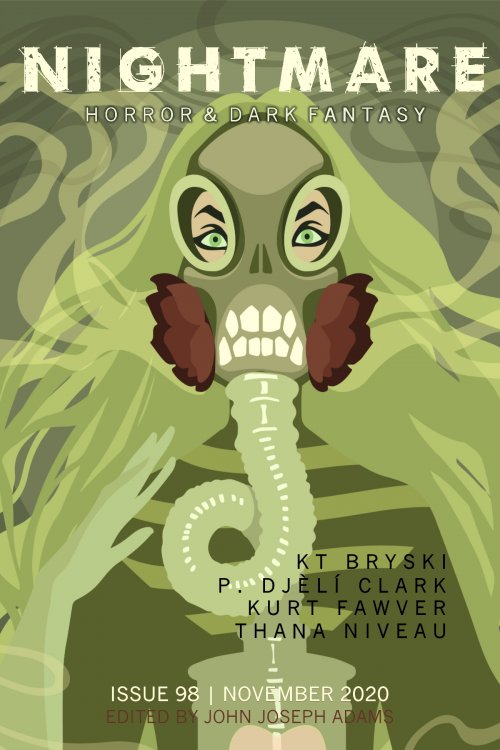
This… isn’t quite a story, but it’s new and more importantly it’s in Nightmare, which is a market I’ve been trying to crack for years. Have finally managed it with this essay about stories. Horror stories, to be precise. Nightmare has a regular column called “The H Word” that does short essays about various things within the genre, and this piece of mine is about haunted houses. “The Haunted Boundaries of House and Body” is an extract from a longer piece that I’m working on, about how haunted houses are frequently gendered as female.

It’s basically an excuse for me to read my way through the horror canon under the guise of scholarship.

Anyway, the story referred to in the essay is one of mine that’s not available online. That story, “The Knife Orchard,” about a piece of family history, is one of the original stories collected in my recently published collection The Mythology of Salt and Other Stories. It’s apples and sharp edges and haunting, and ultimately about turning away from haunting, which is a piece of good sense I am determined to appreciate. Anyway, you can read the essay at the link, so let me know what you think!

Nonfiction, Papers, SFF

Humans as Ecological Actors in Post-Apocalyptic Literature

I have a new paper out! “Humans as Ecological Actors in Post-Apocalyptic Literature” has been published in MOSF Journal of Science Fiction, in their special issue on environmental SF. This is also the first paper I’ve ever co-written, and my fellow author is Meryl Stenhouse. It was a really enjoyable writing experience, so I think we’re going to work together again once we can figure out our next topic!

Post-apocalyptic literature is frequently environmental in nature, or explores significant ecological impacts. These affect the surviving human and nonhuman populations, and are characterised by scale. While some of the apocalypses of science fiction literature are limited to the destruction of a single species – as occurs, for instance, in P.D. James’ The Children of Men – others, such as Cormac McCarthy’s The Road, illustrate an environmental collapse that destroys entire ecosystems.

Human response to apocalypse occurs on both an individual and a communal level, but that response, within the literature, tends to focus more often on social or economic consequences. However, the ability of humans to further shape their natural environment tends to be heightened in environmental apocalypse, as compromised ecologies become ever more vulnerable to human activity. The ability of humans to function as ecological actors, as shapers of surviving ecologies, is therefore not only a fundamental – if frequently underexplored – part of that narrative, but it also indicates potential pathways for real-life response to ecological apocalypse.

Notable, in the post-apocalyptic narratives explored in this paper, is how the impact of human behaviour on environment is dependent on apocalyptic scale. The construction of refugia, the realignment of surviving communities to sustainable practices, and the increasingly destructive human presence on ecologies incapable of reclamation contrasts with, for example, the increasing nonhuman biodiversity that can follow the widespread destruction of the human population.

Nonfiction, Papers, SFF

Confronting the Minotaur

I have a new paper out! “Confronting the Minotaur: Gender, Reconciliation, and the Labyrinth in Fantasy Literature” has been published by BFS Journal.

I love labyrinths, I really do. They pop up a lot in fantasy lit, and I’m always glad to see them. They always seem more exciting in fantasy than in real life, but such is the case for a number of settings, I’m sure. Anyway, over the years I’ve noted a number of variations related to gender: who solves the labyrinth, who’s settled in the middle of it, that sort of thing. One of the archetypal stories is of course that of Theseus, who – with the help of Ariadne – solves the labyrinth to confront the monstrous devouring Minotaur at the centre of it. If we take this as a basic pattern (albeit one that rests primarily on the European tradition of labyrinths, as opposed to those traditions from other parts of the world) we can see how such patterns are repeated in, for example, Ursula K. Le Guin’s The Tombs of Atuan and J.R.R. Tolkien’s The Hobbit and The Lord of the Rings. Whether the maze is made out of underground tunnels or the dead marshes, the risk of being eaten or otherwise swallowed up is significant. Does this pattern change, however, when the solver of the labyrinth is female? Meredith Ann Pierce’s The Darkangel is an interesting contrast here, where the monstrous devourer exists outside the labyrinth, and the centre is a place of science and safety.

I tinkered with this paper on and off for well over a decade, so I’m glad it’s finally been published. Let me know what you think!