Articles, Nonfiction, SFF

Unpaid Green

I have a new article out! “Unpaid Green: Voluntary Conservation Work in Speculative Fiction” can be read for free in the latest issue of Journey Planet. The whole issue’s free to read, which is nice – and it’s a special issue on workers’ rights in SFF.

So much of speculative fiction is imagining different ways to live, and that includes work. When we picture what work will be like in the future, for instance, what kind of things are we prioritising? What are we hoping for, and what are we critical of? Can we even picture a working future reliably? What about the growing influence of technology and AI, or of environmental change and resource management?

It’s a fascinating topic to explore, so when I saw the submissions call I thought “I have to come up with something for that!” And given that most of my creative work is near-future science fiction, generally related to climate or to the environment, it’s no surprise where my focus went.

There’s a lot of work to be done building ecological resilience into the systems around us. This might end up being the most important work of the lot, even. A lot of it’s done by volunteers. What does that say about how much we value their work? Something to think about. That’s what my article focuses on, anyway. Please take a look!
Articles, Horror, Nonfiction

The Haunted Boundaries of House and Body

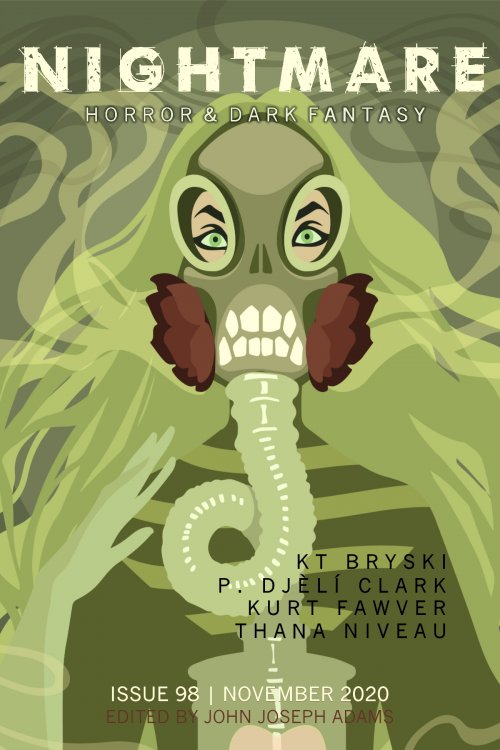
This… isn’t quite a story, but it’s new and more importantly it’s in Nightmare, which is a market I’ve been trying to crack for years. Have finally managed it with this essay about stories. Horror stories, to be precise. Nightmare has a regular column called “The H Word” that does short essays about various things within the genre, and this piece of mine is about haunted houses. “The Haunted Boundaries of House and Body” is an extract from a longer piece that I’m working on, about how haunted houses are frequently gendered as female.

It’s basically an excuse for me to read my way through the horror canon under the guise of scholarship.

Anyway, the story referred to in the essay is one of mine that’s not available online. That story, “The Knife Orchard,” about a piece of family history, is one of the original stories collected in my recently published collection The Mythology of Salt and Other Stories. It’s apples and sharp edges and haunting, and ultimately about turning away from haunting, which is a piece of good sense I am determined to appreciate. Anyway, you can read the essay at the link, so let me know what you think!

Nonfiction, Papers, SFF

Humans as Ecological Actors in Post-Apocalyptic Literature

I have a new paper out! “Humans as Ecological Actors in Post-Apocalyptic Literature” has been published in MOSF Journal of Science Fiction, in their special issue on environmental SF. This is also the first paper I’ve ever co-written, and my fellow author is Meryl Stenhouse. It was a really enjoyable writing experience, so I think we’re going to work together again once we can figure out our next topic!

Post-apocalyptic literature is frequently environmental in nature, or explores significant ecological impacts. These affect the surviving human and nonhuman populations, and are characterised by scale. While some of the apocalypses of science fiction literature are limited to the destruction of a single species – as occurs, for instance, in P.D. James’ The Children of Men – others, such as Cormac McCarthy’s The Road, illustrate an environmental collapse that destroys entire ecosystems.

Human response to apocalypse occurs on both an individual and a communal level, but that response, within the literature, tends to focus more often on social or economic consequences. However, the ability of humans to further shape their natural environment tends to be heightened in environmental apocalypse, as compromised ecologies become ever more vulnerable to human activity. The ability of humans to function as ecological actors, as shapers of surviving ecologies, is therefore not only a fundamental – if frequently underexplored – part of that narrative, but it also indicates potential pathways for real-life response to ecological apocalypse.

Notable, in the post-apocalyptic narratives explored in this paper, is how the impact of human behaviour on environment is dependent on apocalyptic scale. The construction of refugia, the realignment of surviving communities to sustainable practices, and the increasingly destructive human presence on ecologies incapable of reclamation contrasts with, for example, the increasing nonhuman biodiversity that can follow the widespread destruction of the human population.

Nonfiction, Papers, SFF

Confronting the Minotaur

I have a new paper out! “Confronting the Minotaur: Gender, Reconciliation, and the Labyrinth in Fantasy Literature” has been published by BFS Journal.

I love labyrinths, I really do. They pop up a lot in fantasy lit, and I’m always glad to see them. They always seem more exciting in fantasy than in real life, but such is the case for a number of settings, I’m sure. Anyway, over the years I’ve noted a number of variations related to gender: who solves the labyrinth, who’s settled in the middle of it, that sort of thing. One of the archetypal stories is of course that of Theseus, who – with the help of Ariadne – solves the labyrinth to confront the monstrous devouring Minotaur at the centre of it. If we take this as a basic pattern (albeit one that rests primarily on the European tradition of labyrinths, as opposed to those traditions from other parts of the world) we can see how such patterns are repeated in, for example, Ursula K. Le Guin’s The Tombs of Atuan and J.R.R. Tolkien’s The Hobbit and The Lord of the Rings. Whether the maze is made out of underground tunnels or the dead marshes, the risk of being eaten or otherwise swallowed up is significant. Does this pattern change, however, when the solver of the labyrinth is female? Meredith Ann Pierce’s The Darkangel is an interesting contrast here, where the monstrous devourer exists outside the labyrinth, and the centre is a place of science and safety.

I tinkered with this paper on and off for well over a decade, so I’m glad it’s finally been published. Let me know what you think!

Nonfiction, SFF, Uncategorized

Spring Again

I’ve a new academic chapter out! My paper “Spring Again: The Problem of Evil and the End of Winter in C.S. Lewis’ Narnia” is out in A Shadow Within: Evil in Fantasy and Science Fiction, edited by Francesca T. Barbini from Luna Press Publishing.

My love of fantasy began with Narnia. The first book I ever really remember reading was The Lion, the Witch and the Wardrobe, which my parents gave to me on the Christmas following my fourth birthday. I spent Christmas morning tucked in a chair and enraptured, while Mum vacuumed up tinsel around me. I’d finished by lunch, and my parents (untrusting souls that they were) were so disbelieving they actually quizzed me on the contents of the book. I passed, though for the life of me I couldn’t remember that the witch’s knife was made of stone.

As an adult I still enjoy Narnia, problematic though it sometimes is. (The Last Battle, I must admit, is one of my most hated books of all time.) So when I saw the Luna Press call for papers, I thought I’d write about evil in Narnia. Here’s the abstract:

In The Chronicles of Narnia by C.S. Lewis, evil is perceived as directly resulting from personal choice. Each individual is solely responsible for their own moral decisions, and these decisions both impact the continuing ethical development of the self and influence how the individual addresses the problem of evil. This is particularly well illustrated in the case of Edmund Pevensie, and this paper argues that it is his willingness to accept and atone for the evil within himself that directly leads to the end of the enchanted winter imposed on Narnia. In this sense, evil is not only present within the individual, but is externalised in the land that that individual inhabits.

Basically, it sums up as “prophecies are always dodgy”. The Beavers have no logic, poor things.