Horror, Papers, Pop culture, SFF

Multiple Mortalities in Pretty Deadly

I have a new paper out! “Deathface Ginny (Kelly Sue DeConnick, 2014–20) – Death and #MeToo” can be read in Death in the 21st Century: A Companion, part of the Genre Fiction and Film Companions series from Peter Lang, edited by Katarzyna Bronk-Bacon and Simon Bacon.
I have to admit, though, I continue to think of this particular chapter by its subtitle: “Multiple Mortalities in Pretty Deadly.” That’s what it was all the time I worked on it, so that’s the way I remember it. You don’t always get to pick your titles, and when the editors have to stick to a particular format – there’s a lot of fascinating case studies in this book, so standardisation helps readers to keep track! – that’s when your original title gets bumped down.

I’m not primarily a comics critic, but very occasionally I do a paper on comics, whenever I find something I just can’t resist writing about. This time round it’s Pretty Deadly by Kelly Sue DeConnick and Emma Ríos, which is a series I’m just fascinated by. It’s kind of weird western/historical, with a number of different reapers wandering around representing different types of death. The art is gorgeous, but what really interests me is how much of a puzzle it is – all these interlocking pieces fitting together in unexpected and thoughtful ways. It’s just a great read, and so when I saw a call for papers that was looking for representations of Death in 21st century pop culture I saw my opportunity and I pounced on it. Not sorry.

Horror, Papers, Pop culture, SFF

Monstrosity, Mutation, and the World without Us

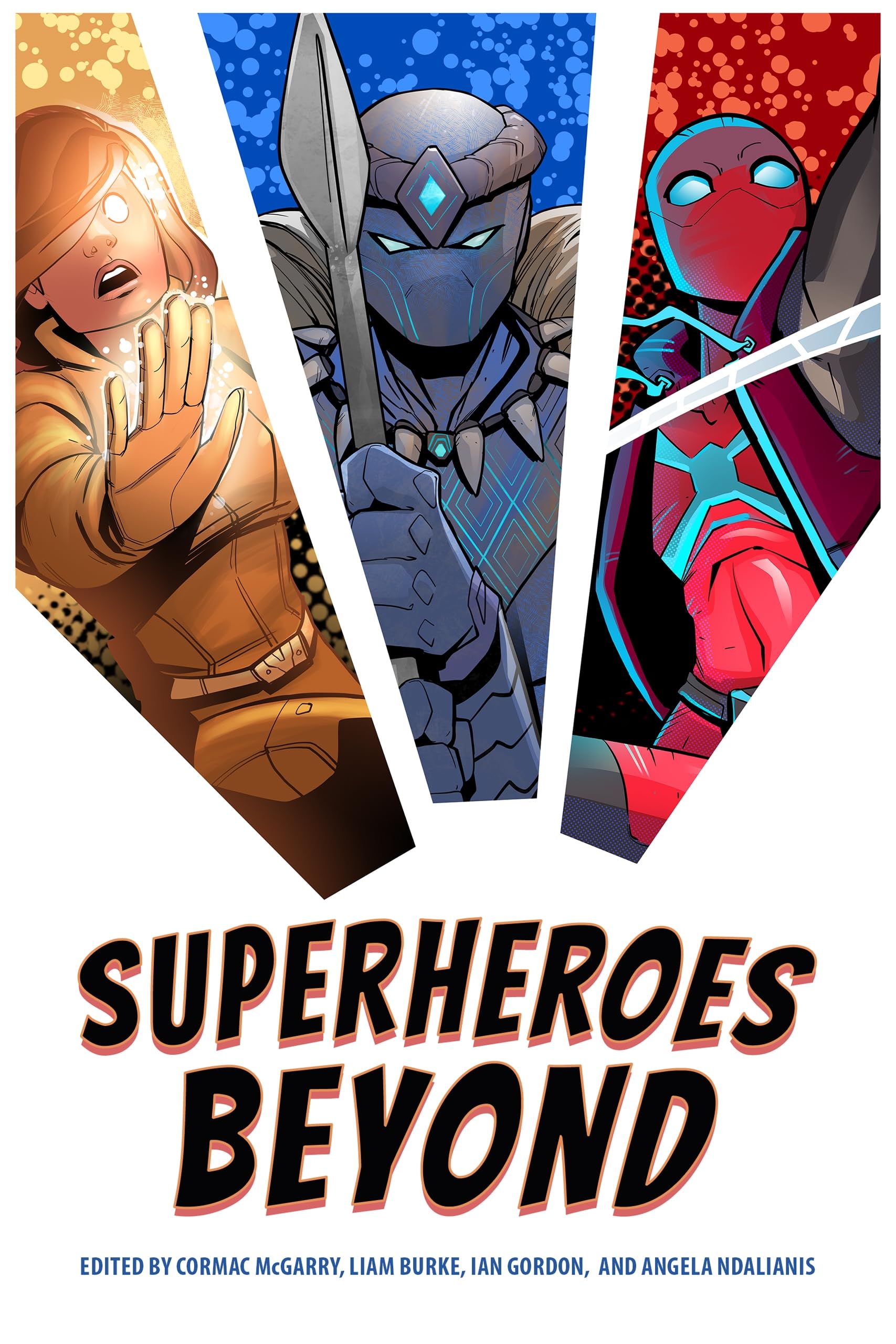
I have a new paper out! “Monstrosity, Mutation, and the World without Us” can be read in Superheroes Beyond, recently published by the University of Mississippi Press.

This paper has been a long time coming. Back in 2018, I presented it at the Superheroes Beyond conference in Melbourne. The city was baking hot – I barely wanted to go outside – but the conference itself was fantastic, focused as it was on how superheroes were presented, in boundary-crossing ways, in popular culture. There was a lot of emphasis on comics, of course, but there were also papers on lots of other media as well, and on superheroes from all around the world. It was honestly one of the most enjoyable conferences I’ve ever been to!

The conference led to a book project. It was not quick. All credit to the editors – Cormac McGarry, Liam Burke, Ian Gordon, and Angela Ndalianis – for keeping the momentum going through the five plus years of the entire book-producing process. I’ve finally got the finished result in my hot little hands and it looks great. I can’t wait to read what everyone else from the conference has written!

My particular paper looked at nonhuman superheroes and eco-horror. There’s some discussion of Swamp Thing, of course, but also mutant bears and Godzilla, and how their creation, their actions (and their reactions) might allow them to be seen through a superhero lens. I’m so glad to see it finally out there!

Food, Horror, Nonfiction, Pop culture, SFF

Food and Horror

I have a new book out! It’s my first non-fiction book, my first full length book, and my first available in paperback (before this I’ve just done short stories and a few novellas).

Food and Horror: Essays on Ravenous Souls, Toothsome Monsters, and Vicious Cravings began as a guest post on The Book Smugglers back in 2015. It very quickly became a monthly series, as Ana and Thea were kind enough to let me ramble on about all aspects of food in horror, from Jaws to the gingerbread house. After a year, I was done. It had been a particularly rewarding experience – people were always very kind and interested, and earlier this year I won the Sir Julius Vogel Award for best fan writing for the food and horror series.

Because of the positive response, The Book Smugglers and I thought we’d turn the series into a book. I spent a few busy months writing new material – there’s an extra 20,000 words in there now, looking at zombies and medical horror, Octavia Butler and the tooth fairy, amongst other things. And now there is a book! It’s longer than anything I’ve ever written that isn’t a thesis; I am prodigiously proud of it.

You can find details of where to pick up your own creepy copy here. And who wouldn’t want a book with that gorgeous cover? The artist is the very talented Kristina Tsenova (who did covers for my stories “The Mussel Eater” and The Convergence of Fairy Tales, also from the Smugglers) and she is extraordinarily talented so please keep her in mind in the future when award season rolls around.

Food, Horror, Pop culture, SFF

Gender and Consumption I: Sex, Sacrifice, and Substitution

darkangelFOOD AND HORROR, PART FOUR

This is the fourth in a series of columns on Food and Horror that I’m writing for Ana and Thea over at The Book Smugglers. It first appeared on their site a couple of months ago.


Recently I was discussing with another writer the possibility of an anthology of dark fantasy and horror themed around food. I made a joke about the title. It involved “Putting the Kitchen Sink back into your Speculative Fiction”.

“I’m not sure it ever left,” was the response. Food is a big part of her stories.

It’s also frequently occurring in mine, albeit in various nasty ways usually ending up in death. But I’ve an interest in food and horror and gender, so the next three months of this column are going to be about that. This month I’ll be focusing on, well, victimhood I suppose. If someone’s going to be faced with a flesh-eating monster, they’ll have a much better chance of survival if they’re not sweet and plump and female.

Food is often associated with femininity. With mothers and grandmothers in the kitchen, with herb gardens and apple orchards and milk. A close association with food, however, doesn’t automatically mean a close association with all aspects of food preparation, of all meals and general dining experiences. But because there’s not a lot of horror in peeling potatoes or making up a ginger lemon syrup, the genre tends to look more closely at the toothy end of things.

At consumption, in other words, and what it’s a metaphor for.

The most obvious answer, especially when you factor in gender, is sex. Those gardens and apple orchards and milk come with connotations of fertility, of sexual awakening and reproduction. And food, like sex, is a sensual experience. It engages the senses: taste, smell, touch. No surprise then that in narratives where sex is, if not forbidden, then very heavily veiled, food steps in as substitute.

Bram Stoker’s Dracula, for instance, has been variously interpreted in a number of different adaptations, and it’s interesting to look at the character of Lucy Westenra. Mina Harker’s best friend, Lucy is young and beautiful and has a number of suitors when she’s attacked and fed on by Dracula. Ultimately she dies (at least the first time) from blood loss.

In Francis Ford Coppola’s 1992 version of Dracula, Lucy is highly eroticised – much more so than in the book – even before she meets the vampire. She’s a flirty, seductive figure and when the title character has her by the throat, or when she’s writhing on the bed awaiting his presence, the sexual element of their relationship is brought to the forefront. In possibly one of the least subtle choices in the film, Lucy is actually raped by Dracula in the garden. It’s sexuality and death, a prelude to consumption. He feels entitled to her body on a number of levels; she is there purely to sate appetites – implicitly with the multitude of suitors awaiting acceptance and explicitly with the vampire.

Earlier versions of Lucy were not so obvious. In the 1931 film version starring Bela Lugosi, the portrayal of Lucy was much more restrained. She’s still attacked in her bedroom, a passive, pretty creature as the bat at the window transforms into a dark figure looming over the bed – but the message is the same, even if the wrapping is less gaudy.

Although really, what else can you expect from a monster that only comes out at night? If there’s ever an excuse to sidle into a young woman’s bedroom – preferably a young woman who’s wrapped in a pale thin nightdress, all ready to be opened up – then this is it. These women are young, on the brink of active sexuality because there’s that underlying association with food, with having liquid sucked out of their bodies as a consequence penetration.

This element of romance tends to be heightened when it takes place with an attractive, or at least magnetic, vampire. The bald, long-nailed horror of Count Orlok may be able to mesmerise his victim but no-one can blame Ellen for fainting, not really. Orlok’s hideous in a way to make the skin crawl, but at least he doesn’t overpower horror so much as to make Ellen complicit in her own consumption. She invites him in, plans to use her own body to distract him until sunrise but there’s agency in that, no matter how badly it turns out for her. It’s the vampires who eat up your sense of self as much as your haemoglobin that are the worst.

In contrast, from the moment the Coppola-Lucy feels fangs sink into her flesh it’s only a matter of time – not just until her body fails, but until her own volition does. There aren’t many vampires following Count Orlok who share his repulsive exterior – or who aren’t able to hide their own ugliness in order to better pass for a romantic, compelling figure: one that’s at home in bedrooms, one that could pass for a lover instead of a monster.

The most successful vampires are lovers as well as monsters. It is, and has always been, a question of appetite – and one that shares the small unsavoury notion of blame. (Did you invite him in? Wearing that? Couldn’t you have covered up a bit more… all that exposed flesh, the long column of throat. How can he resist, when you have what he needs? Such an attractive creature, all dark and dangerous and you did invite him in, to your bedroom without a chaperone. What did you expect would happen? He’ll ruin you, don’t you know. Make you unfit for polite company, the big bad wolf come to eat you up, come to lick your neck, come to kiss and bite and feed…)

Horror frequently comes wrapped in temptation, because temptation comes with choices and the possibility of bad ones. And women are frequently associated with temptation, their bodies causing men to lose control and act like monsters.

No wonder they’re so often eaten up.

But if sex is related to consumption, it’s a relationship that can be implicit, or subsequently taken to extremes. Meredith Ann Pierce’s The Darkangel is a good illustration here, for the vampiric title creature consumes not with sex, but with the sex-proxy of marriage.

Granted, Pierce’s novel (the first in a trilogy of the same name) is directed at young adults, so the connections between sex and horror, between sex and consumption, are perhaps a little more downplayed than they might be in an adult treatment of the same. Yet in The Darkangel, it’s marriage that’s the death-knell for over a dozen young women, and for each of them the marriage is essentially asexual.

The darkangel, previously human, requires 14 brides before his transformation into monstrosity becomes permanent. (This is food as transformative tool again.) The girls are kidnapped at the rate of one per year, and taken to the remote and forbidding castle of the vampyre where a marriage ceremony is performed. Upon the completion of that ceremony, each girl is consumed in three different ways. The vampyre drinks their blood, tears out their hearts to feed to his gargoyle pets, and removes their souls.

The souls are kept in little vials on a necklace. When all 14 vials are filled, the darkangel is to take the souls to his adopted mother, the one who turned him from human to (temporary) monster in the first place. When she drinks the souls as he has drunk the blood, his transformation becomes permanent.

Each of the three consumptions is significant. The vampyre himself has no blood (it was drunk by his witch-mother when she began his transformation) and so he seeks to replenish what he lost through the drinking his wives’ blood in turn. One of the wives comments that “he drinks blood trying to replenish his bloodlessness”, but it’s not any old blood that the darkangel is guzzling down. Marriage has connotations of unity, of separate individuals coming together as one, and so his consumption of their blood can be interpreted as the reclamation of his own, through bodily resources that have become, through marriage, his own flesh. It’s notable that this single act of consumption is the only one the darkangel performs in a year: draining one body of blood is enough to sustain him until his next wedding.

But Aerial, his final wife, concludes that “without blood, nothing heals”. Blood, in The Darkangel, both encourages transformation and arrests it. Blood is used both to transform a child into a darkangel, to maintain that transformation – and it’s hard to consider the brief fluttering of humanity present in the darkangel without wondering if the child-part of him, in its way, is trying to heal what the transformation has made of him.

The tearing out of the hearts is equally significant. The darkangel is heartless himself, at least metaphorically – his own heart remains in his chest, coated with inedible and poisonous lead – for compassion is not one of his characteristics. The torn out hearts are fed to the gargoyles. These creatures keep watch on the castle, and warn of any attempts by the brides or their servant-women to escape, as well as any potential intrusion.

But the gargoyles are trapped themselves, and not truly gargoyles. Rather, they are transformed warden-creatures, originally designed to protect their own countries and act as kindly guardians of the people that live therein. Captured, transformed, and ignorant of their prior state they not only help to keep captive the young girls it would have been their remit to protect – they also eat their hearts. If food has the power to transform, it can also be an instrument of vengeance. Remember the story of The Juniper Tree, where a jealous stepmother fed her stepson to his father in a stew? A malicious, spiteful act – one carried out by a heartless creature. The warden-animals, implacable enemies of the darkangel and his kind, are forced to collude in the consumption of his victims… in the consumption of their wards. No wonder they cannot remember. As the father in The Juniper Tree is transformed through vengeance into a cannibal, so the wardens are transformed into gargoyles, into a nastily subversive rewrite of their former role. They keep their purpose – watchers and protectors – but the subject of their watchfulness and protection has changed. It’s difficult to imagine, for them, a more horrifying fate.

The final consumption, that of the soul, recalls another fairy tale. “Bring me her lungs and liver,” says the Evil Queen of Snow White fame, wanting to wipe her rival off the map completely by consuming her soul along with her flesh. The destruction of souls in The Darkangel signifies the same: the complete absence of life, the impossibility of resurrection. “Our souls will not ascend as others’ do,” says one of the wives, anticipating their consumption. “They will sink into the witch’s dark and be nothing.”

Perhaps the most horrifying part of The Darkangel is those wives. Their souls, ripped out on their wedding night and stored in the darkangel’s necklace, keep them tethered to their ruined bodies. Without blood or heart, each of them becomes a wraith… a thin and desiccated monstrosity, unable to die and unable to heal. Aerial’s first confrontation with these once-women shows how pathetic and hideous their marriage has made them:

“Some stood in corners or crouched, leaning back against the walls. Some crawled slowly on hands and knees; one sat and tore her hair and sobbed. Another paced, paced along a little of the far wall. All screamed and cowered at the entrance of the vampyre. …. The women looked at Aerial with caverns where their eyes should have been. Their starved cheeks were translucent in the lamplight, the skin of their faces pulled so tight Aerial could see the imprint of their teeth through their lips. Their arms looked like bird’s legs – skin on bones with no flesh in between. They cringed; they trembled. One of them moaned: her voice was hollow. Their hair was all coarse and dry as blighted marshgrass.”

So it’s bad enough on a physical level: these young beautiful girls (because it’s only the most beautiful girls who get chosen as brides, naturally) eaten at until they’re withered old hags. But having their souls taken away for provender has also done something to their minds. The wraith-wives only have the tiniest fraction of brain-power left to them. All they really know is what’s been done to them, and that fraction of knowledge eats away at them so that all they can do is relive the horror, over and over.

None of them remember how long they’ve been in the castle, although they know that it’s been less than 14 years. They don’t remember which of them was first: “Our memories fade, then come back again. None of us can now remember back much farther than a day-month, and there were always many of us a day-month ago”.

They don’t even remember their names.

It’s at this last point that The Darkangel really skews the connection between sex and food so often illustrated by many of the vampire narratives. The wraiths aren’t shy when it comes to complaining about what’s been done to them – but there’s never any mention of rape. All their food-horror is related to marriage itself, and not the marriage bed. (Even though the marriage takes place in the bedchamber, the imagery Pierce focuses on are the children’s toys at the foot of the bed.)

It’s not sex that’s the prelude to being eaten up here, it’s marriage. It’s losing your name and your identity along with the right to control your own body. The wraiths have no names. When others refer to them, it’s in the form of their relationships: the darkangel’s brides, the darkangel’s wives. Their identity has been subsumed by his. They are entirely a reflection of their husband. It’s a narrative born out of expected gender roles, as well as expected sexual ones.

Vampires may eat humans as a substitute for sex, but consumption in horror can come from other substitutions, and other expected roles.

One obvious alternative is the human sacrifice. If you want to bring sex back into it (or not, as the case may be) then it’s news to no-one that virgin sacrifices often appear to have a higher value. And these, note, are rarely the sacrifice of some awkward, adolescent boy with a face full of pimples. They’re far more likely to be a young woman, preferably beautiful, preferably well-brought up. I don’t know why dragons give extra points for noble birth (perhaps they’re looking for high calcium content in the bones, and milk is expensive?) but when they’re about to flame their sacrificial dinner, they seem to like it looking fetching. Even in cases like that of the Minotaur, allowed seven young men and seven young maidens to devour every year, it’s youth and nobility that are offered up.

One assumes it’s because of value. Not just value to the dragon, but value to those doing the sacrificing. Or, I should more accurately say, it’s a question of limited value.

Consider: if you’ve a monstrous creature ravaging your borders, and said creature can be kept within clearly defined limits (geographic or otherwise) by giving it someone to chomp on, what do you do? It’s a terrible death – burning first, perhaps, or just being ripped apart limb by limb – but the anticipation is the worst of it. The sacrificed party knows what lies ahead and it’s sharp-toothed and smells of rotting meat. The breath of carnivores, and the whole community behind – parents, friends… – pushing them into the jaws of doom.

Yes, it’s pretty terrible for that poor person. But it’s also a terrible choice for those who have to decide which lucky person gets to be eaten. One can do it by lot, as with the Minotaur… but even lotteries have standards of eligibility and reasons why not.

Consider the very dark choices faced by the British government in the series Torchwood: Children of Earth. To prevent total destruction, they must give up 10% of the nation’s children to alien invaders. These children are to undergo what amounts to endless torture in order that their bodies produce a chemical that acts as a recreational drug for said aliens. The procedures that allow the children to be fed off turn them into withered husks not very much different from that of the darkangel’s wives.

A lottery is considered. It would be the fairest way – but good luck convincing the people in power to risk their own children. The solution comes down to choice – to the bottom 10% of the school league tables. The children most likely to grow up poor and uneducated; the children most likely to be social misfits. Stone cold logic has its own horror, and in this case the needs of the many outweigh the needs of the few, so off to misery those little failures will go because horror is choice as much as it is inevitability. Having your children taken from you is tragedy. Making them go yourself is a far darker thing.

Especially as these choices can be a pretty balancing act. Send a victim that’s too low-value and there’s a risk of upsetting the monster by not showing it sufficient respect. (The Torchwood aliens don’t care. A dragon might.) Keep sacrificing your most valuable individuals and you materially damage the well-being of the community you’re trying to protect. So what’s left?

The young and pure and pretty, that’s who. The ones who don’t have enough knowledge or experience or talent (or power) to be materially useful. Pretty isn’t useful. Virginal isn’t useful. They are socially well thought of, however, and that’s the main thing. It’s easy to shed tears over the pretty young thing chained to a rock. Those tears signify value, of a sort.

They don’t signify respect.

And that’s really the most horrifying thing about the offering up of flesh to monsters. It’s not the being eaten that’s the scary part. It’s knowing that you’re only being eaten because you’re minimally relevant. If you’re really lucky, the prospect of your passive, dreadful death might motivate someone with power to come along and either save or avenge you (see: fridging) but really, disposability wins the day.

It’s this sort of half-arsed valuation that turns up so often in possession narratives – and if you think that possession stories aren’t a form of consumption, then think again.

Picture your garden variety possession story, whether it’s ghost or demon or what-have-you. It’s body horror of a singular type, when conscious control over your own body is given over to something other than you. This isn’t the result of viruses or flesh-eating bacteria. There’s sentience at work here, and what it eats is space. Mental space, emotional space, spiritual if you believe in that sort of thing, and it’s fairly hard to take possession narratives seriously without some suspension in that area.

Consider how Regan is presented in William Peter Blatty’s The Exorcist. When Father Karras first comes to see her, the little girl (or what is passing for her) is deep in the grip of possession, strapped to a bed. There are still fragments of Regan, of the Regan-personality able to be shown, but her physical state shows her as both consumer and consumed. Her “wasted arms and legs”, her “hollow sockets”, her “face shaped into a skeletal, hideous mask” – Regan’s body is losing substantial amounts of weight. She’s being eaten up from the inside, her fleshy, puppy-fat body whittled down in order to sustain the demonic personality inside her. This is very well depicted in the film, although it prioritises the imagery of decay, of rotting. In the film Regan’s wounds are unhealthy-looking, as if she has already begun to decompose – to be digested by the demon.

That demon feeds on her body as well as her mind – in all respects but one. For the Regan strapped to the bed is the demon-personality even more than the little girl, and the physical manifestation of this is apparent in a single area: Regan’s stomach.

For all that Karras can see the rest of her body wasting away he can also see the “distended stomach jutting up so grotesquely”. This clearly isn’t a literal interpretation of the possession – the demon hasn’t actually swallowed Regan, hasn’t eaten her up and stored her in her own stomach in a horrid play against her own emaciation. It is however indicative of the devouring relationship between demon and girl: the physical body contains both the girl being eaten away by the demon, and the demon who is eating up the girl.

This last devouring imagery is reinforced later in the book (and the film) by the appearance of writing on Regan’s torso – on the chest just above her stomach. “Help me”, Karras observes, the “bas-relief script rising up in clear letters of blood-red skin”. And it’s Regan’s handwriting, pressing up against her own flesh as if she was locked inside, swallowed by a larger entity and pressing to get out, a little freckled Jonah swallowed up by the whale.

The Exorcist is fairly psychoanalytic – if deliberately so – in its gender roles. The little girl is still a female presence, still paired with monstrosity, and there are undertones that she is as troubled as she is because of the breakdown of her family – especially the presence of a career-minded, not very domestic mother. I have to admit I don’t have a whole lot of sympathy with this approach, but the contrast with the paternal figures, the rescuing Fathers of the church, is clear. On one side the monstrous (eaten up, eating up) feminine, on the other order in the shape of ordinated men.

The text flat out states that this is the most common gender narrative in exorcism: Karras “believed the majority of cases he had studied had been caused by precisely those two factors [suggestion and hysteria]. Sure. For one thing, it mostly hits women.

While I haven’t seen every exorcism horror film ever made, I’ve seen a damn lot of them and, from a horror narrative perspective at least, Karras isn’t wrong. It’s nearly always women who are the victims of horror possession – women or children, anyway. The point is that neither of them are men. At least, as victims they’re not associated with active masculinity in the same way as the various exorcists of these narratives are.

Why is this? When it’s time to pick a character to be eaten up, to be swallowed up by a demon, why is that character so often a woman?

Perhaps it’s the influence of The Exorcist. It’s the giant in the genre, the one all other horror possessions are compared to. And Hollywood is known for regurgitation, of more than just the pea-soup kind.

But it’s hard not to look at the overall pattern and draw another conclusion. The same conclusion that one draws when they look at who the vampire tends to bite, and who gets sacrificed to the monsters and why. If horror uses food as a substitute for sex, it also uses it as a substitute for power.

It’s alright for women (and children) to get eaten up by the demon possessor. They’re passive characters anyway – and besides, it’s heroic to rescue them, to save them from the jaws of a monster. Women are there to be overpowered, to be consumed, and they’re consistently emotional – a perfect body for a demon to slip into. Watching little Regan McNeil fuck herself with a crucifix under the influence is horrible. Replay that scene in any cinema, with, for example, Nikolaj Coster-Waldau in the same role and I’m prepared to bet money that there’d be as much smirking in the audience as there would be shivers.

That says something about the expectations of horror and power and eating up your victim’s meat suit, and I’m not sure that what it says is good.

But, in fairness, women aren’t only for eating in food and horror. They are also horrifying consumers, which is what I’ll be looking at next month with Grendel’s mother and The Lair of the White Worm and more…

Food, Horror, Pop culture, SFF

Being Toothsome

rogueFOOD AND HORROR, PART THREE

This is the third in a series of columns on Food and Horror that I’m writing for Ana and Thea over at The Book Smugglers. It first appeared on their site a couple of months ago.


It’s the problem of the other gullet. The not-ours gullet, the one that comes with giant teeth that also aren’t ours. You’ve seen the worst of them, no doubt: those jagged-edged pictures of great white triangles, the fossils from Megalodon that cover a palm.

In comparison, our teeth aren’t all that great. Let’s be realistic here: when it comes to food and horror, size matters. It it’s not the size of the teeth themselves, it’s size of the jaw… or the size it can be, having unhinged itself and gaping-ready to engulf the next victim.

We can’t do any of that. Our jaws remain stubbornly tethered; our teeth are small and have a multitude of purposes. Canines for carnivorism, molars for vegetation. Even pulled out of the gum with the roots exposed, they’re not something that reeks of threat. They don’t drip with poison. They don’t regrow but once – there’s no conveyor belt constantly pushing forward new teeth because the old ones got wrenched out with biting on bone.

We don’t have a carnivore’s mouth.

There are other things that do.

Sharks, Tyrannosuarus, salt-water crocodiles…

A few years back I was on internship in Sydney, gone to write science news articles for Cosmos. I spent my off-time sightseeing, and in one museum was preserved, behind glass, a stuffed saltie. It was 7 meters long. Believe me, it was: I paced it out. (From the back, so it wouldn’t see me coming. Even dead, I didn’t trust that thing.)

I gazed at that monster for a very long time, and as I watched it I could practically feel myself being booted a few rungs down the food chain. Had it come to life, in some grotesque parody of every mummy film ever made, I would have run for mine. Had I met something like that in the water, I would have been dead.

There’s not a lot you can do against a predator like that. I’m thinking here of the 2007 case of a Taiwanese vet who got his arm bitten off while examining a crocodile. (For loss of appetite, if you can believe it). Keepers tried to distract the animal from eating the arm. Bullets were fired at its head. They bounced off.

They bounced off. This is the type of creature the term “apex predator” was coined for. We like to think that’s us.

In horror, it’s never us.

The most apt term for this kind of horror – the one that deals with alligators in the New York sewer system, with flesh-eating insects and raptors conspiring to rip you to shreds, with the need for bigger boats and black water – is natural horror. Horror come from nature, that is – the thing we so often insulate ourselves from, carefully cordoned off in national parks and places of interest.

In fairness, the horror isn’t only natural. There’s a supernatural subgenre, where, for instance, werewolves feast on your poor quivering flesh and vamps come through the window at night to drink and gorge and make sure you understand exactly what side of the predator-prey equation you’re actually on.

The most important thing about this type of creature horror is, I think, how very thoroughly it subverts all our expectations. I’m not talking about the expectations of horror consumers here: confronted with a cast of characters in a creature horror story, we know that most of them will be dead before credits, and that they’ll be eaten in a number of increasingly gory ways. I’m talking about the expectations we have based on our relationship with nature.

Naturally this relationship will be different for everyone. A London stockbroker who barely leaves the city mile will have very different natural relationships than a Japanese fisherwoman or a San bushman. I tend to think there’s less romanticism about nature the closer you are to it but I also think that humanity in general has three primary routes of relating to nature, and these are all emphasised or subverted in natural horror.

The first is the desire to organise, to classify. One common motivator throughout culture or setting is the desire to learn, to increase in knowledge and information. We can’t do this without relating an object – or subject – to everything about it. (This is a canine; it’s sharp and used for tearing. This is a molar; it’s flat and used for grinding. What do these teeth tell you about the animal that has them?)

We do this with all the time with animals. My personal organisation system tends to the scientific, the Linnaean. If, in a free-associating exercise someone says to me “saltwater crocodile” my first thought isn’t evil man-eating beast from the pits of hell (Australia), it’s reptile. It’s reptile, then crocodilian, then evil man-eating beast and so forth. And even as I say the last I don’t think of it as a true classification. I’m aware that instinctive emotion is over-ruling the logic behind my organisational impulse.

(It works the other way as well. Once, after a late night viewing of Jaws, I was in that sort of half-asleep state, the one where your feet jerk away from the side of the bed in case of sharks. I was awake enough to know I was on a bed, not a boat, and no shark was going to breach the carpet and start chomping, but still. I was jerking. And then I was dreaming, and I was on a boat and, like Quint, my legs were halfway down the chewing, churning mouth of a great white. In the dream I was shrieking and shrieking and beating the shark around the head with a boathook, aiming for its eyes, trying to make it let go. It was what I was shrieking that was the funny thing. Still half-awake, my mostly-rational mind, the one that knew this was all a dream and that I wasn’t really fighting for my life, was screaming at the top of its lungs: Don’t hurt it, don’t hurt it! Not in the eye, Octavia, it’s an endangered species!!!

Such is the strength of organisation, of classification. Even when your legs are being eaten off there’s an angel on your shoulder and its name is David Attenborough.)

The point is: I have a system.

It’s not the only system. We’ve all got one. Try the salt-water croc exercise on someone along the north coast of Australia and their first response might be don’t swim in the river rather than reptile. It’s a geographical classification (safe river/unsafe river) and a situational one. Try the same question on an Australian Aboriginal person and the automatic response might be mythological.

We cut the world up into pieces, is what I’m saying. The type of blade we use to do the cutting isn’t particularly relevant here. It’s the mental structure we build to reflect the world around us that’s the issue.

Horror upends structure. It makes a total mess of organisation. It primes for a different response, and through narrative it pushes and pushes until, through the experience of horror, that system of organisation is thoroughly (if temporarily) subverted. It changes our relationship with nature – or at least what we perceive that relationship to be.

There can’t be a crocodile in Lake Placid. It’s too far north, too cold. It’s Maine. A crocodile living there goes against all the information collected so far. It goes against everything we know.

Giant anacondas don’t exist. They’ve been confused with other species, eyewitness accounts are unreliable, and if they ever were there they’re extinct now.

Great whites don’t behave that way. There’s no sign of it… probably gone back to deep waters, there’s no silence along the coast, no stillness to indicate a shark that size is still about.

It’s no accident that authority figures are often found at the beginning of killer creature stories. They’re there to tell you why-not. It’s practically an invitation for the monster to come to dinner, and of course it does. The paradigm gets shifted and we have to re-orient our perception of what we expect from the natural world.

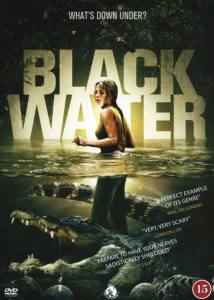
In practical terms: if a horror film like Rogue or Black Water wants to scare me, to make me jump and watch through my fingers, it’s got to interrupt that mental connection of mine, the one that when exposed to saltwater crocodile spits out reptile. It’s got to bypass reptile and go straight to danger, get the hell out. It’s got to immerse me enough in fear for the characters that my organisational system is disrupted, swapping Linnaean certainty for the squeaky terror of the mammalian brain (it’s behind you!), the brain that survived in large part due to scuttling and blind terror under the feet of dinosaurs, due to the ability to run and hide and slide under the notice of the things that would make it dinner.

That’s the first step in creature horror, in remaking the horror consumer into something conscious – even by proxy – of its ability to be consumed. It’s the dislocation of normal that’s the worst. You can classify rats as pests and set out traps. You can make them friends, give them a name and slot them onto the safe list, the one reserved for pets, but if the rats start swarming, boiling up the stairs and chewing down the attic door to get to your warm beating body, Willard, then the neat little categories you’ve made for them mean nothing at all.

If you want to eat someone in horror, first you set them adrift in their universe.

Then you look at their ability to exploit things.

That’s the second means that humans have to engage with the natural universe. There’s organisational, the mental perspective, and then there’s the tangible counterpoint: the ability to manipulate. Every capable human from every society does this. Whether they make shelter out of bricks or snow or yak-hide, whether they build tools from bone or stone or petrochemicals, the manipulative principle is fundamental to the species.

It’s a principle that helps to reinforce the organisational, even. If you classify yourself, for instance, as a hunter-gatherer, then pretty much by definition there are things to be hunted and gathered, and tools to help you do so. A spear reinforces your identity as a hunter, an identity predicated on the organisational idea that you are a creature that hunts.

Until you’re not.

The ability to manipulate the natural environment and its inhabitants gives a sense of control. More than a sense, actually – it can give our species a legitimate, verifiable control over our natural surroundings and how they affect us. This control is necessarily limited – it’s one thing to experiment on mako sharks, as in Deep Blue Sea, making them more intelligent and monitoring their progress; it’s quite another to keep them contained and harmless – but the control is there, and it helps to reinforce a sense of order.

Until it doesn’t.

It’s extraordinary how easily, as a species, we designate areas as safe, like the seaside resort town of Amity in Jaws. In the minds of the summer flux of tourists, the lifeblood of the little town, Amity is categorised as holiday, as leisure and relaxation (in much the same way as Rogue and Black Water tourists treat their environments – it no coincidence that authority figures in creature horror are often supplemented with tourists, with people so disengaged from the natural world that they even package up and sell the experience of it, as if the ability to package makes it safe to do so).

Go to any beach like Amity and you’ll see the environment manipulated to match the belief. Lifeguard towers on the beaches, buoys and flags… as if sharks care about flags. As if swimming between them will keep you safe from those ever-replenishing teeth.

The manipulative is a wide-ranging means of engagement. It’s careless and careful, positive and exploitative and utterly fucking dreadful. It’s factory farming (come back from the flipside when humans are the ones being farmed, as in Soylent Green or Daybreakers). It’s nuclear waste, creatures turned mutant from radiation and out to get their own back. It’s engineered viruses that turn people into flesh-eating zombies. It’s tools to make monsters, and tools to keep monsters away.

We put a lot of faith in tools. They’re the high point of the manipulative principle, the things that allow us to crack open our own abilities, to exploit the world around us. We’re so used to them that when they fail it’s as if the ground’s fallen out beneath us.

Remember that Taiwanese vet? Imagine you’re him. Hoping to get your arm back from the crocodile that’s taken it before it’s eaten, or too mangled for reattachment. And someone shoots a gun at the croc and the bullets bounce back.

Now wouldn’t you feel just a bit let down? What’s the point of a gun, if not to successfully shoot things?

Without tools – or without adequate tools – we’re vulnerable. It’s one thing to dive in shark-infested tropical waters, as that poor unfortunate couple did in Open Water, but there’s a place of safety on the boat, that built construct that’s taken them safely out onto the reef and can take them safely off it again. When it sails merrily away, however, and they’re forgotten in the water with nothing to keep them afloat but their own tasty body fat, it’s immediately clear how inadequate the two of them are in the water, how incapable they are of ensuring their own survival.

If you want to eat someone in horror, first you set them adrift in their universe. Then you compromise their tools; their ability to make tools.

You level them down on the food chain, in other words. You remind them that, for all their accomplishments as individuals, as the representation of the most advanced species on the planet, when those accomplishments are taken away they’re nothing but a not-very-fast conglomeration of poorly protected meat.

Once you’ve done that, you drop them into a relationship. Not with one of their fellow victims, no. That’s not the primary relationship in a creature horror. The primary relationship is between the creature and the person (or people) it wants to eat. This overshadows everything else, and in doing so it subverts the final means that people have of engaging with the natural world: through their experiences of immensity.

Everyone’s done it, in every culture. They’ve looked up at the sky and felt small, looked at the world around them and felt dwarfed. There’s just so much of it. And especially for people living today, that awareness is supplemented by that of other species (the millions we share a planet with) and of our own (the billions we share a planet with). It becomes easy to think of things in aggregate.

Objectively, we know we’re part of the food web.

That knowledge becomes rather more immediate, however, when you’re being hunted by something that wants to eat you. The natural world narrows very quickly then. It becomes very personal. Natural immensity essentially stops existing, and everything is pared down to that one essential relationship. Nothing else counts. It barely exists. What good are billions of stars or three hundred thousand different types of beetle when you’re crouching in a mangrove forest scanning the water below your tree for movement? How can you really be terrified by a sense of the cosmic unknowable when a fin surfaces in front of your face? (You know what that fin means.) How can you feel any sense of awe at the immensity of space when an alien’s acid blood is eating through the hull?

You can’t, that’s how.

That’s what being food does to you. It makes you small. It cuts you off, first from what you think, then from what you can do. Then it starts to cut off the natural world itself, because there’s only so much stage set necessary for a sticky end, only so much blood that can possibly be spilled.

If you want to look at just how crucial organisation, manipulation and immensity are in creature horror, look no further than creatures of the supernatural. Look, for example, at vampires. No, not the sparkly ones. This isn’t that kind of horror.

I’m talking about the horror vampires. The ones who are meant to be frightening, who feed because they’re monsters and that’s what monsters do, and they don’t feel even the slightest bit bad about it.

Now, look at how characters respond to these vampires.

They respond with abstract thought. They respond with tools. Those tools are so glorified they essentially become fetish objects: the stake, the garlic, holy water. The cross. Oh, the cross. I’ll get back to that in a minute.

In a brief aside, though, there’s a difference between character reaction in natural and supernatural creature horror. It’s subtle and often inconsistent, but it’s there. In creature horror, when it’s the snake or the shark or the raptors that are after you, the typical fetish tool of other genres, the gun, is only moderately useful. More often than not it has little effect, or it jams or runs out of bullets at the crucial moment. Natural creature horror reduces the human to the mammal: characters must run and hide, must realise the uselessness of their tools, their new position on the food chain. Sometimes they come back with bigger tools, with better weapons (“We need a bigger boat”), but for the majority of the story they are reduced to mobile meat. With a natural predator, they tend to react as natural prey. There’s abstract thought and tools, yes, but these aren’t emphasised the way they are during supernatural horror.

In classic vampire stories, the tool is the whole point. It’s the linchpin of the story, and the characters know nearly from the get-go what they need to survive. What they need are the reminders of their pre-horror state.

Remember: everyone has a system. Everyone has a way that they organise the universe, and presented with something supernatural, that organisation disintegrates. Can this really be happening? the characters ask. Do vampires actually exist? Are they going to eat us? Oh my God! They’re going to eat us!

The role of the vampire is to reduce the human to meat.

The role of the cross is to allow the human to say I am not meat.

How does it do this? It does it in three ways.

First, the cross is a tool. There are precious few tool-users in the animal kingdom, and humans are the tool-makers par excellence. It comes from having big brains and an opposable thumb, from being able to manipulate matter, but it is also delineation. It’s that organisational impetus again: human are on the list of tool-users. They are not on the list of not-tool-users, and it’s widely accepted that being on the former gives a genuine claim to a certain level of superiority.

If you have a cross when you’re facing down a vampire, you’re more than prey, because tool-users are predators too – and thus the individual universe begins to right itself. Identity stops shifting, relationships settle back. If you hold up a cross to a genetically-engineered mako shark it will still eat you, because the natural world isn’t shuffled back into position by supernatural intrusion. If you hold it up to a vampire with mako teeth, though, you’ve got a chance.

Why is this?

It’s the organisational principle again, the one the manipulated object supports. Beating off a vampire with a cross is an obvious relic of Christian mythology – and that mythology has at its base the idea that humans are different from all other animals. It’s abstract thought: the ability to form links and religions and philosophies, to think beyond being red in tooth and claw. You think tool-users make a short list? Take a look at what’s on that one.

There’s us and then there are the rest of them – all of them – and the dividing line is harsh. Humans are superior, the only ones with an understanding of good and evil. Vampires don’t have that. They are purely evil, and so they stay moral inferiors. They might be stronger, they might be faster. They might be able to change shape, but on an underpinning, irrevocable level they lie beneath on the hierarchy of creatures inhabiting God’s earth.

This doesn’t work in natural horror, which tends to owe more to science and science fiction than to fantasy. A Jurassic Park T. rex with a clear opportunity for lunch isn’t going to pass up a tasty human morsel, because the natural world has no sense of moral or religious authority. It’s Darwinism all the way, the survival of the fittest. It’s the fundamental, individual relationship between a single predator and a single prey animal, the shrinking immensity of the universe to one life and the ending of that life.

In the supernatural, fantasy-based horror universe, the predator-prey relationship is never so isolated. The cross works because immensity exists, because there’s something to back up the idea that humans do stand apart, that they are not just meat, not just warm little packages for those who fly or slink or stalk about them, looking for a way in. The human relationship with immensity then overwhelms that with a single predator and that predator is subsequently diminished.

Except when it isn’t.

Horror, always a genre for exacting prices, has one for this. If a character wants to take advantage of being superior they have to really believe that they are. That’s an ever more difficult thing to do as science shines a light in shadowed places and we wake from long dark dreams to rationalism. I’m an atheist, myself. If a vampire jumped out at me and by a truly remarkable chance there was a cross to hand… well. I’ve seen Fright Night (the original, that is, not the remake). I know how well a cross you don’t believe in works, and the answer is not at all. I’ve seen 30 Days of Night, too. “Please, God,” weeps Kirsten, face to face with the worst of the lot, the head vampire Marlow. “God?” he says, looking up and then down again, shaking his head. “No God.”

Without belief, nothing works. Without belief, you really are just meat.

(I think you can guess what happened to Kirsten.)

I wrote a vampire horror story myself once, on this very topic: the power of symbols, the power of belief. It was really more about symbols than it was vampires. “Cuckoo” was published in a fairly obscure print mag and promptly sank from sight, but it did what I wanted it to. It layered mythologies over each other, Christian and pagan, Scandinavian and Transylvanian and Maori in the gum fields of 19th century New Zealand, and when the main character faced down the vampire, it was with weapons from a belief system not her own. She made them her own, however, through metaphor, through analogy, through the mutability of symbols.

She kept her universe organised about her, expressed that organisation through tool use, and through both accessed a wider universe, one built from ideologies not her own.

Meat doesn’t do that. She survived because she could do it when the vampire couldn’t. My sister laughed when she read it. “Only you would beat vampires by looking down on them,” she said. But fuck it, we are social animals. We understand power relationships and hierarchy. So do vamps.

There was a price to her winning, of course. In horror you never get away scot-free. But you can get away. You can avoid being eaten, if only you know what you are, where you are. If you know whether you’re an animal or not.

Sometimes being an animal will save you. Sometimes it won’t. That’s horror. It degrades unsteadily. It cuts down position and perception and the ability to find a place to stand upon, the stability of the world before. Before you were meat.