SFF, Short stories

In(con)solation

I’ve got a new story out! “In(con)solation” is free to read over at Lightspeed. It’s barely more than a flash piece, but it’s also the first story I’ve managed to sell to them – not for want of trying! – so I’m pretty pleased about that.

The title, I’m sorry to say, is something of a pun. I was interested in the effect that sunlight (insolation) has on mental health, and what happens if you’re deprived of it. There’s all sorts of high latitude examples where people don’t see sunlight for seasons at a time, but because this is science fiction they’re all living underground in the aftermath of nuclear apocalypse. The downside to that – one of many, I’m sure – is that one of the possible consequences of exposure to high levels of radiation is cataracts… so what happens when staying in the dark makes you depressed, and the consolation of sunlight makes you blind?

It’s not a cheerful story, as you can imagine, but when I was writing it I found the layered imagery interesting, and it’s always a challenge to write a story that short.

SFF, Short stories

Ernestine

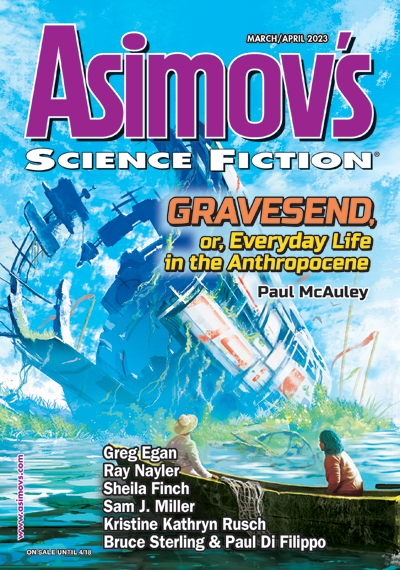
I have a new story out! “Ernestine” is in the March/April issue of Asimov’s; it’s wonderful to have a story in there again. They’re one of my favourite markets.

I actually wrote an early draft of the story back in 2020, when I was an artist in residence at the Christchurch Arts Centre. They were kind enough to give me a place there because the Arts Centre houses a museum about Ernest Rutherford, one of my scientific heroes. The Centre actually used to be of the city university, until many decades ago it got too big for the site and moved. When Rutherford was there as a student, however, he commandeered a tiny subterranean cloakroom known as The Den for his experiments, on the grounds that it was one of the only available spaces with a concrete floor, and therefore less vulnerable to the vibrations of passing trams. That mean his delicate equipment was disturbed less, and so he was left to get on with it. It’s a tiny, dim little space, and I suspect he might have hit his head more than once on the overhead pipes, but nonetheless: I was riveted. More than once I took my laptop down to that cramped little room to write.

“Ernestine” is a standalone piece that’s part of a longer work (still in progress!). The title character is a little girl left alone in a post-apocalyptic environment. She takes refuge in The Den and starts communicating with the ghost of Ernest Rutherford, who is rather more concerned with the practicalities of survival than he is in recreating old experiments. Ernestine, however, needs more than potatoes to survive, and the Great Hall of the Arts Centre is converted, via string and office supplies, to a facsimile of Rutherford’s Gold Leaf Experiment. Science, she finds, can make you friends, and in a post-apocalyptic world, friends are nearly as important as food.

I’m hoping to finally finish the novel version this year, but I’m happy to have this little teaser piece out in the world.

SFF, Short stories

The Meiosis of Cells and Exile

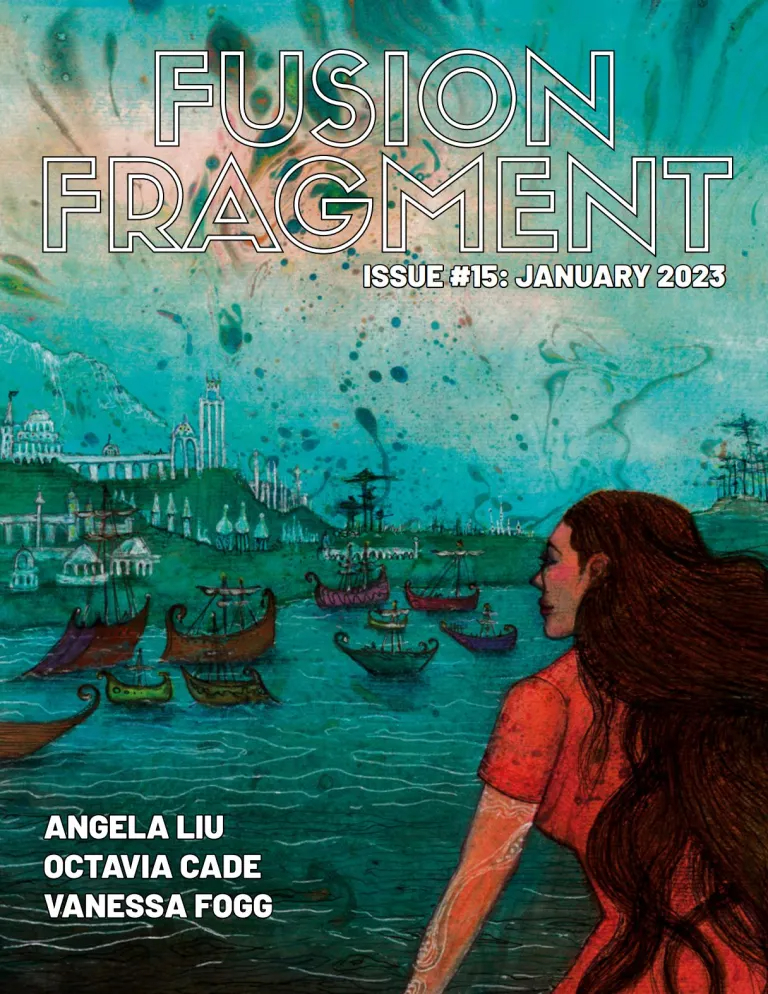
I have a new reprint out! My story “The Meiosis of Cells and Exile,” originally published in Asimov’s, is out in the January issue of Fusion Fragment, which is dedicated to novelettes. I love novelettes, and I’m increasingly writing more of them. They’re a great length for when you want to explore something in a little more depth than a short story would generally allow, but still don’t want to waffle on forever and ask your readers for an hour or more of attention.

“Cells and Exile” is about the Soviet biochemist Lina Stern, who was sent, after a show trial and the execution of her colleagues for anti-fascist activities, into exile. She was in her seventies at the time, so you’d be forgiven for thinking that this whole traumatic, violent experience would have, not to put too fine a point on it, killed her off. Not so. Lina was tough as old boots, and she survived her imprisonment and exile. She even outlived both Stalin and the brutal torturer who jailed her before her exile, and after both their deaths she came back from banishment and went right back to work at the Academy of Sciences, no doubt both deeply grateful and extremely (if quietly) smug.

I’m so glad that this story has seen the light of day again! One day it’ll end up in another collection of mine, one themed around historical scientists, but until that day you can read about Lina in Fusion Fragment, along with the other fantastic novelettes published there.

SFF, Short stories

Pink

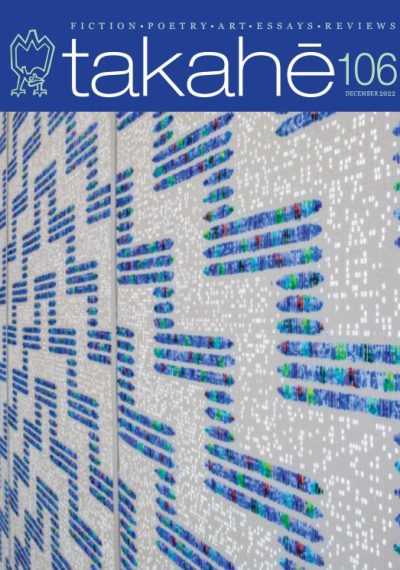
I have a new story out! “Pink” is more than a bit creative nonfiction as well as short story, and it can be found in issue 106 of takahē magazine.

A couple of years back I was down in Christchurch, visiting a wildlife reserve (mostly to see the takahē there, to be honest, so this story clearly went to the right place) and a display about birds informed me that we used to have flamingos in New Zealand. Not any time recently, but millions of years ago when there used to be a lake at St Bathans in Central Otago. They dig up all sorts of fossils there now, and one of them was an ancient relative to the flamingo.

New Zealand is very much bird country, so I couldn’t help but wonder… what would it be like if the flamingo had survived? What change, if any, would it have made to our culture and conservation? “Pink” is that very hypothetical. It’s a fun little piece, and it’s going to be part of the series of essays on NZ ecology I’m due to put together later this year, when I’m down at Canterbury University as their writer in residence. Can’t wait!

Articles, Poetry, SFF, Short stories

Reckoning 7

I have a new book out! Or, more honestly, I am one of a number of people who have contributed to a new book being out. Reckoning, which published creative work on environmental justice, was kind enough to let me sign on as fiction editor for their issue 7, along with Priya Chand (nonfiction editor) and Tim Fab-Eme (poetry editor). Together the three of us, with the help of a number of excellent editorial readers, put together this year’s issue of Reckoning, which we themed around oceans and the global water system.

Each of the several dozen pieces that we picked will be available to read for free online throughout the year. You can see the menu and the publication schedule here. If you’d like to purchase the entire wonderful issue, however, the ebook is available now, and the print release is scheduled for July; details are at the link. There’s over 250 pages of excellent writing there! And that cover, Drua, by Elsie Andrewes, is gorgeous.

Speaking of the fiction writers included in this issue… their work is incredible. From the Great Pacific Garbage Patch to the local swimming hole, from dolphins and sharks and burials at sea, these are hopeful stories of people working to make our watery world a more just and sustainable place. Please take a look.