SFF, Short stories

You Are My Sunshine and Other Stories

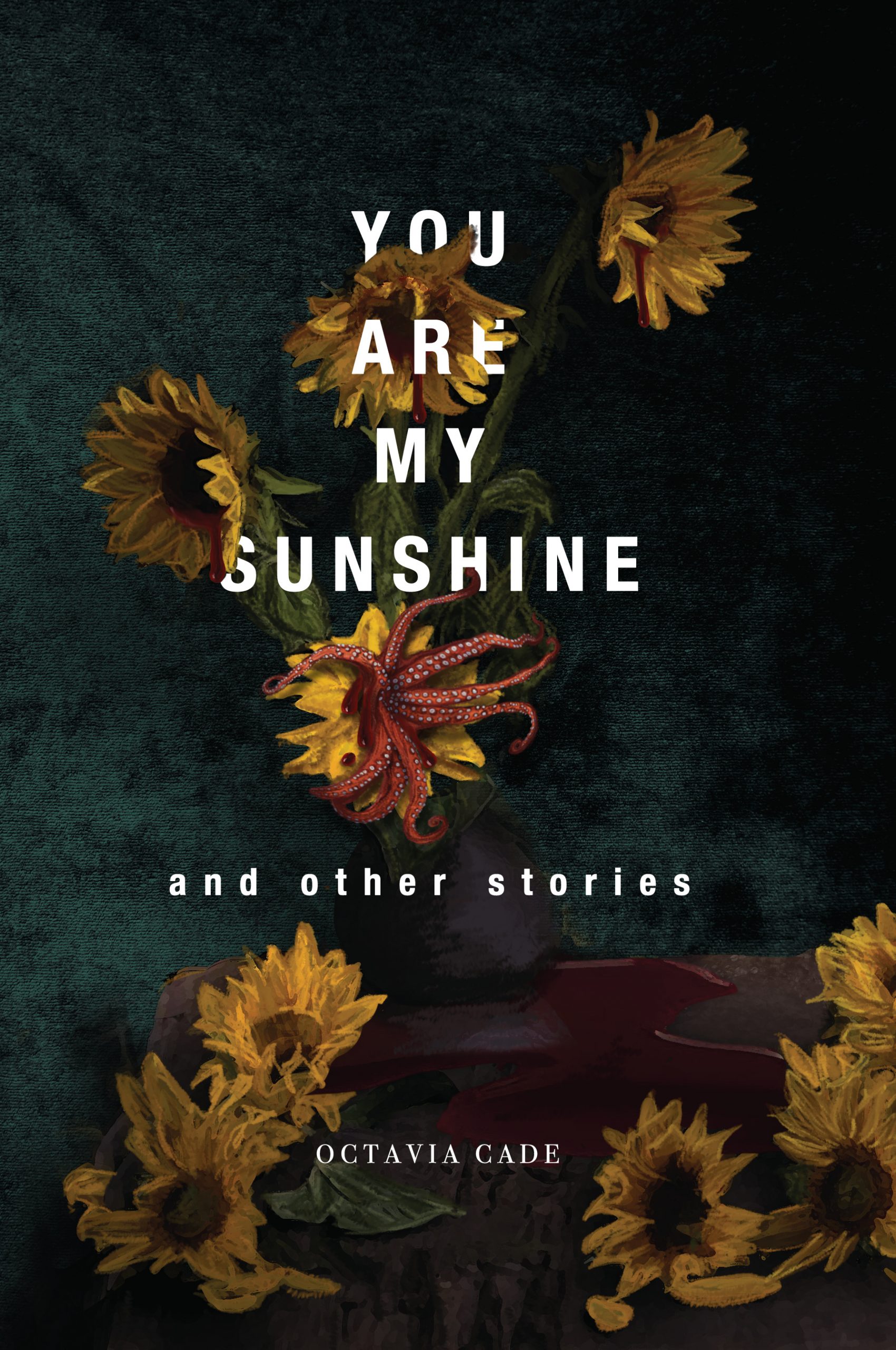
My new collection is out! You Are My Sunshine and Other Stories, published by Stelliform Press, is available now.

It’s a collection of speculative eco-fiction, ranging from eco-horror to solarpunk. Many of the stories have been published before, and you can read them in places like Clarkesworld (“You’re Not the Only One”) or Strange Horizons (“We Feed the Bears of Fire and Ice”). Have a read of either of these to see if you’ll like what’s in the rest of the book!

There’s also a few stories original to the collection, including the title novelette, “You Are My Sunshine.” This is one of my favourites, because it’s just so weird. It’s set in the same world as my Stelliform novella The Impossible Resurrection of Grief, where in the near-future ecological grief at a degrading environment causes a wave of insanity and suicide. Plus, the novella had jellyfish. Lots of jellyfish. There’s no jellyfish in “You Are My Sunshine” – this time it’s starfish. Zombie starfish, which are a real thing. Sea star wasting disease is spread in warming waters, and it causes the poor starfish to disintegrate… but the bits that fall off keep moving. For a while, anyway. If you’re a marine biologist, as main character Cyrus is, that’s pretty disturbing. Also disturbing are the severed human arms that keep appearing on his property, complete with apology notes. It’s bizarre, but I think it’s also a bit funny.

Stelliform has a fantastic range of books, focused on environmental and climate fiction, so if short stories aren’t your thing, take a look at their catalogue and you’re sure to find something appealing!

Horror, Short stories

Those Shining Things Are Out of Reach

I have a new story out! “Those Shining Things Are Out of Reach” can be found in Wilted Pages: An Anthology of Dark Academia from Shortwave Publishing.

Now, I enjoy reading dark academia but I’ve never really written any before this, so when editors Ai Jiang and Christi Nogle kindly asked if I’d be interested in contributing a story, I about fell over myself to give it a go. Especially as I was allowed to take a slightly more speculative approach… Don’t get me wrong. I haven’t gone full-on sci-fi here (tempting though the prospect was), as I wanted to still maintain a very contemporary setting. “Those Shining Things” is, however, ambiguously placed when it comes to time period. It’s near-future, mostly, though informed by historic events.

I was interested to see how far I could push ambiguity in this story; how many things I couldn’t come straight out and say. I’m not, it must be said, an especially subtle writer. When I have something to say I tend to want to hammer it, so maybe this is nowhere near as subtle, or as elliptical, as I hoped it would be, but I still enjoy the lingering sense of threat. A lot of my fiction work is influenced by the dark side of science: unethical experiments and horrific hypotheses, and I’m interested in seeing just how people can get corrupted into behaving that way. This story was a way to explore that. It’s pretty grim, but then this is dark academia.

Sometimes it’s fun to be horrific.

Horror, Papers, SFF

Transgressive Reproduction in “Évolution”

I have a new paper out! “Évolution (Lucile Hadžihalilović, 2015) – Transgressive Reproduction” can be found in The Deep, edited by Marko Teodorski and Simon Bacon. It’s one of the Genre Fiction and Film Companions series from Peter Lang, which means it’s basically an excuse for academics to do close readings on their favourite genre films. In this case, genre films connected to the ocean. Anyone who’s ever loved a sea monster will understand the desire to contribute to a book like this!

I saw Simon talking about the book a few years back on Twitter, inviting calls for papers. I do like creepy ocean stories, so I wracked my brain for one that I could pitch a chapter on. I didn’t have to wrack very hard, because I’d recently seen something very weird and very cool. It was Lucile Hadžihalilović’s film Évolution, which was about women who seemed to be part starfish, living on an isolated island with a group of young sons. These sons were adopted, and human, and being used in medical experiments so that their mothers could reproduce in other ways.

The downside was that the film was in French, and while I have schoolgirl French (propped up by daily lessons with Duolingo) it is still very schoolgirl indeed. The upside was that the script was absolutely minimal – for vast swathes of it there was no talking at all – and so I was determined to manage. Partly because the film was weird and cool and I loved it, but partly because the setting struck me as especially interesting. The women and children primarily inhabited the intertidal zone (my marine biology background was excited to be used!) and the navigation of their transgressive biologies could be mapped onto aspects of that environment.

It’s a short paper, but I had fun writing it. If you get a chance to see the film, don’t hesitate! It’s amazing.

Horror, SFF, Short stories

Lise Meitner Speaks to the Living

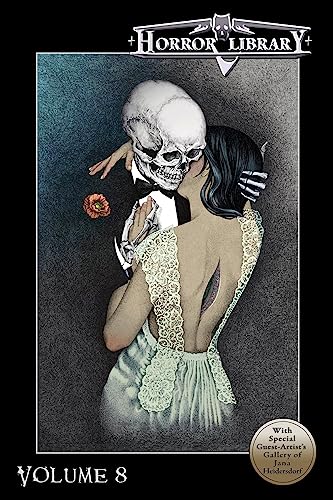
I have a new story out! “Lise Meitner Speaks to the Living” is out in volume 8 of Horror Library, edited by Eric J. Guignard. It’s one of my science history stories, this time about Lise Meitner, who was one of the physicists who discovered nuclear fission. She was invited to work on the atomic bomb in World War Two, but refused on moral grounds. I don’t know how much comfort that would be in the wake of something like Hiroshima and Nagasaki, though… it was still her work being used as the basis for slaughter. That must have been very hard to live with.

In many ways this is a bookend story; the second of a pair. The first of them, “Otto Hahn Speaks to the Dead,” about a chemist who worked on chemical weapons in World War One, was originally published in The Dark.

Meitner and Hahn were friends. Complicated friends, but friends for all that. When push came to shove, one of them went along and one didn’t. That, too, must have been hard to live with. A relationship built on ground seeded with landmines, I think. I wonder how much each of them resented the other, deep down. If they did. (How could they not?)

It was meant to be a two-story thing. Two and done.

I’m not sure that I am done, to be honest.

Horror, Papers, SFF

Entering the Ecosystem

I have a new paper out! “Entering the Ecosystem: Human Identity, Biology, and Horror” is in the book Horror and Philosophy: Essays on Their Intersection in Film, Television, and Literature, edited by Subashish Bhattacharjee and Fernando Gabriel Pagnoni Berns, published by McFarland.

I love eco-horror films, especially the animal horror type. I don’t care if it’s mutant bears or giant crocodiles or experimented-on sharks, I always end up rooting for the monster. Let’s be honest: most of the time they’re not doing anything wrong. They’re just wandering around their natural habitat, acting as bears and crocodiles and sharks do, when along comes this meaty little biped, all excited to interfere with them. Of course they’re going to look at us and think food.

This can be deeply destabilising from the human point of view. Dangerous, too, but beyond the being eaten alive or torn apart or what have you is the sense of identity loss we feel at suddenly being booted a few rungs down the food chain. The vast majority of us are used to thinking of humans as somehow separate from the rest of the animal world. We’re smarter. We have science and opposable thumbs and ways to insulate ourselves from the natural world. Animal horror films remind us that we’re not so removed as we’d like to think. That’s so disturbing to watch, and I love it.

Naturally I had to write about it.