SFF, Short stories

Ernestine

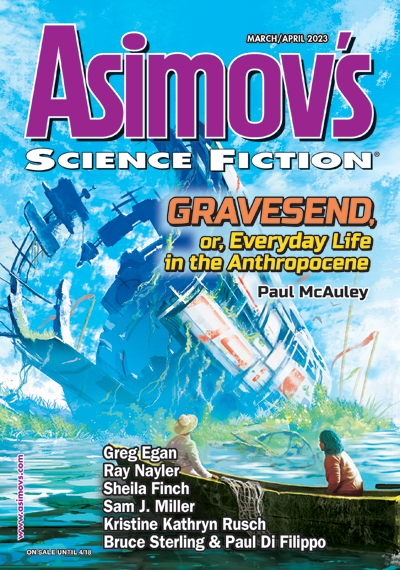
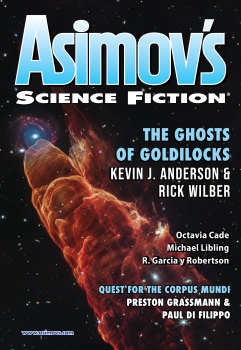
I have a new story out! “Ernestine” is in the March/April issue of Asimov’s; it’s wonderful to have a story in there again. They’re one of my favourite markets.

I actually wrote an early draft of the story back in 2020, when I was an artist in residence at the Christchurch Arts Centre. They were kind enough to give me a place there because the Arts Centre houses a museum about Ernest Rutherford, one of my scientific heroes. The Centre actually used to be of the city university, until many decades ago it got too big for the site and moved. When Rutherford was there as a student, however, he commandeered a tiny subterranean cloakroom known as The Den for his experiments, on the grounds that it was one of the only available spaces with a concrete floor, and therefore less vulnerable to the vibrations of passing trams. That mean his delicate equipment was disturbed less, and so he was left to get on with it. It’s a tiny, dim little space, and I suspect he might have hit his head more than once on the overhead pipes, but nonetheless: I was riveted. More than once I took my laptop down to that cramped little room to write.

“Ernestine” is a standalone piece that’s part of a longer work (still in progress!). The title character is a little girl left alone in a post-apocalyptic environment. She takes refuge in The Den and starts communicating with the ghost of Ernest Rutherford, who is rather more concerned with the practicalities of survival than he is in recreating old experiments. Ernestine, however, needs more than potatoes to survive, and the Great Hall of the Arts Centre is converted, via string and office supplies, to a facsimile of Rutherford’s Gold Leaf Experiment. Science, she finds, can make you friends, and in a post-apocalyptic world, friends are nearly as important as food.

I’m hoping to finally finish the novel version this year, but I’m happy to have this little teaser piece out in the world.

SFF, Short stories

Pollen and Salt

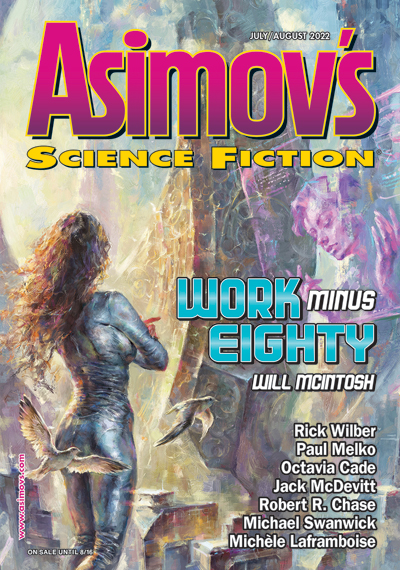
I have a new story out! Well, it came out a couple of months back, but I’m playing catch-up here. “Pollen and Salt” is available in the July/August issue of Asimov’s. I’ve had a few people contact me to say nice things about it, which is lovely, as it’s something of an experiment on my part.

The story, you see, doesn’t have much of a plot. It’s more a mood piece, set in the near-distant future, where a scientist is studying pollen at the edge of a rising ocean – pollen in salt marshes, mud flats, littoral spaces and so forth. The pollen is a record of past vegetation, and as they work the scientist is mourning their partner, who has recently died. It’s a meditation on change, more than anything else, and I was trying to create a story that was sad and quiet and still very aware of the beauty and potential of that new world, even when the parts of it that were loved are gone. Also, there’s a goose.

So, something of an experiment on my part! I don’t know that I’ll write a lot more stories like this in the future, but I worked on this one for several years, and I’m genuinely pleased with the result. If you can, please take a look!


SFF, Short stories

Inside the Body of Relatives

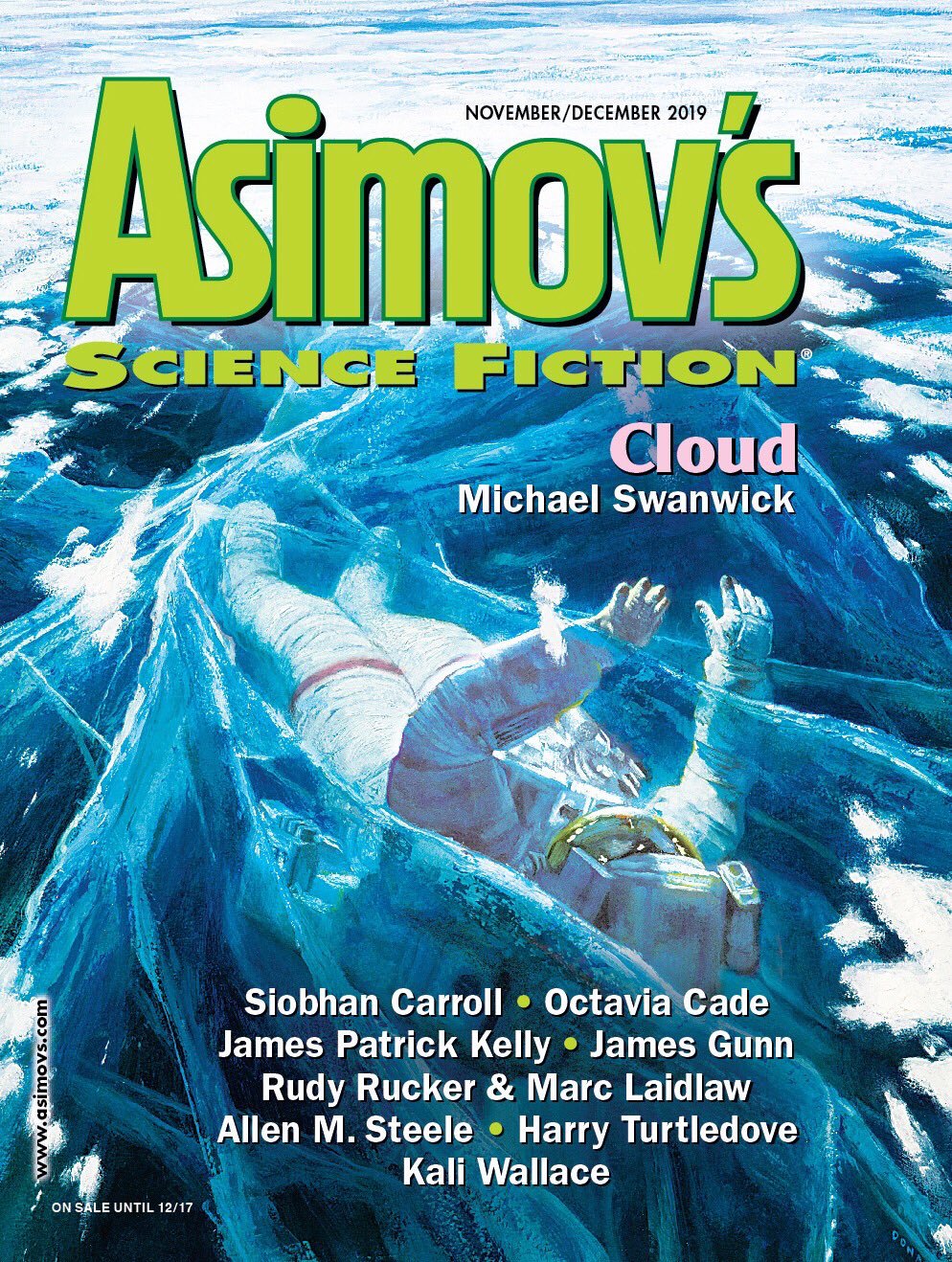
I have a new story out! “Inside the Body of Relatives” is in the November/December 2019 issue of Asimov’s Magazine. It’s the fourth story I’ve had in Asimov’s, and the first which is actually a short story. Everything else I’ve had published there has been a novelette, so it’s good to have sold them something different. It’s a short story because it’s only a little idea, and sometimes you just don’t need to pad out a good idea with extra words. That idea – and I don’t want to spoil it, exactly – is something that came to me one night when I was lying in bed, tucked up under the duvet and listening to rain on the roof. And it was such a simple idea, and it seemed so obvious…

It’s also a story that features that staple of the science fiction narrative: artificial intelligence. Specifically, an AI dwelling. There’s a reason this is a trope (often a horrifying trope) but I wanted something not-horrifying for this. It’s a quiet little story about aging and loneliness and evolutionary biology, so there seemed no reason to go all overwrought with it. Anyway, here’s a teaser of it:

There’s a reason I don’t have a lot of guests – or worse, a tenant, for all the rent would round out my super. I like my house quiet.

“Quiet as the toooomb,” says the house, in response. It gets sarcastic when it’s worried. “I don’t like to think about you getting depressed,” it says.

“I’m not depressed.”

“Loneliness can be a trigger for depression,” says the house. “You are lonely, and I am not a substitute…”


SFF, Short stories

The Backward Lens of Compromise

I’ve a new story out! “The Backward Lens of Compromise” is the third novelette of mine to appear in Asimov’s, and I’m really happy for it to be there. Like the other two, “Backward Lens” is about science history – this time, the history of telescopes and the astronomers who look through them. Interwoven with this is a modern day story of science education.

As a science communicator, I’m all for science ed. But science can be expensive to teach – it needs labs and equipment for hands-on work – and in impoverished communities, with underfunded public schools, it’s easy to cut. And in this story that’s what’s happening, except it’s going further than the classroom. An old observatory is being shut down, one that works with schools to teach students about the stars. The observatory doesn’t make money, and the kids from this disadvantaged community are deemed to be no-hopers anyway, so why throw good money after bad in getting them a proper education? Needless to say, the observatory’s astronomer has no truck with this… and neither do the kids themselves. And the observatory is changing around them, all magic and seeing and comprehension, and it turns out that what these no-hoper kids have already been taught about science and science history is an empowering thing…

Because it is. Because critical thought and objective methodology, the ability to discover new things, is a crucial aspect of education. Kids who lack it become citizens who lack it, and that’s what leads to poor schools in the first place.

Science, SFF, Short stories

The Meiosis of Cells and Exile

asimovsI have a new story out!

“The Meiosis of Cells and Exile” is a novelette about the Soviet scientist Lina Stern. It’s just been published in the latest issue of Asimov’s.

I enjoy mixing science history and speculative fiction, and “Meiosis” is an example of this. Lina Stern (1878-1968) was a biochemist and director of the Physiology Unit in the Academy of Sciences. She was also a member of the Jewish Anti-Fascist Committee, and Stalin was not impressed. Free speech was not something he found to be a priority, and the scientists and writers making up the Committee disagreed – to their very great cost. 15 members of the Committee were arrested and imprisoned for several years before being sentenced to death in a political show trial. Most were executed in 1952 in what came to be known as The Night of the Murdered Poets.

Lina was the only survivor, saved by her scientific talent and sent into exile in Kazakhstan instead. She was in her seventies at the time, and my story tells of her travel into that exile, fuming with what has been done to her and the rest of the Committee.

There’s (kind of) a happy ending to all that horror. Lina, despite her age, survived both Stalin and the miserable torturing bastard who imprisoned her and the rest of the League. She came back out of exile and spent the next 14 years of her very long life working for science, heading up the Physiology Department again at the Biophysics Institute.

It’s an apt story to be out at the moment, I reckon. Have been on Twitter the last few days, watching accounts from the Badlands National Park and NASA go rogue on climate change, tweeting science facts even though they’re under significant pressure not to. Scientists have the responsibility to speak truth to power, and I reckon Lina would have agreed.

(If you’re interested in reading more, Lina Stern also turns up as a supporting character in my short (free!) novel The August Birds.)