Poetry, Science

Radioactivity

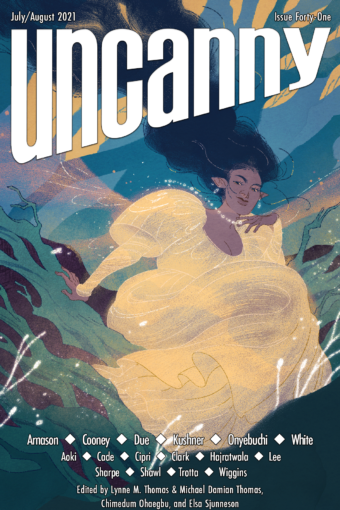
I have a new poem out! To be perfectly honest it came out a couple of months ago, but I’m behind on updating the website, so I suppose if you haven’t come across said poem yet it’s new to you. Anyway, “Radioactivity” is free to read in the wonderful Uncanny Magazine. I’ve sold to Uncanny before, but never a poem, so it’s lovely to be in there again, and in a different form.

“Radioactivity” is a poem about Marie Curie. She’s a scientist I have always admired, and let’s face it, when you think of the history of women in science she’s at the very top, or close to it. My favourite story about her is referenced briefly in the poem. It’s about her cookbook. Now, when Marie was researching radiation, it was the big new thing in science and no-one really understood that it wasn’t the best idea to shove highly radioactive material in your pockets and handle it with bare hands and so on. But Marie had her hands and her pockets, and when she finished working in the lab for the day she’d go home and cook her family dinner, and when she did the radioactive material that was smeared all over her fingers transferred to the pages of her cookbook, as she flipped through it looking for recipes. That cookbook still exists. It’s in the Bibliothèque nationale de France, and to this day it’s so radioactive that it needs to be kept in a lead-lined box.

I love that story. It makes Curie seem so utterly human… as does, I hope, the rest of the poem.

Novels, SFF

The Stone Wētā wins SJV

I’m happy to say The Stone Wētā has won the Sir Julius Vogel Award for best novel! The SJVs are Aotearoa New Zealand’s annual awards for achievement in speculative fiction, so I’m very thankful to everyone who voted for it. Climate fiction is an increasingly notable part of science fiction, and it’s fantastic to have it be represented like this, as climate change is, I feel very strongly, the defining issue of this century.

I’d like to mention, too, some of the other work that was celebrated. To start with, of course, congratulations should go to the other writers who were also nominated for best novel. They were Drew Bryenton for Gad’s Army, B.T. Keaton for Transference, A.J. Lancaster for The Court of Mortals, and Dan Rabarts and Lee Murray for Blood of the Sun. What a fantastic field to be a part of! The other SJV categories were equally well represented, but special mention should go to A.J. Fitzwater for winning both best novella (for No Man’s Land) and best collection (for The Voyages of Cinrak the Dapper) and Casey Lucas, who took out the best short story award for the incredible “For Want of Human Parts.” Finally, I was pleased to see Cassie Hart awarded for her Services to Science Fiction, Fantasy and Horror.

The Aotearoa New Zealand speculative community is small but wonderfully talented, and it’s fantastic to have such a pool of supportive and creative people to share pages with. Thank you all! Thank you, especially, to publisher Marie Hodgkinson at Paper Road Press, and the amazing cover artist Emma Weakley, for all their work on the book.


Papers, SFF

Worldbuilding in Ursula K. Le Guin

I have a new paper out! “Environmental Change as a Catalyst for Worldbuilding in Ursula K. Le Guin’s Always Coming Home” has just been published. You can find it in Worlds Apart: Worldbuilding in Fantasy and Science Fiction, edited by Francesca T. Barbini for Luna Press Publishing.

I have to admit, Always Coming Home is not my favourite Le Guin book. It’s actually quite far from my favourite. (That will forever be The Tombs of Atuan.) And if I’m being absolutely, perfectly honest, I find Always Coming Home to be over-detailed for my tastes. However, it is an absolutely excellent example of worldbuilding, and one that stems from cataclysmic environmental change. It’s part purported history, part thought experiment, part possible future, and what I find compelling amidst all that welter of detail is just how far the worldbuilding spreads. I mean, I know that in some corners of speculative fiction, writers will rabbit on forever and fucking ever about extraneous bits of encyclopaedia that are only marginally masked as story, but rarely is the focus so broad. Environmental change, in Le Guin, changes everything. Economics, family life, art, science… it’s all affected.

As an academic, that fascinates me. I’m interested in how speculative fiction deals with environmental change, and Always Coming Home is a deeply considered example of it written by someone much cleverer than me. Now, if only it had that creepy labyrinth…

Horror, Papers, Science, SFF

Inoculation and Contagion

I have a new paper out! Something very appropriate for the times, too, in that it deals with infection and disease. The paper’s called “Inoculation and Contagion: The Absence of Vaccination in Bram Stoker’s Dracula” and it’s free to read at Supernatural Studies. If you go to the table of contents for the issue you can also download a free pdf of the paper, which is great.

I love Dracula. I really do. It’s one of the great horror stories of all time, and yet when I reread it again a couple of years back, I began to wonder. Why is there no mention of vaccination in it? Two of the main characters are doctors. They treat vampirism as a contagious disease, and vaccination was, at the time of Stoker’s writing (and at the time the novel was set) an accepted medical practice. It was even a compulsory practice when it came to smallpox. And yet… nary a mention. Not even to say that it wouldn’t work so no use trying. Now, Stoker is long dead and so can’t be asked, but still… can a bit of research find a reason for this curious omission? It just might, I thought, and it has. Without verification from Stoker we can’t be sure if it’s the right reason, of course, but it’s certainly a plausible one.

And honestly, for me, plausibility is enough. My curiosity is satisfied. I would say, however, that just because you can’t vaccinate yourself against vampirism doesn’t mean you can’t vaccinate yourself against a number of other diseases. You can, and you should.

Papers, Science, SFF

Microbiology and Microcosms

I have a new paper out! It’s in Surreal Entanglements: Essays on Jeff VanderMeer’s Fiction, edited by Louise Economides and Laura Shackelford, published by Routledge. The paper’s called “Microbiology and Microcosms: Ecosystem and the Body in Shriek: An Afterword.” Which is a fancy way of saying that I’m talking about the human microbiome, the plethora of different species that live in and on the human body. Most of my academic work seems to sit in the intersection between science and speculative fiction, and this is another example of that.

Shriek: An Afterword is one of the Ambergris books; a series in which VanderMeer explores the city of Ambergris, which is the home of both humans and a fungal species called the gray caps. Fungus contaminates in Ambergris, and Duncan Shriek, one of the primary characters of the book, is slowly turning to fungus himself. Which made me think of the human microbiome, and how we are already host to fungal organisms – you and I and everyone have fungi living inside us as a matter of course, and so Shriek’s transformation is a sort of speculative extension of existing biology. It causes him – and everyone around him – to reassess his identity, and that reassessment is something that the human microbiome is prompting as well. We so often think of a human as being a singular organism, when we really are not. In reality, that apparently singular organism is more of a colony than anything else! How this impacts on the way that we think about ourselves is something I find just fascinating, and it’s that which prompted the essay.