Science, SFF

Pre-order: The Stone Wētā

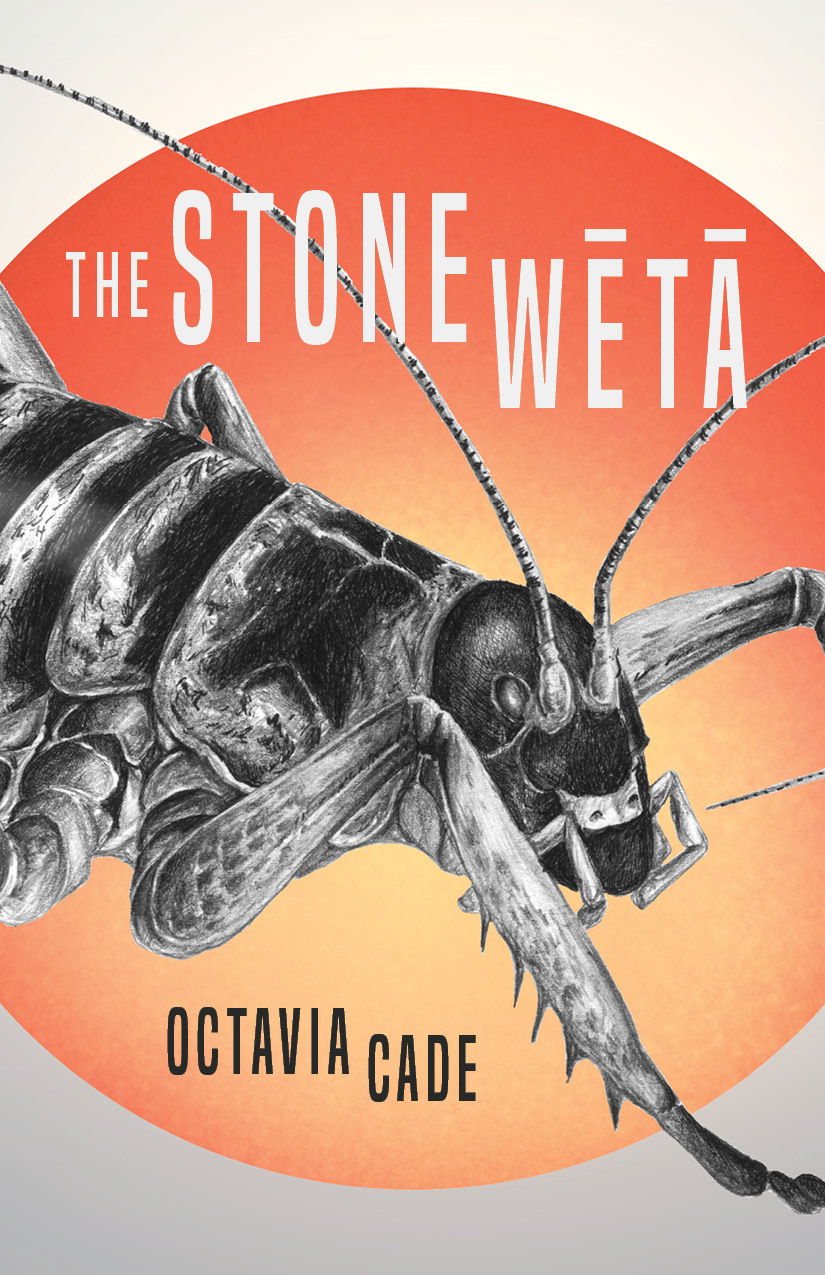
I have a new book coming out! The Stone Wētā, from Paper Road Press, is due out on April 22. That’s Earth Day, which is deeply appropriate for a novel about climate change and how it can affect us and our planet. The Stone Wētā is based on the short story of mine, of the same name, which was published a couple of years back in Clarkesworld.

We talk about the tyranny of distance a lot in this country. That distance will not save us.

With governments denying climate science, scientists from affected countries and organisations are forced to traffic data to ensure the preservation of research that could in turn preserve the world. From Antarctica, to the Chihuahuan Desert, to the International Space Station, a fragile network forms. A web of knowledge. Secret. But not secret enough.

When the cold war of data preservation turns bloody – and then explosive – an underground network of scientists, all working in isolation, must decide how much they are willing to risk for the truth. For themselves, their colleagues, and their future.

Murder on Antarctic ice. A university lecturer’s car, found abandoned on a desert road. And the first crewed mission to colonise Mars, isolated and vulnerable in the depths of space.

How far would you go to save the world?

You can pre-order hard copies of The Stone Wētā at the Paper Road Press site. E-copies are also available to pre-order at Amazon, Kobo, Apple, and Barnes & Noble.
Science, SFF, Short stories

The Atomic Hallows and the Body of Science

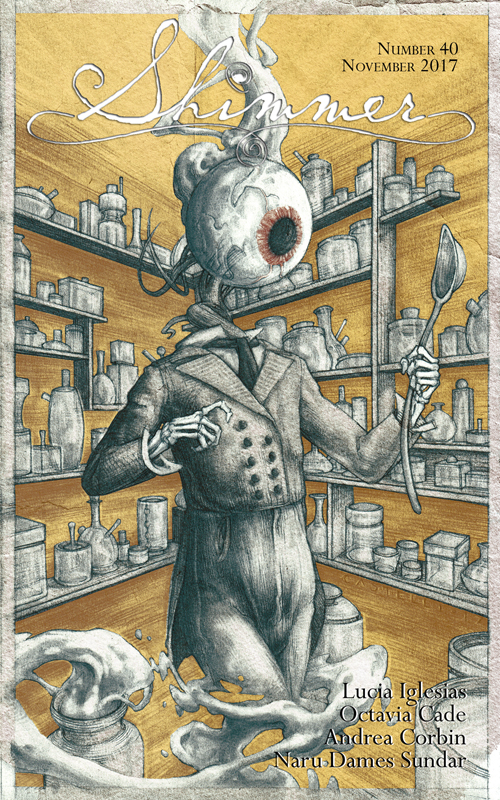
I’ve a new story out! And it’s a Shimmer story! AT LAST AT LAST I HAVE A SHIMMER STORY.

Right. You see, Shimmer has long been on my list of “bucket markets” – by which I mean markets I want to get a story into before I get hit by a bus and die. I have tried for years to get a story into Shimmer. It is a very hard thing to do. Why? Because Shimmer is a consistently excellent speculative fiction market, and so it gets a lot of submissions. I think they were commenting on Twitter that they got 5000 stories a year sent to them? Of which they publish maybe 24. So you can see the odds are stacked against.

This story of mine, “The Atomic Hallows and the Body of Science” (free to read at the link there), is the 28th story I have sent them. 28!!! It took that much work before they bought a story from me. I’ve been pretty open about this on Twitter – and now here – because I know from experience how discouraging constant rejection can be if you’re a writer. And it is discouraging – but it’s also part of the business, so you need to learn to not take it personally and keep trying. Editors want you to succeed, they want to buy an awesome story from you. The Shimmer editing staff, in particular, are lovely, and they were just as excited as I was to break that rejection streak I think.

I mean, if I can do it so can you. So don’t give up! And here’s a little snippet from the story to inspire you:

Lise Meitner
Co-Discoverer of Nuclear Fission

A spear breaks its blade upon ribs and punctures hearts. It shines with ice-coated needles in the salt air, over breakfast.

“I’ve had a letter,” says Lise to her nephew. He’d come to visit for the holidays so she wouldn’t be alone in the cold country of her exile. “I’ve had a letter and I don’t know what to make of it.”

She thinks she might be worried.

They walk across a frozen river, across the flood plain and into snowy woods—at least Lise walks, while her nephew glides on skis beside her, under crisp, frosted trees that smell of sap and pine and holiday gifts. Her fingers tingle in the cold, and their tips shine oddly in sunlight…


Novels, Science, SFF, Short stories

The Stone Weta

I’ve a new story out! “The Stone Weta” is free to read in this month’s issue of Clarkesworld.

It’s one of my favourites of the stories I’ve written – although, to be fair, the new and shiny ones tend to be my favourite at any given time. But this one is special. Partly because it deals with science denial, which can always exercise me to ranting, and partly because although it started as a short story, it very quickly became apparent to me that this was a short story I could build a novel around. And so I am: my current writing project (one of them, anyway) is a sort of sci-fi thriller set in this world, and around this issue.

“The Stone Weta” is about climate change, and how scientists can work to preserve data that governments want deleted or repressed. It’s a fairly topical subject at the moment, given the pressure put on organisations such as the American EPA and the Australian CSIRO when it comes to climate science. And in this story, an underground network of women scientists are smuggling data, stashing it in different places around the world in case it disappears from where it shouldn’t. And they take the code names of weird natural creatures, these women, because that’s what they study and the lessons of biological survival given by these species are an inspiration for keeping resistance alive…

Hemideina maori

In winter, the mountain stone weta crawls into crevices, into cracks in the stone and it squats there, waiting. It is a creature of summer days and winter strengths, of cryogenic hibernation. When the world freezes about it, becomes a stretch of snow and ice and darkness, the stone weta freezes solid in its bolthole. Eighty-two percent of the water in its body turns to ice; the weta is climate in a single body, it is a continent broken off and geology made flesh.

When the weather warms the weta thaws, resumes its life amidst the stone monuments of the Rock and Pillar range…

Please check it out! And keep an eye on your elected officials, because some of them wouldn’t recognise the scientific method if it fell on them from a great height (or entrapped them in a poisonous circle of gympie gympie).


Science, SFF, Short stories

The Meiosis of Cells and Exile

asimovsI have a new story out!

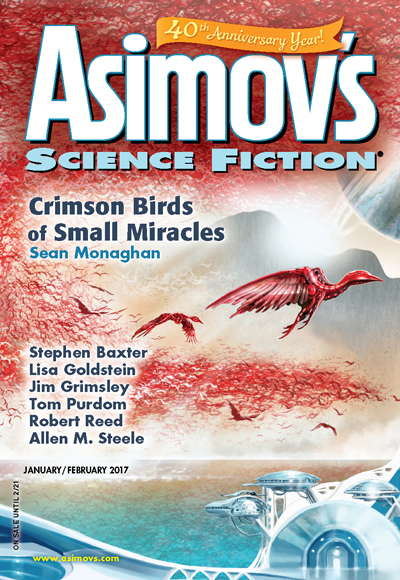
“The Meiosis of Cells and Exile” is a novelette about the Soviet scientist Lina Stern. It’s just been published in the latest issue of Asimov’s.

I enjoy mixing science history and speculative fiction, and “Meiosis” is an example of this. Lina Stern (1878-1968) was a biochemist and director of the Physiology Unit in the Academy of Sciences. She was also a member of the Jewish Anti-Fascist Committee, and Stalin was not impressed. Free speech was not something he found to be a priority, and the scientists and writers making up the Committee disagreed – to their very great cost. 15 members of the Committee were arrested and imprisoned for several years before being sentenced to death in a political show trial. Most were executed in 1952 in what came to be known as The Night of the Murdered Poets.

Lina was the only survivor, saved by her scientific talent and sent into exile in Kazakhstan instead. She was in her seventies at the time, and my story tells of her travel into that exile, fuming with what has been done to her and the rest of the Committee.

There’s (kind of) a happy ending to all that horror. Lina, despite her age, survived both Stalin and the miserable torturing bastard who imprisoned her and the rest of the League. She came back out of exile and spent the next 14 years of her very long life working for science, heading up the Physiology Department again at the Biophysics Institute.

It’s an apt story to be out at the moment, I reckon. Have been on Twitter the last few days, watching accounts from the Badlands National Park and NASA go rogue on climate change, tweeting science facts even though they’re under significant pressure not to. Scientists have the responsibility to speak truth to power, and I reckon Lina would have agreed.

(If you’re interested in reading more, Lina Stern also turns up as a supporting character in my short (free!) novel The August Birds.)

Papers, Poetry, Science

Nature as Creative Catalyst

entanglementsI’ve a new book chapter out!

Actually, that implies there was an old book chapter. Nope! There’ve been a handful of papers, but this is is the first academic chapter I’ve had published. It rejoices in the name of “Nature as Creative Catalyst: Building Poetic Environmental Narratives through the Artists in Antarctica Programme”, and it is riveting stuff I tell you.

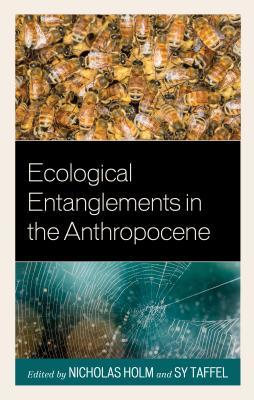
But if you think that title’s a mouthful, have a look at the collection that it’s in: Ecological Entanglements in the Anthropocene, edited by Nicholas Holm and Sy Taffel. Perhaps it’ll all be a bit clearer when I tell you that the working title of the project, for most of the time I was involved in it, was Working With Nature. Basically, it’s a collection of essays on the many different ways that people interact with their natural environment. Aside from mine, there are chapters on photographing the Australian landscape, suburban landscapes, postcolonial property rights in New Zealand, and more. The focus does tend towards the Antipodean, but it’s not the only setting explored.

My own chapter looks at New Zealand’s Artists in Antarctica programme. Every year, artists are sent down to Scott Base, to live and work with the scientists there. This is done in order for artists to communicate the Antarctic environment to the general public, in different ways than the scientists do. Basically, to give a more well-rounded experience of the continent to said public, who let’s not forget are the ones paying for NZ’s research programmes on the ice. The more invested the public is in Antarctic conservation and science, the better – at least as far as I’m concerned. Selected artists may be writers, film-makers, visual artists, textile artists, musicians, and so on. Being a poet myself, I focused on the visiting poets and how they built environmental narratives of their experiences.

I’m not going to lie, one day I’d love to be part of the Artists in Antarctica programme myself. Still, until that happy day, I can at least appreciate the work of the poets who have been able to go thus far… namely Bill Manhire, Bernadette Hall, Chris Orsman, and Owen Marshall. Lucky, talented bastards.