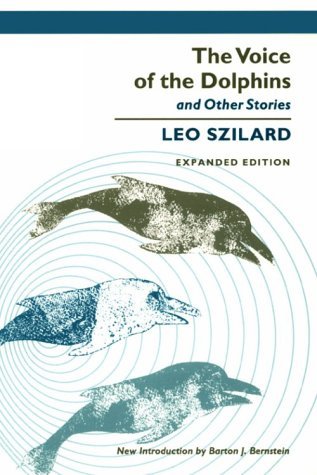
 The Voice of the Dolphins and Other Stories (Expanded Edition)
By Leo Szilard
Published by Stanford University Press, 1992
#
I admit, I’ve always had an interest in the Manhattan Project. It’s a fascinating period of history – as part of my PhD research, I went on a trip to Los Alamos to write a collection of poetry based around the Project’s wartime work. Thus, I’m already familiar with Szilard – arguably the man who more than anyone else saw the potential of (and the potential horror of) atomic war, and realised the need for Allied research. It was Szilard who went to Einstein, who wrote with him the letter to Roosevelt that kickstarted the Manhattan Project. He also drafted the petition that argued for a bloodless demonstration of the atomic bomb as a means of ending the war, rather than its ultimate use on the cities of Hiroshima and Nagasaki.
Knowing this, I wonder if I would have recognised the author of this collection, had I found it with the author’s name whited out. I can’t honestly say that I would – but I would have been close, I think. The Voice of the Dolphins is not a work written by what I would call a “natural writer” – someone whose prime concern is the linking together of word and image, someone concerned with the aesthetics of a sentence. For someone who is so associated with the written word – with letters and petitions – Szilard doesn’t have a great deal of fluidity in his language. Of course, he was multilingual where I am not so that is perhaps an ungenerous assessment.
That being said: if this book had come to me, apparently authorless, it wouldn’t be hard to perceive the kind of man who wrote it. The concern with failure is so profound, the nuclear issue so pronounced, that it’s easy to see in its pages the stamp of someone who could have been involved in the Manhattan Project. Add to that the historical context of the stories – so concerned with the Cold War, with the relationship between Russia and the USA – that the provenance is almost certain.
Szilard tried to publish some of the stories in this collection in fictional and non-fictional fora. Once one reads “The Voice of the Dolphins” it’s clear why. Having failed to prevent war-time use of the atomic bomb, Szilard is trying to develop a blueprint of a global community where nuclear weapons can be limited in their use, where the international debate over their use becomes a catalyst for peace. Some of it, looking back, seems almost pitifully naive: the insistence that a nuclear power give two weeks’ notice of intent to the city that they plan to bomb, so that the inhabitants of that may safely evacuate. Reading that now seems almost laughable… but then I thought of Szilard, writing desperately away until his hand cramped, trying to find a way out of the maze that he himself conceived and helped to build. I thought of how (as described in Bernstein’s comprehensive introduction) he sent copies of that story to a number of American officials and politicians, how he had the story translated into Russian so that he could get it to Khruschev… the poor man. You could weep for him, you really could.
It’s not a large collection, only six stories. A couple of them are more typically science fiction, regarding alien perceptions of Earth under/after a global nuclear war that at least in “Report on Grand Central Terminal” has left the planet bereft of human life. “Xram thinks that there had been a war fought between inhabitants of the two continents, in which both sides were victorious” (145).
Once can infer that this is Szilard’s nightmare, the end-point of his work, wrought all too well – and all too necessarily, to make the fear of it just that much more bitter. No matter how Szilard must have dreaded the possible nuclear future he helped to build, he also knew that such a future was coming, and better it not come at the hands of the Nazis. Such are our choices made: easy choices, and easy to be right in. (To be wrong in.)
The bulk of the remaining stories – including “The Voice of the Dolphins”, the largest and most significant of all the pieces – outline ways to avoid this future, the lack of it, the alien curiosity. They are, essentially, alternate histories. In “Dolphins”, there is a scientific breakthrough: communication between humans and dolphins is ostensibly established, and the latter are found to be clearly and deeply intelligent. The dolphins then guide humanity through political and scientific changes that ameliorate the risk of nuclear way and eventually lead to global peace and prosperity. The interest here is in Szilard’s hypothetical sequence of events – and it very nearly is a simple sequence. As I commented above, one should not look for a particularly literary value here. The value lies in the historical context, in the thought experiment of a great thinker, set in the environment caused by his life’s work.

 My first poetry collection is out! Chemical Letters has just been published by Popcorn Press, and – unsurprisingly, given the title – is about the periodic table of elements.
 ojcade.com