Horror, SFF, Short stories

The Barrens

I have a new story out! “The Barrens” is available, free to read, in the latest issue of Three-Lobed Burning Eye. It’s great to have a story in there again!

“The Barrens” is a body horror/eco-horror sort of story. A while back I read an article about kina barrens here in New Zealand: “kina” being what we call Evechinus chloroticus, the NZ sea urchin. I do love those spiky creatures! They’re so interesting to look at. They are less interesting, though, when they turn the sea floor into desert. You see, there are lots of kina and they are very hungry, and given that we have stupidly overfished their natural predators – crayfish and snapper – the local sea urchin population has exploded.

You can eat sea urchins too, but we don’t seem to be eating enough of them. Admittedly, I’ve never had a meal of kina myself, so I’m hardly one to talk. I read that article about kina barrens, though, and immediately thought that it would make a great horror story. I don’t know why, but I had a sudden image: people with kina for eyes, sea urchins embedding themselves in sockets. Which is implausible and mostly grotesque but also such a great image, especially when the little horrors burst out.

Hence the body horror. Yeah.

Anyway, I had immense fun writing this story, so please go ahead and take a look at it, as well as all the other fantastic stories in this issue of 3LBE.

Horror, SFF, Short stories

How to Dispose of a Dead Albatross

I have a new story out! “How to Dispose of a Dead Albatross” is free to read at Strange Horizons.

It’s a bit of a weird story. Very experimental, but then it’s part of an experimental project of mine. I’m currently the Robert Burns Fellow at the University of Otago, which basically means I’m the writer in residence there for 2025. One of the projects that I’m working on as part of the Fellowship is a near future science fiction/climate fiction novel called Bloom, in which a toxic algal bloom invades Otago Harbour. Dunedin, you understand, sits on that harbour, so it’s a very local story!

Down near the bottom of New Zealand’s South Island, Dunedin is a great place for wildlife spotting. There are sea lions here, and penguins, and a colony of albatrosses on Taiaroa Head. I’ve been out to see that colony, and the birds are amazing. In the world of Bloom, however, they’re also dead. Poor albatrosses! A lot of the wildlife is dead, in the novel, with the waters choked by algae. And somehow, without my planning it, the novel started to be this exploration of how people might respond to this strange and quietly violent disruption of their environment. “How to Dispose of a Dead Albatross” is actually the first chapter of the novel. It works as a standalone, so when I saw that Strange Horizons was open again for submissions earlier in the year, I sent it along.

I’m so pleased I did!

Articles, Nonfiction, SFF

Unpaid Green

I have a new article out! “Unpaid Green: Voluntary Conservation Work in Speculative Fiction” can be read for free in the latest issue of Journey Planet. The whole issue’s free to read, which is nice – and it’s a special issue on workers’ rights in SFF.

So much of speculative fiction is imagining different ways to live, and that includes work. When we picture what work will be like in the future, for instance, what kind of things are we prioritising? What are we hoping for, and what are we critical of? Can we even picture a working future reliably? What about the growing influence of technology and AI, or of environmental change and resource management?

It’s a fascinating topic to explore, so when I saw the submissions call I thought “I have to come up with something for that!” And given that most of my creative work is near-future science fiction, generally related to climate or to the environment, it’s no surprise where my focus went.

There’s a lot of work to be done building ecological resilience into the systems around us. This might end up being the most important work of the lot, even. A lot of it’s done by volunteers. What does that say about how much we value their work? Something to think about. That’s what my article focuses on, anyway. Please take a look!

Horror, Papers, Pop culture, SFF

Multiple Mortalities in Pretty Deadly

I have a new paper out! “Deathface Ginny (Kelly Sue DeConnick, 2014–20) – Death and #MeToo” can be read in Death in the 21st Century: A Companion, part of the Genre Fiction and Film Companions series from Peter Lang, edited by Katarzyna Bronk-Bacon and Simon Bacon.

I have to admit, though, I continue to think of this particular chapter by its subtitle: “Multiple Mortalities in Pretty Deadly.” That’s what it was all the time I worked on it, so that’s the way I remember it. You don’t always get to pick your titles, and when the editors have to stick to a particular format – there’s a lot of fascinating case studies in this book, so standardisation helps readers to keep track! – that’s when your original title gets bumped down.

I’m not primarily a comics critic, but very occasionally I do a paper on comics, whenever I find something I just can’t resist writing about. This time round it’s Pretty Deadly by Kelly Sue DeConnick and Emma Ríos, which is a series I’m just fascinated by. It’s kind of weird western/historical, with a number of different reapers wandering around representing different types of death. The art is gorgeous, but what really interests me is how much of a puzzle it is – all these interlocking pieces fitting together in unexpected and thoughtful ways. It’s just a great read, and so when I saw a call for papers that was looking for representations of Death in 21st century pop culture I saw my opportunity and I pounced on it. Not sorry.

Horror, Papers, Pop culture, SFF

Monstrosity, Mutation, and the World without Us

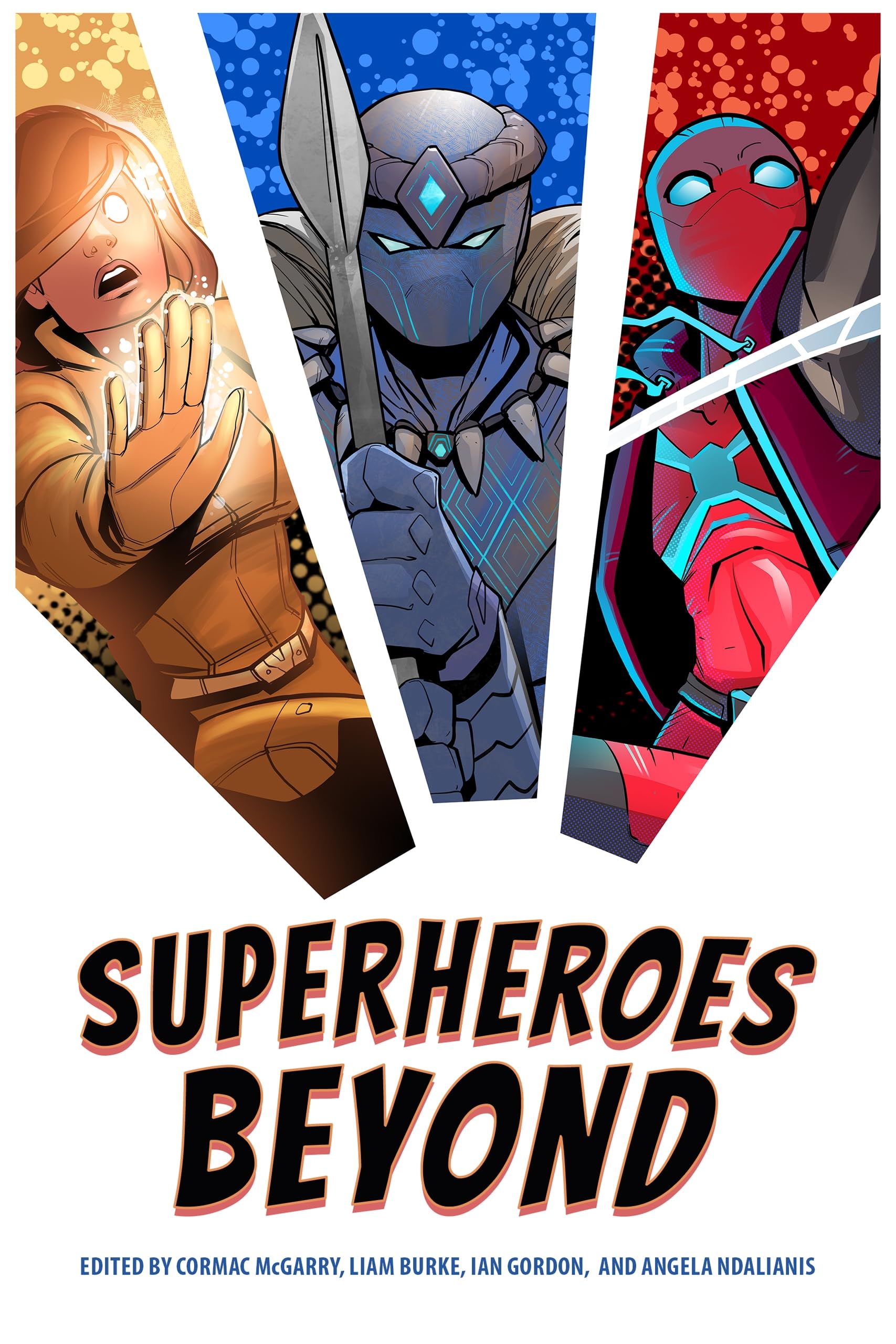
I have a new paper out! “Monstrosity, Mutation, and the World without Us” can be read in Superheroes Beyond, recently published by the University of Mississippi Press.

This paper has been a long time coming. Back in 2018, I presented it at the Superheroes Beyond conference in Melbourne. The city was baking hot – I barely wanted to go outside – but the conference itself was fantastic, focused as it was on how superheroes were presented, in boundary-crossing ways, in popular culture. There was a lot of emphasis on comics, of course, but there were also papers on lots of other media as well, and on superheroes from all around the world. It was honestly one of the most enjoyable conferences I’ve ever been to!

The conference led to a book project. It was not quick. All credit to the editors – Cormac McGarry, Liam Burke, Ian Gordon, and Angela Ndalianis – for keeping the momentum going through the five plus years of the entire book-producing process. I’ve finally got the finished result in my hot little hands and it looks great. I can’t wait to read what everyone else from the conference has written!

My particular paper looked at nonhuman superheroes and eco-horror. There’s some discussion of Swamp Thing, of course, but also mutant bears and Godzilla, and how their creation, their actions (and their reactions) might allow them to be seen through a superhero lens. I’m so glad to see it finally out there!