SFF, Short stories

Monsters in the Garden

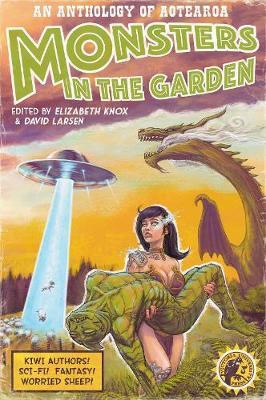
There’s a fantastic new anthology out from Victoria University Press, and I have a story in it! “The Stone Wētā” was reprinted in Monsters in the Garden: An Anthology of Aotearoa New Zealand Science Fiction and Fantasy, edited by Elizabeth Knox and David Larsen. New Zealand was supposed to host WorldCon this year, although the whole pandemic turned the convention virtual in the end, and this anthology was meant to celebrate that. It ended up being a little late for WorldCon, but it came out just in time for Word, one of the major national literary festivals, held every year in Christchurch. Quite coincidentally, I was in Christchurch for the launch – I was finishing up a writing residency at the Arts Centre there – so I was able to do a reading at the launch, which was exciting.

What is really exciting, however, is the table of contents. New Zealand has a long history of speculative fiction – our national scifi and fantasy awards are named after Sir Julius Vogel, who was prime minister here in the 19th century and wrote a book of feminist science fiction after he retired. So there’s a wide range of authors to pick from, and the anthology has a nice range of older and more contemporary writers. I am thrilled to bits, however, to be in the same table of contents as Maurice Gee, whose children’s books I adored as a kid and still love today. Also, Janet Frame is in there. I am in a table of contents with Janet Frame!!! Ridiculously delighted.

Horror, SFF, Short stories

The Body Politic

I have a new story out! “The Body Politic” can be found in Recognize Fascism, edited by Crystal M. Huff, from World Weaver Press. Recognize Fascism is a science fiction and fantasy short fiction anthology that does what it says on the tin. Fascism, sad to say, is one of those unfortunate ideologies that never seems to die. It’s always trying to sprout in new and unpleasant forms – and it’s best to be able to discern these as quickly as possible, so you can kick the shit out of them early and save yourself the trouble of doing it when they’ve got an even larger and nastier foothold in civilised society.

Anyway, my story is really more body horror than sci-fi or fantasy, and it’s weird body horror at that. One of the hallmarks of fascism, I think, is its attempts to control the body, particularly in the areas of identity and reproduction. In this little story, then – one of the few flash pieces I’ve ever written – the effects of fascism begin to literally appear on the body, limiting that body’s potential and rendering it weaker than before, and less capable of rebellion.

It’s such a good idea for an anthology, recognizing fascism, and I’m so glad that Crystal and World Weaver Press took a chance on what is really a very experimental piece of work. But it’s not just me – the anthology is positively stuffed with interesting, provocative stories by a number of truly excellent authors. Please take a look.

SFF, Short stories

The Mythology of Salt and Other Stories

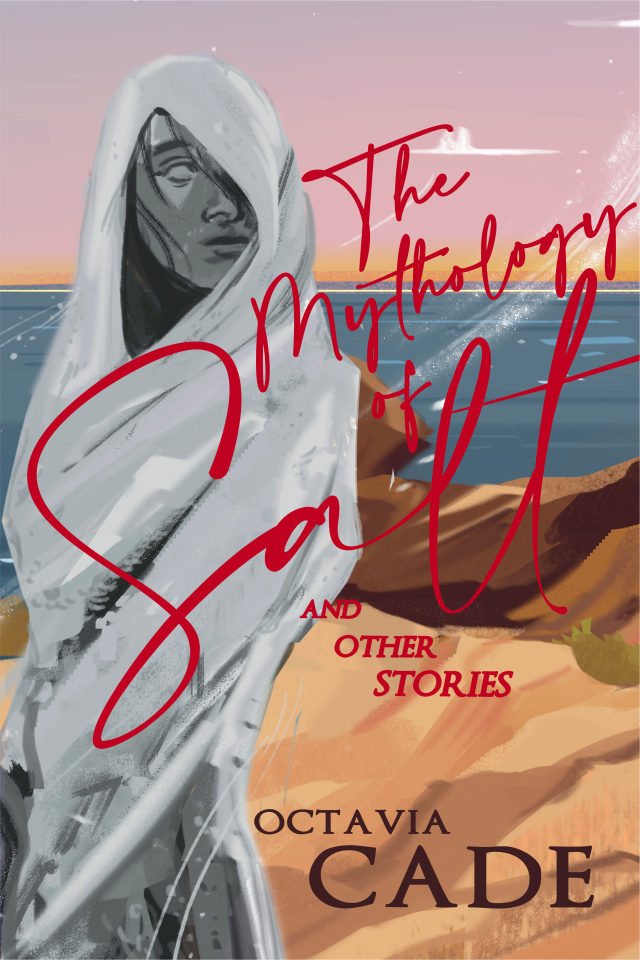
I have a new book out! The Mythology of Salt and Other Stories is my first short story collection, and it’s published by Lethe Press. Just look at that beautiful cover!

A collection of short stories themed around women and knowledge, The Mythology of Salt and Other Stories is full of poignant moments. Scientists and ghosts, the natural world and mythology, all meet and circle one another in choreography at times aspiring, at times melancholic.

That’s what it says on the back, anyway. There are eighteen stories in here, some of which you might have read in places like Shimmer, Strange Horizons, Kaleidotrope and Liminal Stories. There are also a couple of stories – “In the Shadow of Yew Trees” and “The Knife Orchard” – that are completely new and previously unpublished.

My favourite story in here is “The Atomic Hallows and the Body of Science,” which mashes up elements of the Arthurian waste land with the development of the atomic bomb. I’m also very glad to have reprinted in here “Cuckoo,” which was one of the first stories I ever had published (and the only vampire story I’ve ever written). It remains one of the stories I’m most happy with.

You can get The Mythology of Salt at Amazon, Barnes & Noble, and of course at Lethe Press.

Nonfiction, Papers, SFF

Humans as Ecological Actors in Post-Apocalyptic Literature

I have a new paper out! “Humans as Ecological Actors in Post-Apocalyptic Literature” has been published in MOSF Journal of Science Fiction, in their special issue on environmental SF. This is also the first paper I’ve ever co-written, and my fellow author is Meryl Stenhouse. It was a really enjoyable writing experience, so I think we’re going to work together again once we can figure out our next topic!

Post-apocalyptic literature is frequently environmental in nature, or explores significant ecological impacts. These affect the surviving human and nonhuman populations, and are characterised by scale. While some of the apocalypses of science fiction literature are limited to the destruction of a single species – as occurs, for instance, in P.D. James’ The Children of Men – others, such as Cormac McCarthy’s The Road, illustrate an environmental collapse that destroys entire ecosystems.

Human response to apocalypse occurs on both an individual and a communal level, but that response, within the literature, tends to focus more often on social or economic consequences. However, the ability of humans to further shape their natural environment tends to be heightened in environmental apocalypse, as compromised ecologies become ever more vulnerable to human activity. The ability of humans to function as ecological actors, as shapers of surviving ecologies, is therefore not only a fundamental – if frequently underexplored – part of that narrative, but it also indicates potential pathways for real-life response to ecological apocalypse.

Notable, in the post-apocalyptic narratives explored in this paper, is how the impact of human behaviour on environment is dependent on apocalyptic scale. The construction of refugia, the realignment of surviving communities to sustainable practices, and the increasingly destructive human presence on ecologies incapable of reclamation contrasts with, for example, the increasing nonhuman biodiversity that can follow the widespread destruction of the human population.

SFF, Short stories

Year’s Best Aotearoa/NZ SF&F, Volume 2

This must be one of the most gorgeous covers I’ve seen recently! It’s by Laya Mutton-Rogers, who has done an absolutely beautiful job.

New Zealand hosted WorldCon this year, or at least it was supposed to (thanks to pandemic, the whole thing went virtual) but anyway: this, the second volume of Year’s Best Aotearoa New Zealand Science Fiction & Fantasy, was designed to coincide with the convention, in an effort to introduce more people to Kiwi speculative fiction. I was lucky enough to have a story in the first volume, so I was just as delighted to have a story in the second.

“Inside the Body of Relatives” was originally published last year in Asimov’s. It’s a story about an elderly woman and her artificially intelligent house. It’s a very quiet story, with no AI going rogue or anything like that – just a house programmed to be kind trying to get its increasingly lonely owner to socialise more. Which she does, eventually, but not in any way the house expects. It’s evolutionary biology to the rescue, and the story itself developed from one of those nights when I was tucked up in bed, listening to the rain on the roof and contemplating building materials. Which I don’t do very often, but in this case it all came together nicely.

Thanks to Marie at Paper Road Press for publishing one of my stories again, and if you’re interested in this lovely book, you can find it here.