Novellas, SFF

The Impossible Resurrection of Grief

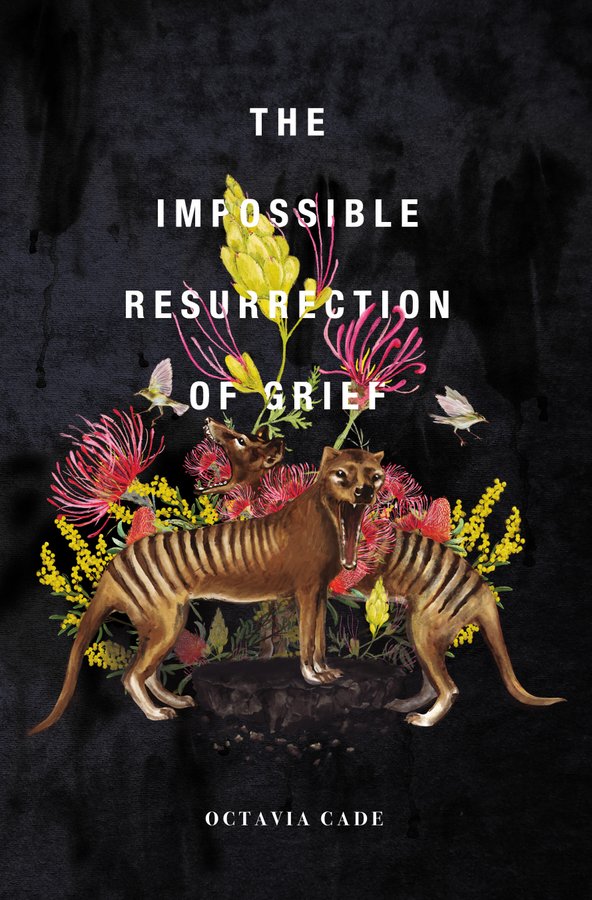
My new book is out! The Impossible Resurrection of Grief is published by Stelliform Press, and it’s more climate fiction from me. This time, though, I’m focusing on the idea of ecological grief.

With the collapse of ecosystems and the extinction of species comes the Grief: an unstoppable melancholia that ends in suicide. When Ruby’s friend, mourning the loss of the Great Barrier Reef, succumbs to the Grief, the letters she leaves behind reveal the hidden world of the resurrected dead. The Tasmanian tiger, brought back from extinction in an isolated facility, is only the first… but rebirth is not always biological, and it comes with a price. As a scientist, Ruby resists the Grief by focusing her research on resilient jellyfish, but she can’t avoid choosing which side she’s on. How can she fight against the dead and the forces behind them when doing so risks her home, her life, and the entire biosphere?

The book’s had some pretty good reviews! You can find a selection of them from The Chicago Review of Books, Locus, Ancillary Review of Books, and The Spinoff Book Report.

You should be able to buy or order the book most places (please consider ordering through your local bookstore!), and you can find all your buying options either on my book page here or at Stelliform.
Novellas, SFF

Pre-Order: The Impossible Resurrection of Grief

I have a new book coming out! The Impossible Resurrection of Grief is a novella from Stelliform Press, and it’s due out on May 20th. You can pre-order it at the link there.

Before I tell you anything else about it, just look at that cover. Isn’t it gorgeous? The cover artist is Rachel Lobbenberg, and she’s done an amazing job. If you look closely, you can even see the grumpy eyebrows on those little flying rock wrens!

Stelliform’s focus is climate fiction, which is something I’m enormously interested in. When I saw their call for novellas last year, I was determined that I would have to write something for them – I ended up writing this book during my time as artist in residence at Massey University/Square Edge, and I’m truly grateful for their support. My time as artist there was affected pretty strongly by pandemic, and I spent a lot of it in lockdown. One thing I noticed was the odd news article about how many people in lockdown were logged into nature cameras, such as those down at the albatross colony just outside Dunedin. People were feeling nature-deprived, and it struck me that as climate change accelerates and biodiversity plummets, the phenomenon of ecological grief (which is beginning to get some attention in academic circles) might become a more significant part of daily life.

In the climate-affected future of Grief, this is exactly what has happened. The Great Barrier Reef has died, and the repercussions of this, and of all the other ecological absences, are felt through a phenomenon known simply as Grief. But in out of the way places, some scientists are working to bring back to life some of the creatures that have been lost…


SFF, Short stories

The Streams are Paved with Fish Traps

I have a new story out! And unlike my last two, this one’s not horror. It’s actually optimistic for once, but that’s what tends to happen when you write solarpunk. It’s an area I’m interested in doing more work in, as I like the focus on community, diversity, and sustainability that’s generally a hallmark of the genre.

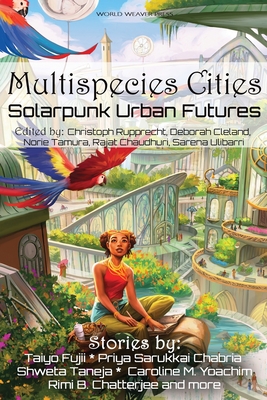
This particular story, “The Streams are Paved with Fish Traps,” can be found in the anthology Multispecies Cities: Solarpunk Urban Futures, from World Weaver Press. The anthology was produced with the support of the Research Institute for Humanity and Nature in Kyoto, Japan, so as you can see there is a strong focus on an interdisciplinary approach here, and that’s something I appreciate.

My own story talks about urban ecology, which is a field that, like solarpunk, I’m becoming increasingly interested in. Back in 2019, I saw a news story out of Wellington, New Zealand, about a discovery some ecologists had made in the storm water systems beneath the city. The pipes were being colonised by fish, including eels, and I thought that was just marvelous. I knew straight away that I wanted to write a story about it, and so when World Weaver Press contacted me, wanting to know if I’d write a story for their upcoming anthology, it was an easy choice. I’m so glad to be a part of this project! Hopefully there’ll be many more like it in the future.

Articles, Horror, Science, SFF, Short stories

The Past and Future Lives of Test Subjects

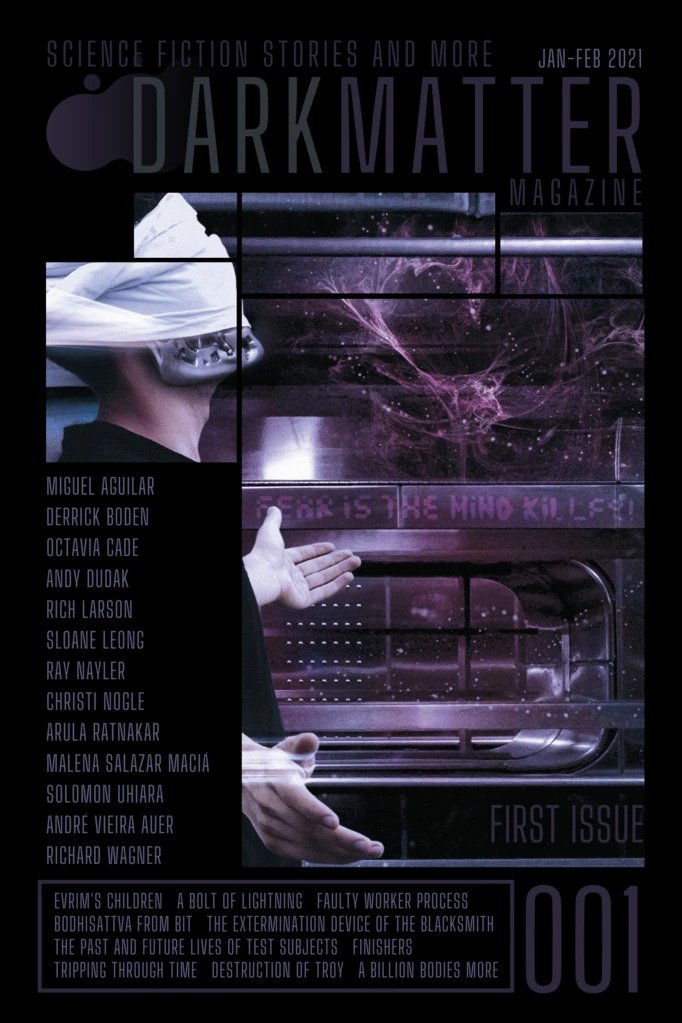
I have a new story out! And it’s fucking terrible. I don’t say that lightly. The story itself is well-written and decently constructed, don’t get me wrong. I’m not fishing for affirmation of my writing ability. But the subject is monstrous. It’s also, unfortunately, drawn entirely from fact. “The Past and Future Lives of Test Subjects”, available in issue 1 of Dark Matter Magazine, is about the Tuskegee Syphilis Experiments.

Those experiments, should you be so fortunate to have never heard of them, comprised a 40 year study in which the United States Public Health Service oversaw the “treatment” of syphilis in a study group of Black men. I say “treatment,” because although these men were told they were receiving medical care they really weren’t. The purpose of the study was to monitor the progression of untreated syphilis in the human body, and of course there’s no-one alive who would volunteer to the be the subject of that experiment, but the Public Health Service decided to go ahead and experiment anyway and not bother with any of those nasty consent issues.

This is the darkest story I’ve ever written. The people who ran this study were deeply, violently racist, and they clearly had absolutely no ethics at all, so be warned if you choose to read. You may prefer the accompanying essay, which I’m pleased to say Dark Matter also chose to publish in the same issue. “The Past and Future Lives of Scientists” goes into greater detail of the experiments in question, and places them within the ethical context of past failure and future necessity.

SFF, Short stories

Come Water, Be One of Us

I have a new story out! My last story of the year. It’s called “Come Water, Be One of Us,” and it’s free to read at Strange Horizons, just click on the link.

This is a story inspired by true events. As the wee paragraph at the beginning says, back in 2017, the New Zealand Parliament recognised the Whanganui River as a legal person. You might think that sounds strange, but I’ve long been irritated by the legal fiction that corporations are people when they clearly fucking aren’t. Making rivers legal people as well redresses the balance – and takes into account indigenous beliefs about the personhood of the river in question. And this isn’t just a Kiwi thing. Not long after the NZ Parliament did its bit, the Ganges and Yamuna Rivers in India, and the Rio Atrato in Colombia were also made legal people by the respective governments of those countries. (And it’s not just rivers. At least one mountain here in NZ has been accorded the same status.)

I like the idea of making ecosystems legal people. It gives another layer of protection, and if you know anything about the state of rivers in NZ, you know they need all the protection they can get. But it’s also, in its way, a potential pushback against the ridiculous idea that corporations have the same legal protections as you and me. Those fucking things are not alive. I don’t care how much you love Amazon. It is not an ecosystem like the South American river, and Apple didn’t grow on any bloody tree. They are not alive.

It really annoys me. So I used the idea of rivers, fighting back against the corporations, because what is a person, really? I’m so glad that Strange Horizons bought this story. I had a feeling it was right up their alley – occasionally, when you write a story, you just know it’s a good fit for a particular market. And they got Galen Dara to illustrate it. Galen Dara!!! Author achievement unlocked right there, I tell you. Just look at it. Isn’t it beautiful?