Horror, Papers, SFF

Entering the Ecosystem

I have a new paper out! “Entering the Ecosystem: Human Identity, Biology, and Horror” is in the book Horror and Philosophy: Essays on Their Intersection in Film, Television, and Literature, edited by Subashish Bhattacharjee and Fernando Gabriel Pagnoni Berns, published by McFarland.

I love eco-horror films, especially the animal horror type. I don’t care if it’s mutant bears or giant crocodiles or experimented-on sharks, I always end up rooting for the monster. Let’s be honest: most of the time they’re not doing anything wrong. They’re just wandering around their natural habitat, acting as bears and crocodiles and sharks do, when along comes this meaty little biped, all excited to interfere with them. Of course they’re going to look at us and think food.

This can be deeply destabilising from the human point of view. Dangerous, too, but beyond the being eaten alive or torn apart or what have you is the sense of identity loss we feel at suddenly being booted a few rungs down the food chain. The vast majority of us are used to thinking of humans as somehow separate from the rest of the animal world. We’re smarter. We have science and opposable thumbs and ways to insulate ourselves from the natural world. Animal horror films remind us that we’re not so removed as we’d like to think. That’s so disturbing to watch, and I love it.

Naturally I had to write about it.
 

Horror, SFF, Short stories

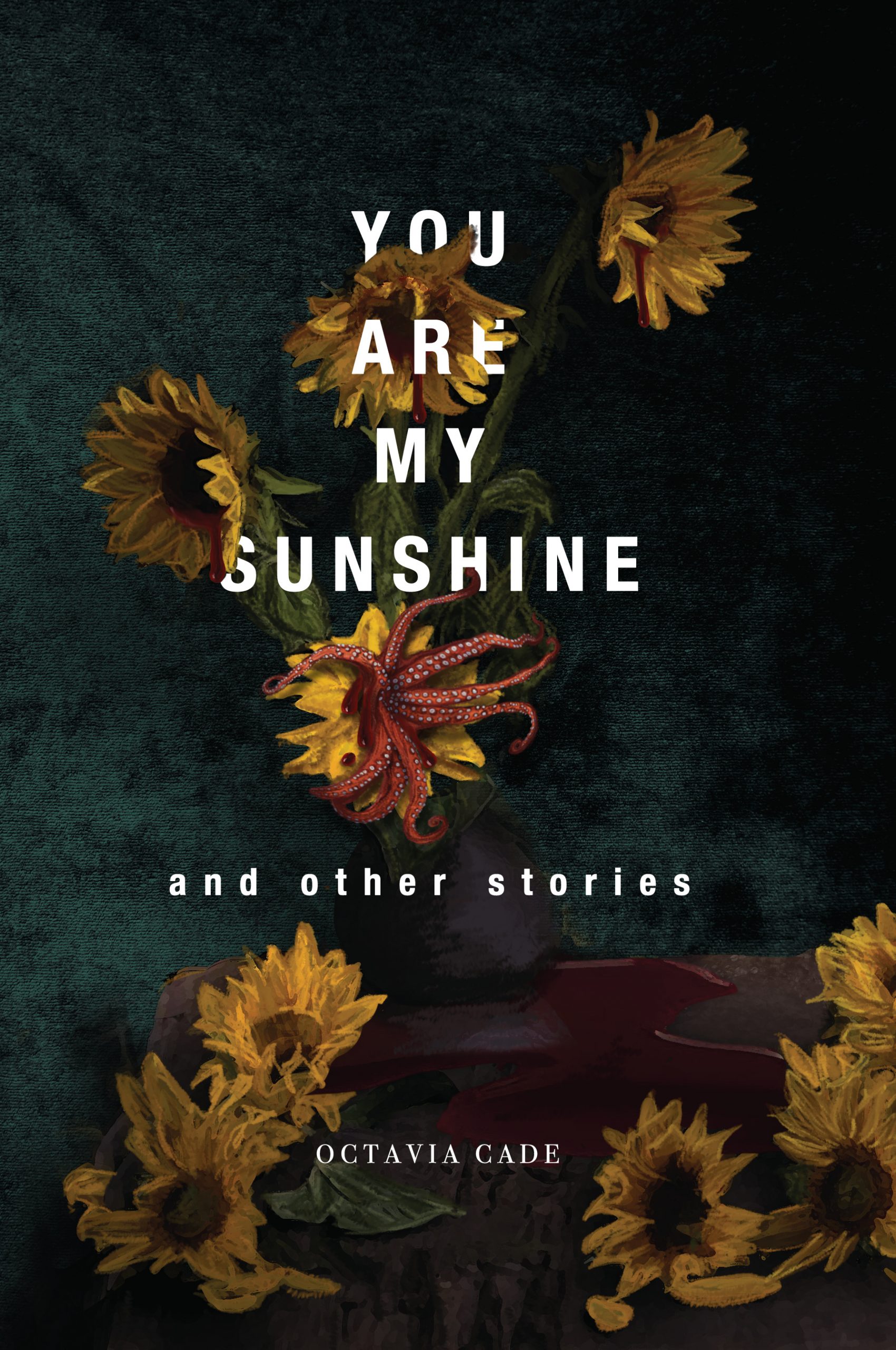
Cover reveal for You Are My Sunshine

My second short story collection, You Are My Sunshine and Other Stories, is out in September from Stelliform Press! I’m really happy to say that the cover is done by the wonderful Rachel Lobbenberg, who did my last Stelliform cover, for The Impossible Resurrection of Grief. I love Rachel’s work – it’s always so detailed and creepy, and the tentacular sunflower here is the perfect example of this.

You can pre-order the book here. If you like eco-horror and solarpunk and the journey from one to the other, this collection might be for you. Behold the blurb:

Sometimes change can hurt. This collection of short stories traces the growing pains of a new world, beginning with the death throes of our current way of life and ending with a world transformed by science and technology, and by grief, hope, love, and humanity’s will to transform. This is a collection that will both tear you apart and tend to your wounds. Cade’s stories are informed by science, tracing the biological and emotional threads that bind us, human and non-human alike. You Are My Sunshine and Other Stories is a promise of what worlds are possible if we allow ourselves to change.

SFF, Short stories

Happiness

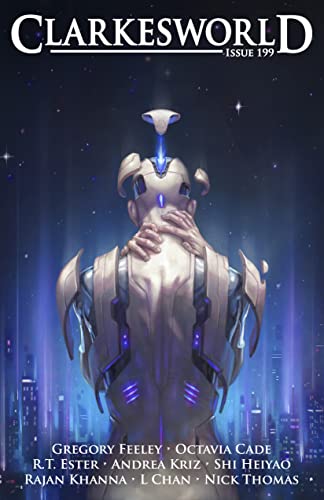
I have another story out! “Happiness” is a choose-your-own-ending novelette that’s free to read in the April issue of Clarkesworld. It’s a bit of an experimental piece, as I’ve never done something of this format before – and it’s deeply, horribly cynical. It may be one of the most cynical things I’ve ever written, and that includes the bears story that was in Strange Horizons a while back.

When it comes to writing about climate, I admit that I bounce between flat-out dystopia and more optimistic stories. I think the optimistic ones may have more value, but there are times when I just can’t resist the former. This is one of those times. “Happiness” is a misnomer. Every ending you choose, you die. You also die happy. Yes, every time. That happy ending tends to be earned, and not in a good way. The unnamed protagonist – and this is a novelette told entirely in the second person, another experimental departure for me! – is honestly not the brightest. Their total lack of awareness, and sometimes even of empathy, means that they never quite realise what’s happening to them, and how their choices, choices that they’re completely certain of, seal their stupid fate. They’re basically a walking Darwin Award, and they never know it. And because they never know it, they die happy, still in the illusion that they’re doing the right thing.

I quite like the choose-your-own-ending format, which is a throwback to when I used to read those types of books as a kid. I think I’d like to try it again one day, but maybe not immediately. Still, it’s good to try new things, creatively, and I’m super grateful that Clarkesworld was willing to let me experiment in their pages.


SFF, Short stories

In(con)solation

I’ve got a new story out! “In(con)solation” is free to read over at Lightspeed. It’s barely more than a flash piece, but it’s also the first story I’ve managed to sell to them – not for want of trying! – so I’m pretty pleased about that.

The title, I’m sorry to say, is something of a pun. I was interested in the effect that sunlight (insolation) has on mental health, and what happens if you’re deprived of it. There’s all sorts of high latitude examples where people don’t see sunlight for seasons at a time, but because this is science fiction they’re all living underground in the aftermath of nuclear apocalypse. The downside to that – one of many, I’m sure – is that one of the possible consequences of exposure to high levels of radiation is cataracts… so what happens when staying in the dark makes you depressed, and the consolation of sunlight makes you blind?

It’s not a cheerful story, as you can imagine, but when I was writing it I found the layered imagery interesting, and it’s always a challenge to write a story that short.

SFF, Short stories

Ernestine

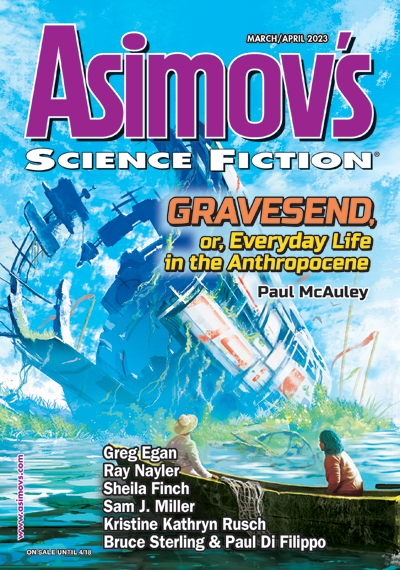
I have a new story out! “Ernestine” is in the March/April issue of Asimov’s; it’s wonderful to have a story in there again. They’re one of my favourite markets.

I actually wrote an early draft of the story back in 2020, when I was an artist in residence at the Christchurch Arts Centre. They were kind enough to give me a place there because the Arts Centre houses a museum about Ernest Rutherford, one of my scientific heroes. The Centre actually used to be of the city university, until many decades ago it got too big for the site and moved. When Rutherford was there as a student, however, he commandeered a tiny subterranean cloakroom known as The Den for his experiments, on the grounds that it was one of the only available spaces with a concrete floor, and therefore less vulnerable to the vibrations of passing trams. That mean his delicate equipment was disturbed less, and so he was left to get on with it. It’s a tiny, dim little space, and I suspect he might have hit his head more than once on the overhead pipes, but nonetheless: I was riveted. More than once I took my laptop down to that cramped little room to write.

“Ernestine” is a standalone piece that’s part of a longer work (still in progress!). The title character is a little girl left alone in a post-apocalyptic environment. She takes refuge in The Den and starts communicating with the ghost of Ernest Rutherford, who is rather more concerned with the practicalities of survival than he is in recreating old experiments. Ernestine, however, needs more than potatoes to survive, and the Great Hall of the Arts Centre is converted, via string and office supplies, to a facsimile of Rutherford’s Gold Leaf Experiment. Science, she finds, can make you friends, and in a post-apocalyptic world, friends are nearly as important as food.

I’m hoping to finally finish the novel version this year, but I’m happy to have this little teaser piece out in the world.