Horror, Short stories

Worm Blood

I have a new story out! It’s called “Worm Blood,” and it’s free to read in issue 71 of The Dark Magazine. I’ve had several stories in that magazine now, and they’re one of my favourite markets.

As you can probably tell from the title, worms play a big part here. It’s a squirmy rural horror story where something terrible has gone wrong on the farm. I can’t honestly say it’s my usual sort of horror story, but I like to try new things and so disgusting creatures that crawl out of holes in the back paddocks fit the bill. For me, though, there’s got to be more than disgusting creatures in a horror story. After all, I’m a biologist at heart, so even supernatural worms must have something about them that’s interesting or appealing if they’re going to be the real centre of the story. These don’t, so they aren’t. What’s more important to me is why they’re there, disturbing the locals and destroying crops, and just what those locals are going to do about it.

I should say at this point that apparently, over in Australia, exist giant Gippsland earthworms that can apparently grow to over three metres long and a couple of centimetres thick, and if you think seeing these delightful creatures is not on my bucket list, you probably don’t know me very well yet. (Though I will say the Gippsland earthworms are much less horrific than the worms of my story, who have no redeeming features whatsoever… )

Articles, Horror, Science, SFF, Short stories

The Past and Future Lives of Test Subjects

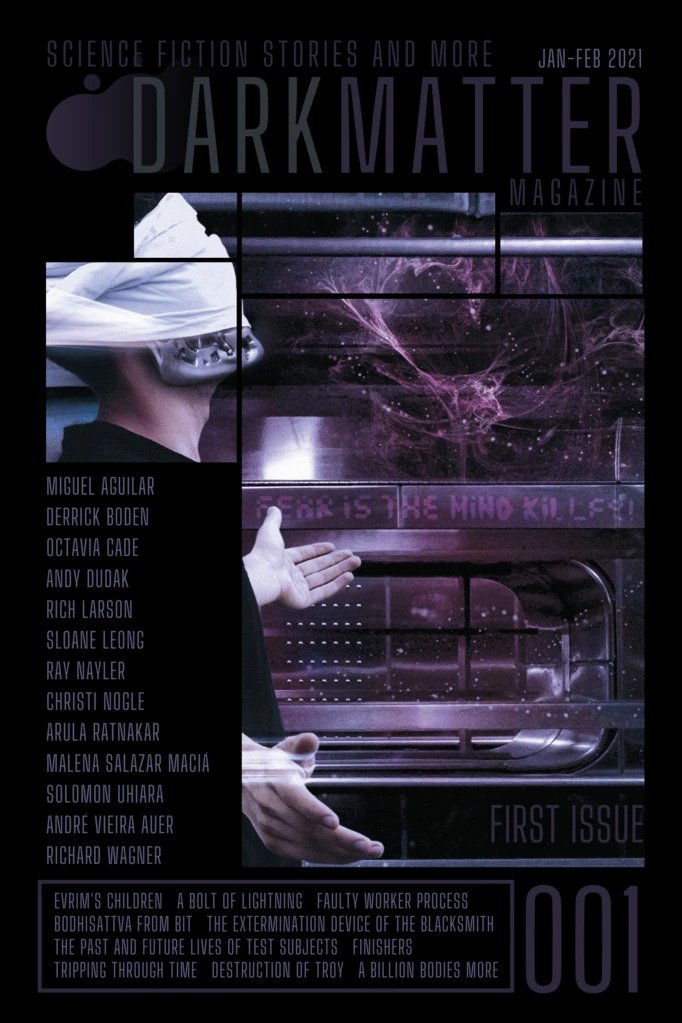
I have a new story out! And it’s fucking terrible. I don’t say that lightly. The story itself is well-written and decently constructed, don’t get me wrong. I’m not fishing for affirmation of my writing ability. But the subject is monstrous. It’s also, unfortunately, drawn entirely from fact. “The Past and Future Lives of Test Subjects”, available in issue 1 of Dark Matter Magazine, is about the Tuskegee Syphilis Experiments.

Those experiments, should you be so fortunate to have never heard of them, comprised a 40 year study in which the United States Public Health Service oversaw the “treatment” of syphilis in a study group of Black men. I say “treatment,” because although these men were told they were receiving medical care they really weren’t. The purpose of the study was to monitor the progression of untreated syphilis in the human body, and of course there’s no-one alive who would volunteer to the be the subject of that experiment, but the Public Health Service decided to go ahead and experiment anyway and not bother with any of those nasty consent issues.

This is the darkest story I’ve ever written. The people who ran this study were deeply, violently racist, and they clearly had absolutely no ethics at all, so be warned if you choose to read. You may prefer the accompanying essay, which I’m pleased to say Dark Matter also chose to publish in the same issue. “The Past and Future Lives of Scientists” goes into greater detail of the experiments in question, and places them within the ethical context of past failure and future necessity.

SFF, Short stories

Come Water, Be One of Us

I have a new story out! My last story of the year. It’s called “Come Water, Be One of Us,” and it’s free to read at Strange Horizons, just click on the link.

This is a story inspired by true events. As the wee paragraph at the beginning says, back in 2017, the New Zealand Parliament recognised the Whanganui River as a legal person. You might think that sounds strange, but I’ve long been irritated by the legal fiction that corporations are people when they clearly fucking aren’t. Making rivers legal people as well redresses the balance – and takes into account indigenous beliefs about the personhood of the river in question. And this isn’t just a Kiwi thing. Not long after the NZ Parliament did its bit, the Ganges and Yamuna Rivers in India, and the Rio Atrato in Colombia were also made legal people by the respective governments of those countries. (And it’s not just rivers. At least one mountain here in NZ has been accorded the same status.)

I like the idea of making ecosystems legal people. It gives another layer of protection, and if you know anything about the state of rivers in NZ, you know they need all the protection they can get. But it’s also, in its way, a potential pushback against the ridiculous idea that corporations have the same legal protections as you and me. Those fucking things are not alive. I don’t care how much you love Amazon. It is not an ecosystem like the South American river, and Apple didn’t grow on any bloody tree. They are not alive.

It really annoys me. So I used the idea of rivers, fighting back against the corporations, because what is a person, really? I’m so glad that Strange Horizons bought this story. I had a feeling it was right up their alley – occasionally, when you write a story, you just know it’s a good fit for a particular market. And they got Galen Dara to illustrate it. Galen Dara!!! Author achievement unlocked right there, I tell you. Just look at it. Isn’t it beautiful?

Horror, Short stories

Imago

I have a new story out! And I blame Animal Planet. It’s entirely their fault. There I was, blamelessly flicking through channels on the telly, and there was a documentary on cicadas. And not just any cicadas – if I wanted just any cicadas, I could see lots of them in the back garden. (I’ve admired their split skins since I was a kid.) No, this was about periodical cicadas. Apparently, over in the US, there’s a type of cicada that swarms every 13 or 17 years. The next swarm, all those years later, is laid by the previous swarm, and all I could think as I watched this programme was “I could make a great horror story out of this!”

So, there you have it. Blame Animal Planet. This weird, gross, insect-filled body horror was inspired by them. Poor things, they probably thought they were sharing scientific and educational information, real learning opportunities. Little did they know, across the other side of world a horror writer was trawling for bait.

I kind of disgusted myself with it, apparently. I certainly made a couple of writer colleagues who were kind enough to read an early draft retch. Apparently they dislike the egg part. Ha.

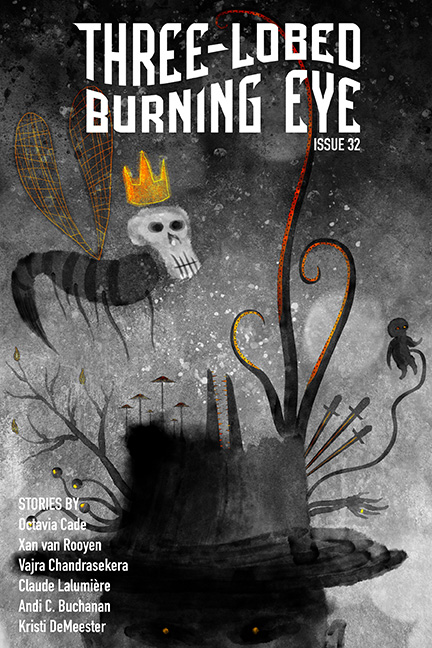
Anyway, “Imago” is free to read at Three-Lobed Burning Eye. If your stomach’s strong enough, that is.

SFF, Short stories

The Science of Pacific Apocalypse

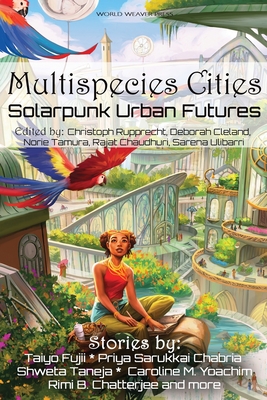
I have a new story out! “The Science of Pacific Apocalypse” appears in Rebuilding Tomorrow, which is the follow-up anthology to Defying Doomsday. I actually had a story in Defying Doomsday, which was an awesome anthology focused around the experience of disabled people in the apocalypse. The positive experiences, I should say – the idea was that a history of having to adapt to non-ideal circumstances would actively help disabled people both survive apocalypse and contribute to the survival of others as well. The story I had in that was called “Portobello Blind” and it centred around the experiences of Anna, a 14 year old blind girl left to fend for herself in the abandoned Portobello marine laboratory in Dunedin. (I did some grad work at that lab, so was very familiar with it and its cursed HPLC machine. I do not have fond memories of that machine.) Anyway, Anna managed to survive quite handily, and was engaged in scientific research of her own, monitoring the colonisation rates of shellfish, when her satellite radio picked up calls from other survivors… scientists coming in from distant field research, having escaped the plague that killed nearly everyone else.

So when I got an email from Tsana Dolichva, the editor of both Doomsday and Rebuilding Tomorrow, to ask if I’d write a follow-up to “Portobello Blind,” set some ten years afterwards, of course I said yes. And everyone laughs when I say this, but my story ended up focusing around rebuilding academic publishing after the apocalypse. Anna, now editor as well as scientist, and part of a surviving society that is almost entirely scientists – all those field workers, coming back – doesn’t want more of the same. (If you’ve ever had to read a scientific paper, or any other academic paper for that matter, you’ll know why. They suck the joy out of research.) And because she listens to science more than she reads it, Anna has a vested interest – and a clear advantage – when it comes to making science more accessible for everyone.

Yes, my PhD is in science communication. Why do you ask?