Horror, SFF, Short stories

Seedling

After seven years of submissions, I’m delighted to say that I finally, finally, have a story in Fantasy & Science Fiction. It has taken a long time, and some of the stories I sent there were very good and were published in other markets, but F&SF is one of those bucket list magazines for speculative writers, and they get a heap of excellent stories every single day, so it’s no surprise that it takes persistence to succeed there. Well, persistence I have.

The story that finally got me there was a flash piece about fairy tales and cake. “Seedling” was inspired by the Hansel and Gretel story, which has the dubious distinction of being one of the fairy tales that has typically interested me the least, as well as being the fairy tale that most inspired every childhood birthday cake. My parents had the old birthday cake book from Women’s Weekly that every New Zealand family had at one point, I’m sure, and there are a lot of delightful cakes in there but, as a kid, nearly every year I picked the gingerbread cottage because it had a roof covered in Pebbles and the whole thing was just marvelous. That’s about the only thing I care about in the Hansel and Gretel story: that cottage made of cake, like a sugary angler fish in the middle of the forest.

Except in this story, it’s not the cottage that’s made of cake. Because if you’re trying to camouflage predation in a forest, surely a better option is baumkuchen…

I never had baumkuchen for a birthday cake. It’s on my baking bucket list, though.

Papers, Science, SFF

Tardigrades and Star Trek

I have a new paper out! “Ethics, Experimentalism, and Hybrid Purpose: Navigating Science and the Military in Star Trek: Discovery” is out in the latest issue of Interdisciplinary Literary Studies. Sometime last year I saw their call for papers for a special issue on hybridity in Star Trek, and as I’m on a mission to eventually write papers on all my beloved books and media, I knew I had to submit to it. And the I remembered the tardigrade storyline of Discovery’s first season. I remembered, as well, the Manhattan Project, a period of science history that I find endlessly fascinating, and I knew how I could lump the two together.

The Manhattan Project had an interesting organisational structure, with two effective heads: General Groves, who represented the military, and J. Robert Oppenheimer, who represented the scientists. This structure was something that could be clearly mapped onto the tardigrade storyline, hence the following abstract:

In “Context Is for Kings,” “The Butcher’s Knife Cares Not for the Lamb’s Cry,” and “Choose Your Pain,” three season one episodes of Star Trek: Discovery, the hybrid nature of Starfleet becomes apparent when its scientists come into conflict with its soldiers. The order to treat a potentially sentient tardigrade-like creature as a military resource, subject to what is essentially slavery and vivisection, makes scientific ethics subject to strategic value. In each episode, a separate pairing between scientist and soldier develops, which both critiques the competing philosophies and acts as a metaphor for historical conflicts of this kind.

SFF, Short stories

Metamorphosis

I have a new story out! And it’s basically a love letter to insects. You can find “Metamorphosis” in the latest anthology from Parsec Ink, Triangulation: Habitats. When I saw their call for stories themed around sustainable housing, I knew it was an anthology that I wanted to submit to.

Sustainable housing, you say. Where do insects come into that? Well, “Metamorphosis” is about green roofs, which can increase biodiversity by increasing habitats for insects, among other organisms. But “Metamorphosis” isn’t just about green roofs. It’s about cockroaches and transformation. The title has probably given you a clue. If you’ve read Kafka’s story of the same name, about a man who turns into a cockroach, you’ll have found the connection. In my story, Gregor’s sister Grete, who couldn’t stand her brother when he was a cockroach, is now a primary school teacher in New Zealand. (Gregor gets to be a cockroach. Grete gets to be immortal. She has the better deal.) Anyway, Grete’s teaching kids about green roofs and how good they are for insects, which means that she has to grapple with the fact that her relationship with cockroaches is… difficult.

Sometimes you have to learn appreciation for revolting things. I was surprised to find, when researching Kafka’s original story, that Gregor was never specifically a cockroach. The insect he turned into was left unnamed, but so widespread is the revulsion for cockroaches that readers just assumed that was what he was. Which is both funny and tragic, because it’s not the fault of the cockroaches that, like Grete, I find them so viscerally disgusting.

Maybe habitat building can improve them.


Poetry, Science

Radioactivity

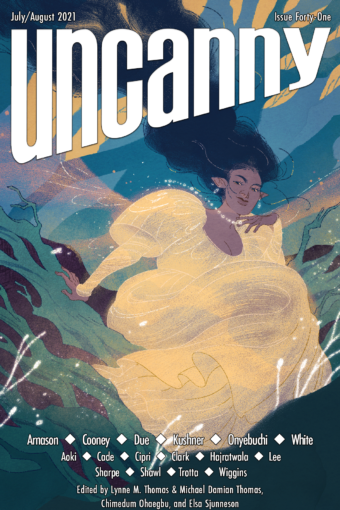
I have a new poem out! To be perfectly honest it came out a couple of months ago, but I’m behind on updating the website, so I suppose if you haven’t come across said poem yet it’s new to you. Anyway, “Radioactivity” is free to read in the wonderful Uncanny Magazine. I’ve sold to Uncanny before, but never a poem, so it’s lovely to be in there again, and in a different form.

“Radioactivity” is a poem about Marie Curie. She’s a scientist I have always admired, and let’s face it, when you think of the history of women in science she’s at the very top, or close to it. My favourite story about her is referenced briefly in the poem. It’s about her cookbook. Now, when Marie was researching radiation, it was the big new thing in science and no-one really understood that it wasn’t the best idea to shove highly radioactive material in your pockets and handle it with bare hands and so on. But Marie had her hands and her pockets, and when she finished working in the lab for the day she’d go home and cook her family dinner, and when she did the radioactive material that was smeared all over her fingers transferred to the pages of her cookbook, as she flipped through it looking for recipes. That cookbook still exists. It’s in the Bibliothèque nationale de France, and to this day it’s so radioactive that it needs to be kept in a lead-lined box.

I love that story. It makes Curie seem so utterly human… as does, I hope, the rest of the poem.

Novels, SFF

The Stone Wētā wins SJV

I’m happy to say The Stone Wētā has won the Sir Julius Vogel Award for best novel! The SJVs are Aotearoa New Zealand’s annual awards for achievement in speculative fiction, so I’m very thankful to everyone who voted for it. Climate fiction is an increasingly notable part of science fiction, and it’s fantastic to have it be represented like this, as climate change is, I feel very strongly, the defining issue of this century.

I’d like to mention, too, some of the other work that was celebrated. To start with, of course, congratulations should go to the other writers who were also nominated for best novel. They were Drew Bryenton for Gad’s Army, B.T. Keaton for Transference, A.J. Lancaster for The Court of Mortals, and Dan Rabarts and Lee Murray for Blood of the Sun. What a fantastic field to be a part of! The other SJV categories were equally well represented, but special mention should go to A.J. Fitzwater for winning both best novella (for No Man’s Land) and best collection (for The Voyages of Cinrak the Dapper) and Casey Lucas, who took out the best short story award for the incredible “For Want of Human Parts.” Finally, I was pleased to see Cassie Hart awarded for her Services to Science Fiction, Fantasy and Horror.

The Aotearoa New Zealand speculative community is small but wonderfully talented, and it’s fantastic to have such a pool of supportive and creative people to share pages with. Thank you all! Thank you, especially, to publisher Marie Hodgkinson at Paper Road Press, and the amazing cover artist Emma Weakley, for all their work on the book.