SFF, Short stories

Responsibility

at the edgeI have a new story out! “Responsibility”, aka “The Story About The Zombie Chickens (I Can’t Believe Anyone Bought This)” is out in the anthology At The Edge from Paper Road Press.

At The Edge is largely a collection of stories from New Zealand and Australian writers, themed around edges and boundaries and liminality. When I saw the call for submissions last year, I knew it was something I wanted to write for. And luckily my story was accepted!

Though it has to be said, “Responsibility” is not the kind of story I usually write. For one thing, it’s about zombies. They’re not something I generally gravitate to, but I suppose everyone’s got a zombie story in them somewhere and this is mine. For another, it’s very black-humoured – well, a lot of people seem to find it funny anyway, and I’m not a funny writer in general. Sad and morbid, maybe, but not funny. And I’m embarrassed to say that, zombies aside, it’s based on a true story. A few years back I ended up pet-sitting for my sister while she went overseas for a month. At the time she had two dogs and two cats and six chickens, and she was barely out the door before one of the chooks keeled over. I found it dead in the coop, in classic position: on its back, with rigid little feet in the air.

I buried it under her front lawn. I tried to bury it discreetly at the edges under bushes, but everywhere I dug saw me hit a polythene layer under the sod so I gave up and middle of the lawn it was (it serves my sister right for being a decent gardener). That night there was a storm, and after watching a horror film I was tucked in bed, listening to the thunder and wondering if the chicken was really dead. Sample internal conversation: “Self, are you sure you didn’t bury that poor thing alive?” “Self, it had rigor mortis.” “But Self, are you certain it wasn’t just chilled and unconscious?! It was sick, after all.”

Yes, I know, but I freaked myself out sufficiently that I scuttled out into the storm, in my nightie, to roll a giant planter over the top of the grave, just in case this bloody chicken decided to crawl out of its two foot deep hole and come seeking revenge.

Of course it ended up a story.

We were born at the same time, my sister and I, born into bodies of opposites. Yet for all that we love each other, though her touch means death and mine does not. Though her house is full of zombies and mine is full of life. But sisterhood comes with responsibility and with care, so when she asks if I will house-sit for her while she goes from Auckland to New Orleans, to speak at conferences of deaths that are not her own, deaths that are dry-toothed while hers run with red, with soft and sinking flesh, I agree.

Winter’s house is filled with tetrodotoxin and datura. Dried puffer fish hang from the kitchen ceiling and the benches are littered with pestles. There are two dogs that were schnauzers once, two cats who slink in silence, and six chickens in the pen, their feathers dull and drooping but they all eat from her hand with relish and fight over finger bones…

At The Edge (and the rest of the story) can be found at Amazon or Paper Road Press.

SFF, Short stories

Portobello Blind

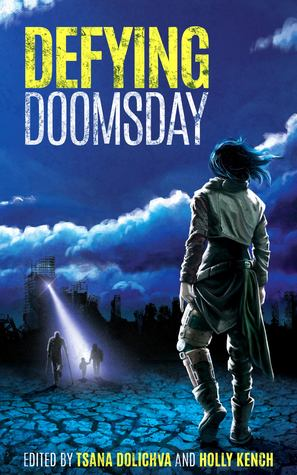
doomsdayI have a new story out! It’s in the anthology Defying Doomsday from Twelfth Planet Press, which is edited by Tsana Dolichva and Holly Kench. As you can probably guess, it’s a collection of apocalyptic/post-apocalyptic short fiction, but with a twist: in each story, the protagonist is disabled.

If you’ve ever paid much attention to this sub-genre, you’ll recall that disabled characters, when they exist, exist pretty much solely to die early on. An illustration of edge and cruelty, and all so very realistic (and that’s a loaded descriptor in genre fiction, one that’s continually applied only to some circumstances and not to others). But if you’re used to navigating a hostile world, to constantly being at a disadvantage, who’s to say you can’t use these skills to good effect when disaster hits?

Anna, the protagonist of my story “Portobello Blind”, is, as the title suggests, blind. She’s also 14 years old, and stuck alone at the fairly isolated Portobello Marine Laboratory, Dunedin, after her father leaves to find supplies and never comes back. Now the Portobello lab is a real place – I did some grad work on algae there – and while it has a nice big break room with food in the fridge that food can’t last forever, and Anna understands pretty quick that she has to find a way to feed herself if she wants to stay alive…

The worst part of the apocalypse was the sheer bloody boredom of it.

Anna had never expected to be the – apparently – sole survivor of a quick and dirty plague, but if she had, her expectations would have been different. All the apocalypse stories she knew had conflict and danger and high stakes, arenas and journeys and great symphonic soundtracks.

Anna spent hers fishing.

You can pick up a copy of Defying Doomsday at Amazon, or any other number of places.

KiwiWalks

Dunedin Heritage Walks

I spent many years at university down in Dunedin, so technically I’ve walked every bit of these walks already. But there I was, flipping through the utterly delightful 1001 Walks You Must Experience Before You Die, and there they were: the Dunedin Heritage Walks.

They’re not very long, less than an hour each. Both of them start and end in the Octagon, which is Dunedin’s version of the town square, a place where I’ve spent many happy hours, mostly drinking. And each walk wanders round the oldest buildings of the city, built way back when Dunedin was the richest city in the country, courtesy of the nineteenth century Otago gold rush.

So last weekend I happened to be back down in Dunedin, attending a conference there (I gave a paper on the presentation of science in a couple of second season episodes of The West Wing). And on Saturday morning, after the conference, I had a few hours to kill before flying home and there was a southern miracle: sunshine on a winter’s day! It was even warm. So I picked up the relevant pamphlet from the information centre and went and did the Heritage Walks officially instead of technically. It was basically a hunt for those little historic plaques on the sides of buildings I was already familiar with, but the walks were very pleasant nonetheless. And I was pleased to see that Dunedin’s being covered in murals – like the one of a moa, by an artist called Phlegm. Another detail I’ve never seen before is one of the stained glass windows in the cathedral, which refers to the local environment, being filled with seals and yellow-eyed penguins and other organisms rarely seen inside a church.

Current Count: 996 Walks To Experience Before I Die.

Novellas, Science, SFF

The Ghost of Matter wins SJV!!!

ghost-of-matter_cover_medThis last weekend was New Zealand’s national science fiction convention, Au Contraire. It’s also when the Sir Julius Vogel Awards are held. The Ghost of Matter was nominated for best novelette/novella, and I’m pleased to say that it won!

I was so convinced it wouldn’t that I hadn’t prepared anything to say, and had to stumble to the front to receive the trophy before gaping hopelessly at the audience. I don’t think I was very coherent, but at least I was brief. If it wasn’t clear then, I shared the category with five other fantastic stories, and any one of them could have won. Thanks are due to my editor Marie at Paper Road Press, who helped turn the draft into something a little more well-considered. I’m happy to report that the Shortcuts collection, of which The Ghost of Matter is a part, also won best collection, as well as best artwork for Casey Bailey’s amazing cover.

If you haven’t read it, The Ghost of Matter is about New Zealand’s most famous scientist, Ernest Rutherford. There’s an excerpt available free to read at Paper Road Press, and it’s available to buy there and at Amazon.

Poetry, Science, SFF, Short stories

Carnival Microbial

grendelsongI’ve a new story out!

Carnival Microbial” is free to read in the latest issue of Grendelsong. It’s creepy, creepy science: a circus where the performers are all microbes. Specifically, horrible diseases: Scarlet Fever as a trapeze artist, Tetanus as a human blockhead, and so on. Sandwiched in the middle of this little prose-poetry collection is the freak show… a caravan of historical microbiologists, of deadly bacteriologists. And when Smallpox gets a little too close to Edward Jenner’s cage, the Carnival is out a ringmaster and the microbes have to go about selecting a replacement.

It’s weird biological fantasy, essentially. Now usually my biological preferences fall to plants, but I like talking about science in interesting ways, and there’s more to science than seagrass.

And talking of Jenner, here’s his excerpt. You can read the entire strange thing at the above link if you’re interested.

Edward Jenner: has a cowhide on his wall, stretched tight in four directions and with the feet cut off. The cow’s name is – was – Blossom.

has a milkmaid with poxy hands and otherwise perfect skin, who sings as she squeezes and believes all the tales her mother told her. Her name is Sarah.

has a garden, and a gardener who raises kids as well as cabbages and carnations and chances. The child’s name is James: he is eight years old, with skinned knees, and can be trusted not to make a fuss.

has a scalpel, to scrape the pus from milky hands, to open up the freckled skin with slices and supplement with smallpox. The scalpel doesn’t have a name. Tools very often don’t – or so Blossom and Sarah and Jamie would say, all innocent, as if their opinions mattered to anyone.