Papers, Science, SFF

Microbiology and Microcosms

I have a new paper out! It’s in Surreal Entanglements: Essays on Jeff VanderMeer’s Fiction, edited by Louise Economides and Laura Shackelford, published by Routledge. The paper’s called “Microbiology and Microcosms: Ecosystem and the Body in Shriek: An Afterword.” Which is a fancy way of saying that I’m talking about the human microbiome, the plethora of different species that live in and on the human body. Most of my academic work seems to sit in the intersection between science and speculative fiction, and this is another example of that.

Shriek: An Afterword is one of the Ambergris books; a series in which VanderMeer explores the city of Ambergris, which is the home of both humans and a fungal species called the gray caps. Fungus contaminates in Ambergris, and Duncan Shriek, one of the primary characters of the book, is slowly turning to fungus himself. Which made me think of the human microbiome, and how we are already host to fungal organisms – you and I and everyone have fungi living inside us as a matter of course, and so Shriek’s transformation is a sort of speculative extension of existing biology. It causes him – and everyone around him – to reassess his identity, and that reassessment is something that the human microbiome is prompting as well. We so often think of a human as being a singular organism, when we really are not. In reality, that apparently singular organism is more of a colony than anything else! How this impacts on the way that we think about ourselves is something I find just fascinating, and it’s that which prompted the essay.

Nonfiction, Papers, SFF

Humans as Ecological Actors in Post-Apocalyptic Literature

I have a new paper out! “Humans as Ecological Actors in Post-Apocalyptic Literature” has been published in MOSF Journal of Science Fiction, in their special issue on environmental SF. This is also the first paper I’ve ever co-written, and my fellow author is Meryl Stenhouse. It was a really enjoyable writing experience, so I think we’re going to work together again once we can figure out our next topic!

Post-apocalyptic literature is frequently environmental in nature, or explores significant ecological impacts. These affect the surviving human and nonhuman populations, and are characterised by scale. While some of the apocalypses of science fiction literature are limited to the destruction of a single species – as occurs, for instance, in P.D. James’ The Children of Men – others, such as Cormac McCarthy’s The Road, illustrate an environmental collapse that destroys entire ecosystems.

Human response to apocalypse occurs on both an individual and a communal level, but that response, within the literature, tends to focus more often on social or economic consequences. However, the ability of humans to further shape their natural environment tends to be heightened in environmental apocalypse, as compromised ecologies become ever more vulnerable to human activity. The ability of humans to function as ecological actors, as shapers of surviving ecologies, is therefore not only a fundamental – if frequently underexplored – part of that narrative, but it also indicates potential pathways for real-life response to ecological apocalypse.

Notable, in the post-apocalyptic narratives explored in this paper, is how the impact of human behaviour on environment is dependent on apocalyptic scale. The construction of refugia, the realignment of surviving communities to sustainable practices, and the increasingly destructive human presence on ecologies incapable of reclamation contrasts with, for example, the increasing nonhuman biodiversity that can follow the widespread destruction of the human population.

Nonfiction, Papers, SFF

Confronting the Minotaur

I have a new paper out! “Confronting the Minotaur: Gender, Reconciliation, and the Labyrinth in Fantasy Literature” has been published by BFS Journal.

I love labyrinths, I really do. They pop up a lot in fantasy lit, and I’m always glad to see them. They always seem more exciting in fantasy than in real life, but such is the case for a number of settings, I’m sure. Anyway, over the years I’ve noted a number of variations related to gender: who solves the labyrinth, who’s settled in the middle of it, that sort of thing. One of the archetypal stories is of course that of Theseus, who – with the help of Ariadne – solves the labyrinth to confront the monstrous devouring Minotaur at the centre of it. If we take this as a basic pattern (albeit one that rests primarily on the European tradition of labyrinths, as opposed to those traditions from other parts of the world) we can see how such patterns are repeated in, for example, Ursula K. Le Guin’s The Tombs of Atuan and J.R.R. Tolkien’s The Hobbit and The Lord of the Rings. Whether the maze is made out of underground tunnels or the dead marshes, the risk of being eaten or otherwise swallowed up is significant. Does this pattern change, however, when the solver of the labyrinth is female? Meredith Ann Pierce’s The Darkangel is an interesting contrast here, where the monstrous devourer exists outside the labyrinth, and the centre is a place of science and safety.

I tinkered with this paper on and off for well over a decade, so I’m glad it’s finally been published. Let me know what you think!

Horror, Papers

Moonlight and Silver Bullets

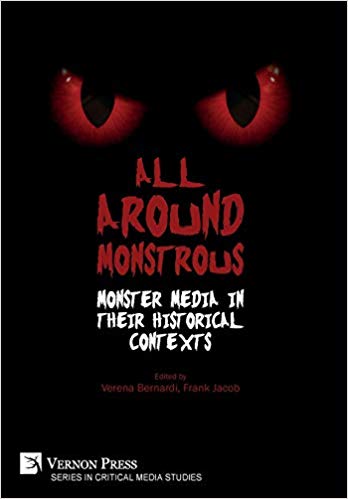
I have a new academic chapter out! “Moonlight and Silver Bullets: Twentieth Century Racial Purity in Werewolf Films” has been published in All Around Monstrous: Monster Media in Their Historical Contexts, edited by Verena Bernardi and Frank Jacob. It’s out from Vernon Press now.

I love werewolf films. It’s a good thing I do, because there are a lot of them. Over 300 at last count – the first one dating from as early as 1913. But here’s the thing: go out into the street and accost ten random strangers. Ask them first how they would recognise a werewolf. Then ask them what kills a werewolf. Odds are, you’ll get the same answers from all ten people. Werewolves turn at the full moon, and they can be killed with a silver bullet.

Yet if you go back and look at werewolf mythology – and it’s been around for thousands of years – you’ll find that silver and moonlight make up tiny fractions of that mythology. Seriously, they may as well be footnotes they’re that minor in the scheme of things. So why have these minor elements of the myth come to be so widely held? Well, go back to the werewolf films and see when things begin to change. Up until the period around WW2, there’s a lot more variation in imagery. Enter The Wolf Man in 1941, and suddenly things begin to coalesce. Not all at once, but that’s the turning point. It could be that this was just a great film that made a lasting impact. But WW2, sadly, was also a time when eugenics began to rear its ugly head, specifically with regard to the nasty spectre of racial purity. And quite apart from werewolves, both moonlight and silver have long associations with purity. How do you recognise a werewolf? His mixed and beastly nature shows under pure light. How do you kill a werewolf? Hit him with a purity bullet, and it might kill him, but his dead body will turn back to its uncontaminated human form.

It’s very very nasty, and it may well be unconscious on the part of film makers and consumers, but the correlation – especially in the context of the times – is there.

Papers, SFF

Sacrifice in Susan Cooper’s “The Dark Is Rising” Sequence

I’ve a new paper out! And it’s on a book series that is close to my heart: The Dark Is Rising series by Susan Cooper, which was the fantasy staple of my childhood. I don’t know how many times I read The Grey King as a kid, but it was a lot. I think as an adult it’s been replaced by The Dark Is Rising volume as my favourite of the series, but it’s a close thing. I still read through all five books at least once a year, generally around Christmas, and I always get something new out of them.

You can imagine, then, just how thrilled I am to have a paper out on it. Cooper’s got some really interesting examples of sacrifice that pop up over and over again in the series, all of them quite distinct from the others, and that’s what I look at in my paper. “Sacrifice in Susan Cooper’s The Dark Is Rising Sequence” is out in issue #19 of BFS Journal. It focuses on what exactly makes a sacrifice: how knowledge and intent work together (or don’t) to form different types of sacrifice, and how the sacrifices made differ between mortal and immortal figures.

We’re used to seeing grand sacrifices in fantasy literature, but so much of the story Cooper tells hinges on the small quiet choices of characters like Jane Drew and John Rowlands, and for me these are often more compelling. These two characters are particularly small and mortal compared to the more supernatural, the more mythological, figures in the text, and it stands to reason that their actions are comparatively small and human, but they’re no less effective – and no less crucial – for all that.