Reviews, Science, SFF, Short stories

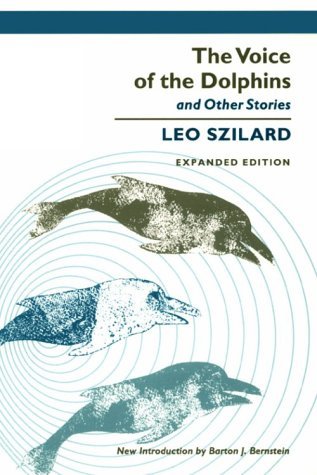
Review: “The Voice of the Dolphins” by Leo Szilard

szilardThe Voice of the Dolphins and Other Stories (Expanded Edition)

By Leo Szilard

Published by Stanford University Press, 1992

#

I admit, I’ve always had an interest in the Manhattan Project. It’s a fascinating period of history – as part of my PhD research, I went on a trip to Los Alamos to write a collection of poetry based around the Project’s wartime work. Thus, I’m already familiar with Szilard – arguably the man who more than anyone else saw the potential of (and the potential horror of) atomic war, and realised the need for Allied research. It was Szilard who went to Einstein, who wrote with him the letter to Roosevelt that kickstarted the Manhattan Project. He also drafted the petition that argued for a bloodless demonstration of the atomic bomb as a means of ending the war, rather than its ultimate use on the cities of Hiroshima and Nagasaki.

Knowing this, I wonder if I would have recognised the author of this collection, had I found it with the author’s name whited out. I can’t honestly say that I would – but I would have been close, I think. The Voice of the Dolphins is not a work written by what I would call a “natural writer” – someone whose prime concern is the linking together of word and image, someone concerned with the aesthetics of a sentence. For someone who is so associated with the written word – with letters and petitions – Szilard doesn’t have a great deal of fluidity in his language. Of course, he was multilingual where I am not so that is perhaps an ungenerous assessment.

That being said: if this book had come to me, apparently authorless, it wouldn’t be hard to perceive the kind of man who wrote it. The concern with failure is so profound, the nuclear issue so pronounced, that it’s easy to see in its pages the stamp of someone who could have been involved in the Manhattan Project. Add to that the historical context of the stories – so concerned with the Cold War, with the relationship between Russia and the USA – that the provenance is almost certain.

Szilard tried to publish some of the stories in this collection in fictional and non-fictional fora. Once one reads “The Voice of the Dolphins” it’s clear why. Having failed to prevent war-time use of the atomic bomb, Szilard is trying to develop a blueprint of a global community where nuclear weapons can be limited in their use, where the international debate over their use becomes a catalyst for peace. Some of it, looking back, seems almost pitifully naive: the insistence that a nuclear power give two weeks’ notice of intent to the city that they plan to bomb, so that the inhabitants of that may safely evacuate. Reading that now seems almost laughable… but then I thought of Szilard, writing desperately away until his hand cramped, trying to find a way out of the maze that he himself conceived and helped to build. I thought of how (as described in Bernstein’s comprehensive introduction) he sent copies of that story to a number of American officials and politicians, how he had the story translated into Russian so that he could get it to Khruschev… the poor man. You could weep for him, you really could.

It’s not a large collection, only six stories. A couple of them are more typically science fiction, regarding alien perceptions of Earth under/after a global nuclear war that at least in “Report on Grand Central Terminal” has left the planet bereft of human life. “Xram thinks that there had been a war fought between inhabitants of the two continents, in which both sides were victorious” (145).

Once can infer that this is Szilard’s nightmare, the end-point of his work, wrought all too well – and all too necessarily, to make the fear of it just that much more bitter. No matter how Szilard must have dreaded the possible nuclear future he helped to build, he also knew that such a future was coming, and better it not come at the hands of the Nazis. Such are our choices made: easy choices, and easy to be right in. (To be wrong in.)

The bulk of the remaining stories – including “The Voice of the Dolphins”, the largest and most significant of all the pieces – outline ways to avoid this future, the lack of it, the alien curiosity. They are, essentially, alternate histories. In “Dolphins”, there is a scientific breakthrough: communication between humans and dolphins is ostensibly established, and the latter are found to be clearly and deeply intelligent. The dolphins then guide humanity through political and scientific changes that ameliorate the risk of nuclear way and eventually lead to global peace and prosperity. The interest here is in Szilard’s hypothetical sequence of events – and it very nearly is a simple sequence. As I commented above, one should not look for a particularly literary value here. The value lies in the historical context, in the thought experiment of a great thinker, set in the environment caused by his life’s work.

Reviews

Review: “The Time Roads” by Beth Bernobich

the-time-roadsTime was like sunlight pouring in all directions, susceptible to prisms or mirrors, or even a child’s hand.”

I can’t deny it: I’ve been waiting for this one for a while. I find the idea of time travel a fascinating one. It’s pure speculation, in a genre known for it.

The Time Roads takes an interesting approach, both structurally and in-story. It’s not a novel so much as four intertwined novellas, taking place over a 17 year period and in different time streams. This is something that could be confusing for readers, but I appreciate the fact that Bernobich doesn’t cut down into chunks. She expects the reader to follow along, and given that I don’t enjoy being pandered to and explained at this gets extra marks from me.

The novellas are set in an alternate political history, one where the relationship between Ireland and Britain has been flipped. Ireland is a great power, and is experiencing (ever more) trouble with its dependencies across the water. This is set against a wider backdrop – both continental and global – of shifting governments and loyalties.

The Golden Octopus (beginning in 1897, but spanning several years) starts things off, with the introduction of Áine, the Queen of Ireland and the commander of her guard, Aidrean. While the latter is off investigating a series of murders, the young Áine is fascinated with the scientist-mathematician Breandan, who is researching his way to viable time travel. A Flight of Numbers Fantastique Strange (1902) explores the murder investigation from another perspective. I won’t spoil the ending, but suffice to say by the time it’s all done the timeline has shifted. Ars Memoriae (1904) returns to Aidrean, who’s sent off to the continent to investigate various plots and treacheries, and it’s here the possibility of altered universes becomes a political tool rather than a personal quest. Finally, back in Ireland – The Time Roads (1914) – Áine is dealing with Anglian rebellion, where politics and time travel are making a giant, murderous mess of her country.

Of particular interest is Bernobich’s conception of altered time – particularly the fact that when time changes, memories of the (alternate) life intrude on the individual as he or she goes about their business. This, as one might imagine, is a highly disconcerting occurrence. It’s the kind of thing that could make one doubt their sanity – but it also allows the characters extra knowledge with which to navigate cause and effect. And to compare their lives before and after, as it were.

One of the characters that strikes me here is Ó Cadhla. An advisor of Áine’s, he’s very much the gruff old uncle figure. He also has a dead daughter, Maeve, who is “resurrected” when timelines shift. Well, good. We see his grief, we feel for him, but everything gets fixed – in his world, anyway. I can’t help but wonder about the parents, if there are any, who have the memories of a live child and the reality of a dead one. What would they do to get hold of a time machine and alter their reality? Unsurprising, then, that personal motive – saving of parents rather than child – is a factor. Push down on one end of a see-saw, and the other end come up.

This emphasis on hinted-at possibilities, in the roads-not-taken, can also be seen relationship between Áine and Aidrean. This is in some ways fundamental to the book as a whole. It’s the strand that ties the novellas together – more so than the time travel to my mind. And yet it reflects that travel thematically: it is a relationship of potential. Implicit in it is the idea of possibility, of different paths and lost potential as their mutual attraction simmers away but never quite comes to fruition. I don’t say this as a criticism. It isn’t. The Golden Octopus seemed to hint at the possibility of a love triangle with Áine and Aidrean at two of the corners, but I’m delighted to say no such thing occurred. I suspected it would. I had girded myself to read through it anyway – but the thing about relationships is that potential frequently goes unfulfilled. It’s a subversion of expectation, but one where the reader is left wondering – very much despite herself – what if? In a book where timelines shift on what if, this is a good and subtle touch.

In one way, I would define The Time Roads as a study in dualities. There are more than two time streams, more than two people playing off each other, so this isn’t an accurate description really. Yet the narrative focus is on duality: duality set against a background of endless possibility, against calculations of probability. This is in some ways a consequence of form. Within the strictures of a novella one really has to focus on the meat of the story and not get side-tracked into dead ends that, no matter how interesting, detract in a limited word count.

This duality is most noticeable in A Flight of Numbers, concerning the character of Síomón. He is contrasted with his sister Gwen, with Aidrean, and finally with his own self. It’s the most effective of the four novellas, to my mind, as it’s simultaneously the most focused and the most emotive of the bunch. It’s not perfect, however – I would have liked a significant woman character who wasn’t a murder victim or consigned, with justification, to the madhouse.

One problem with fantasy set in historical periods is “Everything changes but the status of women”. You know: there’s magic and all sorts of strange new things, but there’s also women, staying in the same traditional roles because realism. Luckily, Bernobich doesn’t do this. In her alternate history, women are educated in tertiary institutions. They instruct there, they are, in Valerija’s case at least, in government (although not in the Irish government, it seems, apart from the Queen. All her advisors are male). A woman is even the religious head of Ireland, even if she’s only in a walk-on part.

True, A Flight of Numbers isn’t particularly well represented: Maeve and Susanna and Gwen are all mathematicians of one variety or another, which is promising: there seems to be an equality of education at least, even if it hasn’t percolated up and into government. Yet in one timeline, they’re barely mentioned. In the other, they’re either murdered or sent completely mad under the weight of numbers and brother and locked away in an asylum. Yet the other three novellas have significant female characters to balance this out, however, so the “Has Decent Women Characters” box gets a big tick from me. (I hope, in particular, that if Bernobich writes more in this universe I get to see more of Gwen. I find her especially fascinating.)

All in all, an interesting read. If I had to rate it, I’d say four stars out of five. I have to say I responded to it more intellectually than emotionally, but then that’s maths for you. The only maths I ever thought was beautiful was group theory, and there’s nothing of that in here. There is, however, an unusual look at time travel in a well-realised world, with plenty of subtle touches.

Disclaimer: I got a free copy of this book in exchange for an honest review.

Novellas, Reviews, SFF

Reviews and reproduction…

I’ve had two new short stories published in the last couple of weeks, both themed around reproduction.

The Absence of Feathers“, a mythological eco-fantasy, has been published in the latest free-to-read issue of Luna Station Quarterly. “Feathers” features the Morrigan and her adopted grand-daughter Einin, and what happens to them when all the birds disappear from the world.

“Vita Urbis”, published in Elektrik Milk Bath Press’ recent urban fantasy anthology Twisted Boulevard, is probably my favourite story. It took me seven years to write, mostly because there were darlings I didn’t want to kill, but the poor things got slaughtered in the end. It’s about an architect who is impregnated by a city, interspersed with scenes from classical mythology, where women were always getting knocked up by bulls or swans or showers of gold, though I hope I’ve given the women involved a bit more agency than Ovid did in his Metamorphoses, which was a major inspiration for this story. There’s also shades of Oz in there, and 1984, to give a bit more density and layering.

That both stories feature myth is no accident. They’re part of a collection I’m working on, called The Mythology of Salt (that being the title of a story of mine that was published in Strange Horizons last year). Salt is based around the idea of women and myth and the consequences of knowledge. There’s two or three more stories I’m planning on finishing up soon, and then hopefully Salt will be complete enough to sell.

Speaking of selling, there’s a couple of reviews of my novella, Trading Rosemary, that have come out recently. The Book Smugglers were very kind and particularly complimentary, and Locus also had some positive things to say. It’s so nice when that happens – Trading Rosemary is my first book, and it’s such a relief to know that people like it.

If anyone’s interested, I also did a guest blog about the novella over at Catherine Lundoff’s site. It was very kind of her to ask me (thanks, Catherine!), and I was pleased to do it.

Reviews, SFF

“The Chrysalids” – John Wyndham

John Wyndham, The Chrysalids. London: Penguin Books.

First published 1955.

chrysalidsJohn Wyndham’s The Chrysalids was one of the seminal books of my childhood. I first read it at about 10, and to this day I still read it every couple of months. There are passages I could probably recite from memory. What fascinated me about this book was partly the setting, and how comfortably it settled with New Zealand’s iconic anti-nuclear policy – in The Chrysalids, the mutated survivors of nuclear war headed towards New Zealand as a relatively pristine haven from the resulting environmental and social catastrophe.

It also introduced me to the idea of mutation – both biological and cultural. I didn’t recognise it in so many words when I first read the book (at ten years old, genetic mutation and social upheaval as such were still far in my mental future) but the idea that one sudden event could prompt an explosion within the human body, and the beginnings of a new type of human being… that was fascinating. What was even more fascinating was the way that this new type of human was treated – hunted down by the genetically pure, sterilised, and thrust out into the wilderness. The really creepy thing was that people would suddenly turn on their neighbours. We see this in the real world all the time – the Rwandan genocide is a particularly brutal example of a flash-point being reached, where neighbours are suddenly dehumanised due to social and cultural expectations of “us” and “other”.

If anything, The Chrysalids represented possibility, and that possibility continues to define the book for me: the idea of sudden and drastic genetic change – how it may have occurred in the past, how we have the capability to bring it about today, why we retain that ability, knowing what it can do… and how we would cope with any possible results.

Being raised in a non-religious family, The Chrysalids was my first real experience of the depths to which religion could be twisted to justify the inexplicable in order to make it understandable. How many could stand up against the need to find meaning after nuclear catastrophe, when scientific knowledge is lost and religion appears to provide a means of protection and escape – if only one can conform enough? This fear of difference and nonconformity – biological and intellectual – and the wholesale rooting out of these perceived spiritual imperfections is chilling. The child David’s dream about his father sacrificing his six-toed friend, Sophie, as he sacrificed a mutant calf is chilling, not just for the cruelty but for the indifference.

We all stood looking at her, and waiting. Presently she started to run from one person to another, imploring them to help her, but none of them moved, and none of their faces had any expression. My father started to walk towards her, the knife shining in his hand. Sophie grew frantic; she flitted from one unmoving person to another, tears running down her face …. He raised his other hand high, and as he swept it down the knife flashed in the light of the rising sun, just as it had flashed when he cut the calf’s throat… (28)

As horrible as this childish dream is, however, if pales to the later realisation of Sophie’s life as an adult – mutilated, sterilised, and thrust out into the radioactive Fringes as a child, as an adult still living there as the lover of a mutated spider-man who would throw her over in an instant for a woman who could give him children. (It appears that only the women were sterilised – male Blasphemies escaped that fate in one of Wyndham’s rare slips.) In her instinctive emotional understanding and her knowledge of her own limitations Sophie despairs: wisdom banished to the wilderness.

Wyndham is careful enough to emphasise the horror of this war-induced dystopia in two different ways. He refuses to make the dystopian community of Waknuk and its surrounds a homogenous set of people. David is exposed to the worst of it, as his father Joseph is a true and unrelenting bigot who is happy to crush his own family in the name of faith. Indirectly, this exposure also allows David to find the humanity in others – in his Aunt Harriet (who drowns her mutated infant and herself to escape having to give up her baby) he sees the possibility of an adult figure prioritising love over religion and its mandated conformity. As he ages, he sees more individuals who think this way, but they are always individuals – there is never the possibility of a community of the dispossessed. Purity of species overrides purity of heart, but even those entrusted with preserving the former can be decent enough to preserve some of the latter. The Inspector who condemns Sophie comforts David more than his father does.

The growing claustrophobia felt by David and his telepathic friends is real and immediate. Despite their abilities, they are powerless in a world of rigid power structures, where governments and individuals take pride in the power of being a true Norm. This takes its toll on them, who would share in that power without truly meriting it by the standards of their own community. They are betrayed by one of their own (and Anne is to be pitied as much as Sophie and Harriet), tortured, killed, and their leader left behind in anonymity as they escape to Zealand, where the new species is growing. As the most ordinary of the Chrysalids, David is the pivotal figure. He is neither as powerful as his little sister Petra, as practical and competent as his lover Rosalind, or as intelligent as Michael. All David has comes from his genetic makeup – his psychic abilities, his growing realisation of difference, and his legacy from his father. David is everyman as he wishes he could be. He is us.

It is that identification, that ordinariness, which provides the subtlest and most horrifying part of the book. For when the escaping Chrysalids are rescued by the Zealand airship, the pursuing Norms are killed – and the Zealander shows no remorse. Her evolutionary rationale for the destruction of inferior species is shocking – especially as the reader is left with no alternative but to accept that the Norms are inferior, and that in the coming struggle – far into the future, to be sure – they should lose, whether they are neighbours or not. In effect, the Zealanders are really no different to the Norms – they aim to preserve their species above all else. Both sides have privileged power above ethics – with some justification. But is some enough? David, who is like us ordinary in his extraordinariness, may dislike the reasoning of his new friend and may think fondly of some of his former family, but he is on his way to a new family, a new community, and his place in it promises to be as secure as his father’s is within the old. In effect, he has escaped his father only to take his place.

Genetics will out, one way or another.

Reviews, SFF

“Genesis” – Bernard Beckett

Bernard Beckett, Genesis, Dunedin: Longacre Press, 2006.

genesisTaking its cue from Plato’s Republic, and with more than a hint of George Orwell, Genesis outlines a world where society is split by genetic identity. In a future resulting from climate change, terrorism, the rise of religious fundamentalism and the onset of World War Three, New Zealand has cut itself off from the rest of the world. In the resulting closed society, a leader called Plato sets out the rules for the new community, rules that will prevent the chaos of the outside world from destroying NZ as it has destroyed the outside world – at least, that is what the reader is led to think. It’s never made quite plain as to the state of life outside NZ – initially, refugees try to enter NZ waters and are blown up by the army. (Anyone familiar with the state of the NZ military today knows that we are now solidly in the realm of science fiction.) After a while, there are less and less attempts. Does this mean that the need grows less, or that the refugees do? This is never made clear, and is a clever way of increasing the claustrophobic tone of the book.

In the early days of the Republic, gene testing divides the population into four groups: labourers, soldiers, technicians, and philosophers. As can be expected, however, the odd individual arises who doesn’t fit into their assigned class as well as he or she might. One of the main characters, Adam Forde, is such an individual. Adam’s life is presented by a young student philosopher called Anaximander, who is preparing for entrance into the Academy: the highest echelon of academia, and the group with the responsibility of running the Republic – a Republic that has drastically changed since Adam’s day.

(And can I just say how extremely refreshing it is to find a recent SF novel that doesn’t cater so wholly to the five second attention span of the MTV generation? (Yes, get off my lawn, you whippersnappers!) By far the very great majority of this book takes place in two or three rooms, where two or several people simply talk to each other. It’s not trying to be Epic Science Fiction (and oh, how I’ve come to loathe that phrase. In fact, if I had every SF publishing house by the balls, I would ban, for a period of at least ten years, the publication of any SF book that could possibly be described as “epic”). It’s trying to be good science fiction. There’s a difference, and I’m lately coming to the conclusion that the two must be nearly mutually exclusive. My favourite SF literature has always resulted from the introduction of a specific technology or event into a society, and the resulting effect on people who are from the future but are in reality Just Like Us. It’s speculative fiction at its finest, uncluttered by the equivalent of summer blockbuster car chases and explosive set pieces. These are fine in their own way (when used sparingly and not as an alternative to actual plot) but are not a substitute for characterisation or actual story-telling.)

Genesis is structured around Anaximander’s oral presentation to her three examiners. The story of Adam’s life has reached legendary status in the centuries since his death, but Anaximander has a new interpretation of it, and him. Originally an extremely capable philosopher himself, Adam was demoted from the philosopher to the soldier class as a result of his inability to conform as expected to social and intellectual norms. It is not long before Adam disgraces himself in his new position as well, murdering fellow soldiers in order to avoid shooting a refugee girl.

Adam escapes the death penalty by being assigned to an experiment in identity: the philosopher William has created a new android, Art. Given that William’s previous efforts had ripped nearby children to shreds, it is decided that Art needs a more disposable test subject to interact with. In fact, by forced interaction with Art Adam is helping to programme the android, and to build its identity into a functioning individual. The science fiction staple of androids as living creatures is used effectively here, especially as Art avoids the by now too-common milquetoast innocence commonly given to androids in his situation. Art, in fact, is a nuisance brat with an annoyingly steep learning curve, and naturally this doesn’t help Adam, who is locked into his own mindset of seeing Art as a subhuman piece of machinery. Beckett manages the two perspectives (and their inherent chauvinisms, for Art is as pro-android as Adam is pro-human) well, although his sympathy initially seems to be with the android, who does tend to get the best lines:

‘Ugly’s still ugly, no matter how you see it.’

‘An interesting assertion. Justify it.’

‘You bring twenty people in here,’ Adam told him, ‘and they’ll all say the same thing. They’ll all say you’re ugly.’

‘Bring in twenty of me,’ Art spat back, ‘and we’d all say your arse is prettier than your face.’

‘There aren’t twenty of you.’

‘No, you’re right. I’m unique. So I can safely say that all androids find you ugly. Not all humans find me ugly. So technically, I’m better looking than you, using objective criteria.’

(Art isn’t your normal android. For one, he looks like an orang-utan. Why a roboticist should make an android in the shape of an orang-utan I’ve no earthly idea, unless it is to somehow reinforce its inferiority from a human-chauvinist point of view.)

But while Adam is fulfilling his role of extending Art’s programming, his input extends far beyond what anyone expects – especially Art. The secret of what happened in the final moments between the two, in their attempts to escape the testing facility, has, Anaximander believes, been lost. And when she finds that the Academy have not only still got the missing archive footage, but are actively keeping it from the public and philosophers both in a ruthless indoctrination programme of their own, her growing proximity to the secret, and how she eventually reacts to it, endangers far more than her standing in the academic community.

Examiner: You have become less careful in your answers.

Anaximander: I have.

Examiner: Are you sure that is wise?

Anaximander: I am sure it isn’t.

The realisation of the extent of the conspiracy within the Academy – a conspiracy that even involves Anaximander’s tutor Pericles, who has prepared her for the Academy examination for years – is pretty shocking. It was the twist I didn’t see coming (there’s another that most readers should get), and both involve identity: how it is formed, how it is kept… and how it is undermined. While it is true that the Republic of Anaximander’s day has reached almost utopian status, with the class divisions and civil unrest of Adam’s day long in the past, the price of maintaining that status has required the Academy to institute distinctly unsavoury measures. What price peace against the life and intellectual freedom of the individual? The totalitarian nature of the Republic has been based from the beginning on control over outside influences; firstly those from outside the borders of the country; and eventually those from within the minds of its citizens, influences in the form of ideas that spread throughout the population like a virus. Unsurprisingly, it is this viral, replicating influence that has the greatest effect. It’s also what dooms the main characters of Genesis – particularly Adam, Art, and Anaximander, but also the Academy in general – a fate that is arguably irrespective of who lives and dies.