Novellas, Papers, SFF, Short stories

2014 In Review

It’s been a busy year, writing-wise. First – and most important! – my PhD thesis has been completed and accepted. Thank fuck. One of the case studies, “Witnessing the Waste Land: Sight, Sound and Response in Edith Sitwell’s ‘Three Poems of the Atomic Age'”, has been published in UnderCurrents: the Journal of Critical Environmental Studies.

I’ve also had my first novellas published. Trading Rosemary (January) and The Don’t Girls (October) were both published by Masque Books. I’ve also self-published two others: The Life in Papers of Sofie K. and Vita Urbis.

On top of that, I’ve had three short stories published: “Vita Urbis” (a short story that would later grow into the above novella) in the urban fantasy anthology Twisted Boulevard by Elektrik Milk Bath Press. Also “Tommy Flowers and the Glass Bells of Bletchley“, which was published in The Dark Magazine, and “The Mussel Eater“, published by The Book Smugglers.

If I’m perfectly honest, I’m fishing for awards nominations. A long shot, but it would be nice. I’m focusing primarily here on two pieces: Trading Rosemary and “The Mussel Eater”.

The Sir Julius Vogel Awards, for speculative fiction by New Zealand writers, are handed out every year Down Under, at the National Science Fiction Convention. As far as I understand, it’s free to nominate and you don’t have to be a Kiwi to do so. Both TR and TME are very NZ focussed – the first is eligible for the Novella or Novelette category, the second is eligible for the Short Story category. Nominations, if you’re feeling kind, can be sent via email to sjv_awards@sffanz.org.nz. They close on January 31st.

Secondly, the Hugos. I’m in my second and final year of eligibility for the Campbell Award. Trading Rosemary is eligible in the Best Novella category, and TME in the Best Short Story (admittedly, though, there have been so many fine short stories this year that I don’t have a lot of hopes for it there). Rosemary has been getting some positive attention from book bloggers and critics, however, so I’m keeping my fingers crossed for her. If you’ve read her and liked her, please consider nominating!

All in all, a relatively successful year – especially academically. Hopefully I can now focus more on other writing now that the beast that is my thesis (540 pages, people!) has been laid to rest.
SFF, Short stories

The Mussel Eater

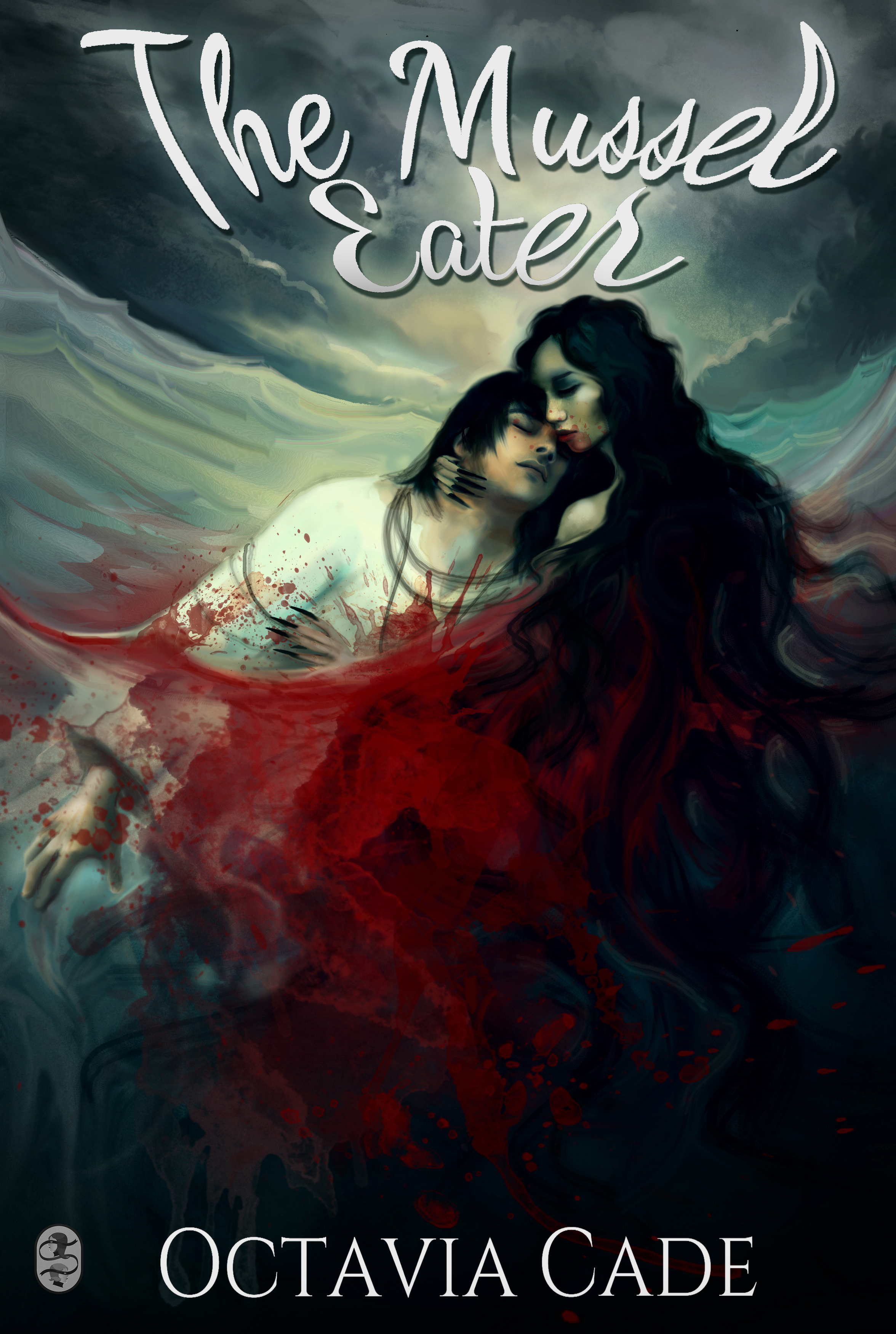
The Mussel EaterA few months back, the dedicated book reviewing team The Book Smugglers put out a publishing call for short stories based around the theme of subversive fairy tale retellings. I’m a fan of both the Smugglers and retellings, so I thought I’d give it a go. I actually had two stories that could fit, so I dithered for a bit and finally decided to submit a story I’d written based on the Maori legend of Pania of the Reef. Naturally, I spent the next couple of months second-guessing that decision, as it wasn’t really a fairy tale, but luckily Ana and Thea liked it anyway. “The Mussel Eater” is now part of their inaugural publishing season.

It’s one of my “future fishing in New Zealand” stories – I’m slowly building up a collection of interlinked stories about a speculative fishing industry full of beasties and burials and robots. The next one’s due out early next year, I believe, in Apex Magazine.

You can read “The Mussel Eater” online at The Book Smugglers for free, and they’ve also got a short essay by me on why I chose this particular story to rewrite. These two things are bundled with a short interview into an e-book put out by the Smugglers – this, as with the other five stories they’ve published this season – is available from their site and various e-publishing outlets.

And seriously, it’s got the most amazing cover. That painting’s done by Kristina Tsenova and it’s beautiful. The claws! The colours! You should check out the rest of her work. She’s really very good.

SFF, Short stories

StarShipSofa: “The Mistress of Fishes”

SSS_SEPT_2014-500x647Now from the “Oops, I’m so behind!” file, comes some very late-breaking news. My short sci-fi story, “The Mistress of Fishes”, has been podcast by the good people over at StarShipSofa. You can listen to the very fine narration by Barbra Dillon here.

Now granted, I’m still quite new at this writing thing, but whenever anyone makes a comment to me about one of my short stories it’s generally this one. It seems to be quite popular, which is nice. Originally it appeared in Regeneration: New Zealand Speculative Fiction II, last year, when it also won a small prize at one of the sci-fi conventions. That prize being Terry Pratchett books, which is fantastic for me as I’m a big fan.

It’s one of several stories I have that focuses on or around the fishing industry in future New Zealand.  Two other of these stories are due out soon from The Book Smugglers and Apex Magazine, and I’m currently writing up another on seaweed. Mostly to help encourage myself to finally finish and submit that paper I have on algae that’s been 90% done for some years now…

SFF, Short stories

Tommy Flowers and the Glass Bells of Bletchley

darkThe first of my code-breaking stories has just come out, in the latest issue of The Dark Magazine. I’ve always been interested in the science of WW2 – especially Bletchley Park and the Manhattan Project – and my fascination with the first of these has ended up in story. I’m planning a series of them – am in the middle of writing stories two and three now – a loosely connected collection with Bletchley Park at the hub.

Given that I’m a spec fic writer, history and the history of science are colliding with magical realism and other brands of fantasy. In “Tommy Flowers and the Glass Bells of Bletchley“, for example, Flowers (who created the Colossus – the first electronic computer – for the purpose of code-breaking) has the extra ability of being able to speak to glass. Each of the Colossi had hundreds, if not thousands, of glass vacuum tubes or thermionic valves, so they certainly would never have run quiet.

“I think it’s whistling at me,” one of the Wrens says to him, giggling. Her hair is damp, plastered to the nape of her neck in little curls, her uniform blouse clinging in the heat. She smells faintly of French chalk and warm glue, the sticky mix invented to loop the paper strips together with prayers and clamping. Behind her, the Colossus rattles and whirs, message tapes rolling at high speed, circling round the bedstead frame.

The valves are conspicuously silent. Tommy doesn’t trust them an inch. “Maybe it’s one of the officers,” he says, not very hopefully.

“I wouldn’t put it past them,” she says, as if someone hadn’t suggested that the Wrens do their work topless, all the better to cope with the vacuum tubes, blazing like a thousand lights and giving off the heat of a hundred electric fires. “But unless that duty officer out there has started whistling in fifths, then I wouldn’t bet money on it.”

There is nothing to do but apologise, and trust that the valves can be intimidated by a savage look. It is a trust that is not repaid. They flicker and giggle for praise, a squeaky carillon just at the edge of hearing, and their bulbous ends illuminate with little sparks of See? See? as the code rolls round.

Flowers had a lot to put up with.

Short stories

Cranky and silent – Lina Stern

This post is written as part of the Women’s History Month Cranky Ladies of History blog tour. If  you would like to read more about cranky ladies from the past, you might like to support the FableCroft Publishing Pozible campaign, crowd-funding an anthology of short stories about Cranky Ladies of History from all over the world.


lina sternLina Stern (1878-1968) was a Russian biochemist whose work predominantly centred on the blood-brain barrier. She was also a member of the Jewish Anti-Fascist Committee, which got onto the bad side of Joseph Stalin and led to her arrest, along with other committee members, on the grounds of treason and espionage.

Lina was the only survivor of the show trial that followed. On August 12, 1952, in what came to be known as “The Night of the Murdered Poets”, thirteen of her fellow committee members were executed by firing squad. Lina was spared solely because of her scientific ability. She was informed by the judge that she was as culpable as the rest, and was to be sent to a labour camp in lieu of execution because her work in physiology was of use to the state.

Lina Stern was 74 years old, and she was the only survivor. She was 74 years old when she was shipped into exile, far from her home and what remained of her friends, and with none of the work that she loved to cheer her. I think Lina must have been unbearably sad, felt unbearably guilty. To be the only one who survived – who would feel no guilt at that? Yet I also think that she must have been unbearably, unquenchably, undeniably angry. Who, again, would not be?

We can only surmise this anger. Ten months into her exile, Joseph Stalin died (and wouldn’t Lina have been pleased to hear that, out in the wastelands, out beyond the black stump in a place that echoed with gunshots). She was brought home, exonerated, restored to standing and to science. It had all been a dreadful misunderstanding, such a shame.

She must have felt the scepticism as a hammer blow. They say the best revenge is living well. Lina came back from exile and back to science, regained prestige and position and respect. She lived well and she lived on.

But Lina Stern never spoke of her time in exile. She took it to her grave. This is something I find terribly interesting. Of course, that ten months would have been an education enough in political realities to stifle any tongue. Stalin might have been dead but he didn’t take politics down with him. Discretion is still the better part, in any age – and yet, and yet. Lina had never been a pushover. She couldn’t afford to be, having had to fight for education and position in a time when women were routinely denied both. She survived prison and interrogation and exile, cruelty and contempt and ingratitude. You can’t fight and survive and learn fear as she learnt it and not know how to be angry, how to channel that anger.

There is power in being a cranky old lady, and power in knowing how and when to hide it. Anger has many faces, and some of them are deceptive. I think Lina learned anger very well indeed. She was practiced in learning, and she was never one to miss an opportunity.