SFF

SFF in Conversation: Smugglers and Magical Creatures

A couple of months ago, I got an email from Ana and Thea over at The Book Smugglers. They were doing a round table on diversity in spec-fic and wanted me to take part. Specifically, diversity in magical creatures – and as someone who’s getting really bloody sick of reading about elves and dwarves and goblin-types, all I can say to that is Yay.

I mean, there’s more to fantasy, right? You’d think with all the options out there, the widest-open genre would be able to mix it up a little. Yet in many ways fantasy is a conservative beastie – the province, often, of kings and queens and social structures that belong more to hundreds-of-years-ago if not to today. It’s bizarre – these continue to exist even when imagination is hurling up weird shit all over the place. Look, for instance, at what reliable, accessible contraception did for women and women’s rights in the real world. But insert that into a mediaeval society – as Martin does with moon tea in ASOIAF – and nope! No difference. Traditional models remain, against all odds and common sense. Little wonder that in a lot of fantasy lit the critters tend to the traditional as well.

Luckily, the recent push in spec-fic for more diversity, more inclusion, has seen a number of authors bringing different ideas to the table. Different monsters, different animals, different magical creatures. As a reader, I’m all for this – reading should stretch me beyond what I already know, expose me to new ideas and new ways of looking at the world. Otherwise it’s just baby-food, right? Apple sauce and sugar puffs. Fun and entertaining, but not enough to learn from.

I live in NZ, so even pasty white as I am there’s at least exposure to another culture’s mythology – I’ve never met a Kiwi who doesn’t know what a taniwha is, for instance. That exposure gives a certain advantage, but by itself that isn’t enough. No-one wants to be an appropriator, to rifle through another culture’s stories and misuse them for gain. Likewise, it’s hard to write with any integrity if you’re deliberately excising the rest of the world from your work so you don’t have to deal with it. I mean, for fuck’s sake. You’re a writer. Crack a book sometime, it won’t kill you. Talk to people. Communicate, learn. There’s more out there than mirrors.

SFF, Short stories

Tommy Flowers and the Glass Bells of Bletchley

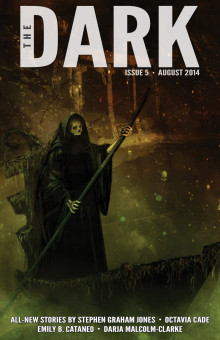
darkThe first of my code-breaking stories has just come out, in the latest issue of The Dark Magazine. I’ve always been interested in the science of WW2 – especially Bletchley Park and the Manhattan Project – and my fascination with the first of these has ended up in story. I’m planning a series of them – am in the middle of writing stories two and three now – a loosely connected collection with Bletchley Park at the hub.

Given that I’m a spec fic writer, history and the history of science are colliding with magical realism and other brands of fantasy. In “Tommy Flowers and the Glass Bells of Bletchley“, for example, Flowers (who created the Colossus – the first electronic computer – for the purpose of code-breaking) has the extra ability of being able to speak to glass. Each of the Colossi had hundreds, if not thousands, of glass vacuum tubes or thermionic valves, so they certainly would never have run quiet.

“I think it’s whistling at me,” one of the Wrens says to him, giggling. Her hair is damp, plastered to the nape of her neck in little curls, her uniform blouse clinging in the heat. She smells faintly of French chalk and warm glue, the sticky mix invented to loop the paper strips together with prayers and clamping. Behind her, the Colossus rattles and whirs, message tapes rolling at high speed, circling round the bedstead frame.

The valves are conspicuously silent. Tommy doesn’t trust them an inch. “Maybe it’s one of the officers,” he says, not very hopefully.

“I wouldn’t put it past them,” she says, as if someone hadn’t suggested that the Wrens do their work topless, all the better to cope with the vacuum tubes, blazing like a thousand lights and giving off the heat of a hundred electric fires. “But unless that duty officer out there has started whistling in fifths, then I wouldn’t bet money on it.”

There is nothing to do but apologise, and trust that the valves can be intimidated by a savage look. It is a trust that is not repaid. They flicker and giggle for praise, a squeaky carillon just at the edge of hearing, and their bulbous ends illuminate with little sparks of See? See? as the code rolls round.

Flowers had a lot to put up with.

Novellas, SFF

StarShipSofa podcasts “Trading Rosemary”

SSS-COVER-July2014-copy-500x647I’m happy to say that my novella, Trading Rosemary, has been podcast by the Hugo-award winning StarShipSofa!

Now Rosemary‘s a bit of a beast so they had to split it into two parts:

Part 1

Part 2

Enjoy! The podcast is free and well worth listening to in general, not just for my story, so I’d encourage you to follow them. They feature work from a lot of interesting authors.


KiwiWalks, Papers

Waikato and the Waste Land

Just a couple of disparate little things today. I’ve been out walking again – only a very lazy half day walk, but another step towards my bucket list goal of one day completing Te Araroa, the walking track that runs the length of New Zealand. I’ll probably be 70 before I finish it, but I don’t really care. I’m only doing it for fun, so racing along isn’t something I worry about.

Anyway, the portion I did today was part of the Waikato section: the Ngaruawahia to Hamilton stretch, which links up to the Hamilton City Traverse I did a few years back. Only about 12km, going alongside the Waikato river, so it wasn’t what you’d call strenuous. There’s a dual purpose cycle/walking trail (Te Awa) being built along the river here that’s part of Te Araroa but it isn’t finished yet, so I walked Te Awa when it was there and along the road bypass when it wasn’t. I’m not a particular fan of road walking – it’s very hard on the feet – but Te Awa itself was looking really impressive. Concrete, which is great for cyclists, not so much for walkers – but still beautifully done, with picnic sections stepped down to the water and scattered with nice solid tables. One day, when the whole thing’s finally done, I might try biking it.

The second is totally unrelated, except for alliteration purposes. A paper of mine, “Witnessing the Waste Land: Sight, Sound and Response in Edith Sitwell’s Three Poems of the Atomic Age” has been published. You can find it in volume 18 of UnderCurrents: the Journal of Critical Environmental Studies. If your library doesn’t have a copy of the print journal, you can find it (and my article) free online here.

It was a bitch of a paper to write. When it was done I was so glad I wouldn’t have to see those damn poems again (“Canticle of the Rose”, “Dirge for the New Sunrise” and “The Shadow of Cain” if you’re feeling particularly masochistic) but lately I’ve begun to think of another paper I could write about them.

Shoot me now.

Short stories

Cranky and silent – Lina Stern

This post is written as part of the Women’s History Month Cranky Ladies of History blog tour. If  you would like to read more about cranky ladies from the past, you might like to support the FableCroft Publishing Pozible campaign, crowd-funding an anthology of short stories about Cranky Ladies of History from all over the world.


lina sternLina Stern (1878-1968) was a Russian biochemist whose work predominantly centred on the blood-brain barrier. She was also a member of the Jewish Anti-Fascist Committee, which got onto the bad side of Joseph Stalin and led to her arrest, along with other committee members, on the grounds of treason and espionage.

Lina was the only survivor of the show trial that followed. On August 12, 1952, in what came to be known as “The Night of the Murdered Poets”, thirteen of her fellow committee members were executed by firing squad. Lina was spared solely because of her scientific ability. She was informed by the judge that she was as culpable as the rest, and was to be sent to a labour camp in lieu of execution because her work in physiology was of use to the state.

Lina Stern was 74 years old, and she was the only survivor. She was 74 years old when she was shipped into exile, far from her home and what remained of her friends, and with none of the work that she loved to cheer her. I think Lina must have been unbearably sad, felt unbearably guilty. To be the only one who survived – who would feel no guilt at that? Yet I also think that she must have been unbearably, unquenchably, undeniably angry. Who, again, would not be?

We can only surmise this anger. Ten months into her exile, Joseph Stalin died (and wouldn’t Lina have been pleased to hear that, out in the wastelands, out beyond the black stump in a place that echoed with gunshots). She was brought home, exonerated, restored to standing and to science. It had all been a dreadful misunderstanding, such a shame.

She must have felt the scepticism as a hammer blow. They say the best revenge is living well. Lina came back from exile and back to science, regained prestige and position and respect. She lived well and she lived on.

But Lina Stern never spoke of her time in exile. She took it to her grave. This is something I find terribly interesting. Of course, that ten months would have been an education enough in political realities to stifle any tongue. Stalin might have been dead but he didn’t take politics down with him. Discretion is still the better part, in any age – and yet, and yet. Lina had never been a pushover. She couldn’t afford to be, having had to fight for education and position in a time when women were routinely denied both. She survived prison and interrogation and exile, cruelty and contempt and ingratitude. You can’t fight and survive and learn fear as she learnt it and not know how to be angry, how to channel that anger.

There is power in being a cranky old lady, and power in knowing how and when to hide it. Anger has many faces, and some of them are deceptive. I think Lina learned anger very well indeed. She was practiced in learning, and she was never one to miss an opportunity.