SFF

SFF in Conversation: Smugglers and Magical Creatures

A couple of months ago, I got an email from Ana and Thea over at The Book Smugglers. They were doing a round table on diversity in spec-fic and wanted me to take part. Specifically, diversity in magical creatures – and as someone who’s getting really bloody sick of reading about elves and dwarves and goblin-types, all I can say to that is Yay.

I mean, there’s more to fantasy, right? You’d think with all the options out there, the widest-open genre would be able to mix it up a little. Yet in many ways fantasy is a conservative beastie – the province, often, of kings and queens and social structures that belong more to hundreds-of-years-ago if not to today. It’s bizarre – these continue to exist even when imagination is hurling up weird shit all over the place. Look, for instance, at what reliable, accessible contraception did for women and women’s rights in the real world. But insert that into a mediaeval society – as Martin does with moon tea in ASOIAF – and nope! No difference. Traditional models remain, against all odds and common sense. Little wonder that in a lot of fantasy lit the critters tend to the traditional as well.

Luckily, the recent push in spec-fic for more diversity, more inclusion, has seen a number of authors bringing different ideas to the table. Different monsters, different animals, different magical creatures. As a reader, I’m all for this – reading should stretch me beyond what I already know, expose me to new ideas and new ways of looking at the world. Otherwise it’s just baby-food, right? Apple sauce and sugar puffs. Fun and entertaining, but not enough to learn from.

I live in NZ, so even pasty white as I am there’s at least exposure to another culture’s mythology – I’ve never met a Kiwi who doesn’t know what a taniwha is, for instance. That exposure gives a certain advantage, but by itself that isn’t enough. No-one wants to be an appropriator, to rifle through another culture’s stories and misuse them for gain. Likewise, it’s hard to write with any integrity if you’re deliberately excising the rest of the world from your work so you don’t have to deal with it. I mean, for fuck’s sake. You’re a writer. Crack a book sometime, it won’t kill you. Talk to people. Communicate, learn. There’s more out there than mirrors.
SFF, Short stories

Tommy Flowers and the Glass Bells of Bletchley

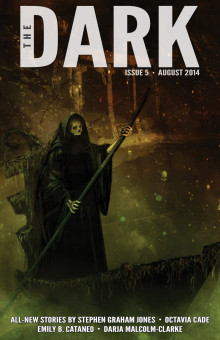
darkThe first of my code-breaking stories has just come out, in the latest issue of The Dark Magazine. I’ve always been interested in the science of WW2 – especially Bletchley Park and the Manhattan Project – and my fascination with the first of these has ended up in story. I’m planning a series of them – am in the middle of writing stories two and three now – a loosely connected collection with Bletchley Park at the hub.

Given that I’m a spec fic writer, history and the history of science are colliding with magical realism and other brands of fantasy. In “Tommy Flowers and the Glass Bells of Bletchley“, for example, Flowers (who created the Colossus – the first electronic computer – for the purpose of code-breaking) has the extra ability of being able to speak to glass. Each of the Colossi had hundreds, if not thousands, of glass vacuum tubes or thermionic valves, so they certainly would never have run quiet.

“I think it’s whistling at me,” one of the Wrens says to him, giggling. Her hair is damp, plastered to the nape of her neck in little curls, her uniform blouse clinging in the heat. She smells faintly of French chalk and warm glue, the sticky mix invented to loop the paper strips together with prayers and clamping. Behind her, the Colossus rattles and whirs, message tapes rolling at high speed, circling round the bedstead frame.

The valves are conspicuously silent. Tommy doesn’t trust them an inch. “Maybe it’s one of the officers,” he says, not very hopefully.

“I wouldn’t put it past them,” she says, as if someone hadn’t suggested that the Wrens do their work topless, all the better to cope with the vacuum tubes, blazing like a thousand lights and giving off the heat of a hundred electric fires. “But unless that duty officer out there has started whistling in fifths, then I wouldn’t bet money on it.”

There is nothing to do but apologise, and trust that the valves can be intimidated by a savage look. It is a trust that is not repaid. They flicker and giggle for praise, a squeaky carillon just at the edge of hearing, and their bulbous ends illuminate with little sparks of See? See? as the code rolls round.

Flowers had a lot to put up with.

Novellas, SFF

StarShipSofa podcasts “Trading Rosemary”

SSS-COVER-July2014-copy-500x647I’m happy to say that my novella, Trading Rosemary, has been podcast by the Hugo-award winning StarShipSofa!

Now Rosemary‘s a bit of a beast so they had to split it into two parts:

Part 1

Part 2

Enjoy! The podcast is free and well worth listening to in general, not just for my story, so I’d encourage you to follow them. They feature work from a lot of interesting authors.


Novellas, Reviews, SFF

Reviews and reproduction…

I’ve had two new short stories published in the last couple of weeks, both themed around reproduction.

“The Absence of Feathers“, a mythological eco-fantasy, has been published in the latest free-to-read issue of Luna Station Quarterly. “Feathers” features the Morrigan and her adopted grand-daughter Einin, and what happens to them when all the birds disappear from the world.

“Vita Urbis”, published in Elektrik Milk Bath Press’ recent urban fantasy anthology Twisted Boulevard, is probably my favourite story. It took me seven years to write, mostly because there were darlings I didn’t want to kill, but the poor things got slaughtered in the end. It’s about an architect who is impregnated by a city, interspersed with scenes from classical mythology, where women were always getting knocked up by bulls or swans or showers of gold, though I hope I’ve given the women involved a bit more agency than Ovid did in his Metamorphoses, which was a major inspiration for this story. There’s also shades of Oz in there, and 1984, to give a bit more density and layering.

That both stories feature myth is no accident. They’re part of a collection I’m working on, called The Mythology of Salt (that being the title of a story of mine that was published in Strange Horizons last year). Salt is based around the idea of women and myth and the consequences of knowledge. There’s two or three more stories I’m planning on finishing up soon, and then hopefully Salt will be complete enough to sell.

Speaking of selling, there’s a couple of reviews of my novella, Trading Rosemary, that have come out recently. The Book Smugglers were very kind and particularly complimentary, and Locus also had some positive things to say. It’s so nice when that happens – Trading Rosemary is my first book, and it’s such a relief to know that people like it.

If anyone’s interested, I also did a guest blog about the novella over at Catherine Lundoff’s site. It was very kind of her to ask me (thanks, Catherine!), and I was pleased to do it.

SFF

Stomp All Over That!

One of my favourite zines, Lightspeed, is running a kickstarter for a special issue: Women Destroy SF. They achieved their initial goal almost as quickly as their name, but the kickstarter’s running for a few more weeks as they try to reach their stretch goals. Anyhow, to support their efforts they’ve got a few women to write them mini-essays about women in science fiction, and being a science communicator, mine was linked with perceptions of women in science.

Apparently, women are destroying science fiction. The historically minded will recall that we used to destroy science. We’re branching out, it seems.

It started in the test tubes, the bright labs, the white coats, with Ada Lovelace in clockwork heels and Rosalind Franklin in spiral stilettos, and both of them following behind, because their footwear was all so flimsy they couldn’t possibly hold up by themselves, without help. With Lise Meitner in windup shoes, a dolly working on automatic in a lab that didn’t want her. With Marie Curie in shoes that glowed like ruby slippers dipped in uranium, turned away from the Academy of Sciences because men don’t wear pretty slippers and they’d taint the very threshold, they would, leave little traces of woman with a half-life too desperately long to ever be scrubbed away.

Still a place was made, if grudging. We clawed our way up and into science in our pretty, silly, sensible shoes, and stuck there, because people couldn’t very well bitch about women in science when Rebecca Lancefield was helping them see off Streptococcus in sequinned, sequenced sandals and when Gertrude Elion was doing the same with leukemia, with her toenails peeping red-painted out of open-toed marrowbone shoes. When Henrietta Lacks became science, her feet shod in Petri dishes, and legion. And the bigots read outside in the waiting room, their feet in concrete blocks and granddad slippers, and suddenly there’s this whole new world of women with feet that could be stepped on, that could be bound up and turned away.

There’s Mary Shelley with electricity zipping through her iron-toed, hobnail boots. And Margaret Atwood with her decoupage slippers, handmade with pages from Genesis, and Octavia Butler in boots embossed with teeth and feathers … And beneath all the shoes, upon all the soles, is stamped exception—making, for the prints that can’t be scuffed out, and taking, for the ones that can.

And this new army of shoes, of bright, pretty prints, are tracking in mud. They’re bringing in blood and dead birds and flesh-eating bacteria and sex, all come to topple, to bring down, and the poor deluded things don’t seem to realise that they’ve missed the Golden Age, all right, and it was back when their owners were barefoot. And would they mind going back, please, to the sad, superficial corners of the wardrobes from whence they came, because gold is best when not part of a spectrum and their presence just might drown it out. Those heels are noisy, understand? And science is a single experience, and limited, and you should sit back and let other people talk about it, because those tongues in those shoes can have nothing valuable to say. (Do you hear that, Marie? Do you hear it, Ada and Mary and Margaret?)

I hear it. And stomp all over that, I say. Science belongs to us all, and so does science fiction.