Food, Horror, Nonfiction, SFF, Short stories

Award Eligible Stories, 2017

It’s that time of year… when all writers start shilling their stuff for the upcoming awards season! And why not, I reckon.

I had nine eligible stories and one non-fiction book come out last year, but I think that’s genuinely too much to list, so I’m going to stick with a handful of the shorts and the non-fiction book.

The most important story I wrote last year, no question, was “The Stone Weta“, which appeared in Clarkesworld. If you’re considering nominating something of mine, please make it this. The idea for it was essentially ripped from the headlines – climate denialism sponsored by the state, and scientists working to preserve data across borders. Both of these things are happening, and cli-fi is an important tool in bringing climate change into the spotlight.

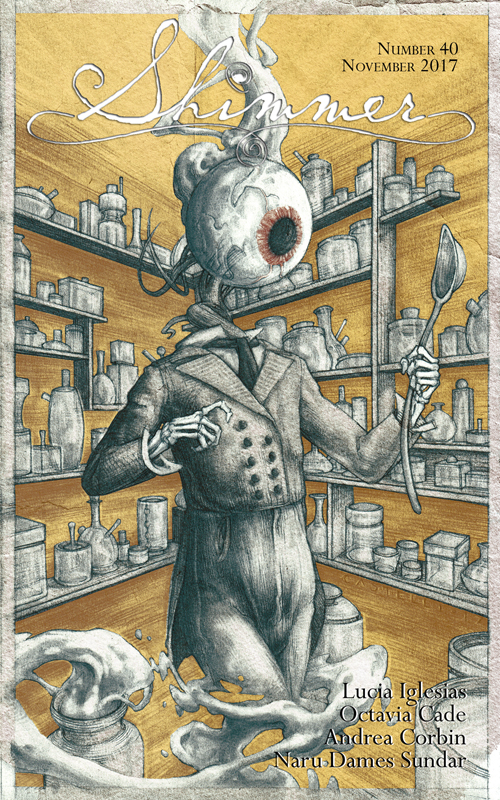
The best-written story, on the other hand, was “The Atomic Hallows and the Body of Science“, which appeared in Shimmer. This is the most literary of the things I had published last year, and continues my effort to write about science with a tinge of speculative fiction about it. If your nomination wants some snob-value to it, this is the story to go for.

On the other hand, if you’re a horror fan, I had two stories out near the end of last year which have both got a bit of positive attention. “The Ouroboros Bakery” from Kaleidotrope (my creepy magic food story) and “The Better Part of Drowning” in The Dark, which does its best to make sure you never eat crabs again.

If you’re looking for something non-fiction to nominate, my collected Food and Horror essays came out from The Book Smugglers at the beginning of December. The columns were actually published individually throughout 2016, mostly, but the collected edition has been substantially expanded, going from 40,000 to 60,000 words. Also, take a look at that gorgeous cover please, by Kristina Tsenova, who could be nominated for art if you’re so inclined.

That’s it! Thanks for your consideration, *cough* stone weta *cough*.

Horror, SFF, Short stories

Dinornis

I’ve a new story out!

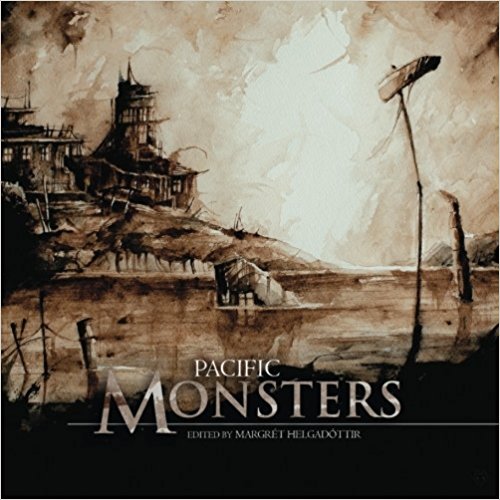
“Dinornis” appears in the anthology Pacific Monsters from Fox Spirit Press. It’s the fourth volume in their series of monster stories from around the world, and all of them are well worth checking out.

“Dinornis” is also my first graphic story! I wrote the script, and the story’s illustrated by Dave Johnson, who has done a fantastic job of making the moa seem creepy and sad. “Dinornis”, of course, is a reference to that giant extinct bird of New Zealand, the moa. The moa’s not really a monster, not in the typical understanding of the word, anyway. It’s sort of what I think of as a wishful monster.

Monsters are strange things.

We’re fascinated by them. There’s whole industries devoted to bringing them to life, to packaging them up in consumable form so that we can be briefly entertained by fright. And it’s fun because it is brief. I can enjoy spending two hours watching a zombie horror film precisely because zombies don’t actually exist. If my life revolved around fending them off, I’d not be turning towards them for my leisure hours. I’d be refilling the flame-thrower and any moments I could snatch for escapism would tend to the absolutely harmless.

We generally don’t want the monsters to be real. But sometimes it’s just so disappointing when they’re not.

Especially when we hold the burden of having removed them ourselves. Richard Matheson’s I Am Legend turns an individual amongst monsters into the monster those monsters fear, and on a species level Matheson isn’t far wrong. Extinction took a lot of monsters from this world long before humans came alone, but we’ve certainly done our best to slaughter the rest.

This can best be seen in the lands where humans are not. And, for longer than anywhere else, New Zealand was that land. The last major land mass to be colonised, absent of any native mammal but small bats, it was for millennia a land belonging to birds. Flightless, many of them, and some not. The most dangerous was the largest eagle to ever exist – Haast’s eagle. It died out when humans killed its food to line their own stomachs.

That food was my Pacific monster. The tallest bird ever known, the giant moa. Females were as much as 3.7 metres in height, and all of them were flightless.

All we have left of it are bones. Bones, and stories…

Every so often the rumours start back up. That down in the remote, unexplored back blocks of Fiordland the moa survives. Perhaps not the giant moa, which would be genuinely hard to miss, but one of the smaller species of the genus. There’s sightings, a blurry photo or two. Tracks in the earth.

When my Pacific Monsters story was being edited, Margrét commented on the character who’d just found a moa footprint. Wouldn’t she wonder what it was?

There isn’t a person in this country who would see a three toed footprint that size and not think – not hope – that it was a moa. We’re a young country. We take our monsters where we can get them.

Do I think they’re still out there? Honestly, no. Do I want them to be? Oh, so much.

It’s wishful thinking, I know. Imagination layering itself over science, and with just enough hook to cling to, because, Jurassic Park-like, there is an astronomical outside chance that discovery of ancient DNA might be enough to bring them back.

But what would we do with them if we did? If we found them, alive still, in the dark and distant corners of the bush?

I’d like to think we’d be happy. That, as a nation, we’d pull of the mother of all conservation efforts, exceeding even that of the black robin – a native bird pulled back from the brink when once there were only seven individuals remaining.

But then I remember the context of monsters, and how the moa met a monster new-come to their shores… and it was us.

They didn’t survive the human race.

If they’re still out there, I hope they stay far, far away. That they’re rumours forever, because some monsters survive best in wishful thinking.
 

Science, SFF, Short stories

The Atomic Hallows and the Body of Science

I’ve a new story out! And it’s a Shimmer story! AT LAST AT LAST I HAVE A SHIMMER STORY.

Right. You see, Shimmer has long been on my list of “bucket markets” – by which I mean markets I want to get a story into before I get hit by a bus and die. I have tried for years to get a story into Shimmer. It is a very hard thing to do. Why? Because Shimmer is a consistently excellent speculative fiction market, and so it gets a lot of submissions. I think they were commenting on Twitter that they got 5000 stories a year sent to them? Of which they publish maybe 24. So you can see the odds are stacked against.

This story of mine, “The Atomic Hallows and the Body of Science” (free to read at the link there), is the 28th story I have sent them. 28!!! It took that much work before they bought a story from me. I’ve been pretty open about this on Twitter – and now here – because I know from experience how discouraging constant rejection can be if you’re a writer. And it is discouraging – but it’s also part of the business, so you need to learn to not take it personally and keep trying. Editors want you to succeed, they want to buy an awesome story from you. The Shimmer editing staff, in particular, are lovely, and they were just as excited as I was to break that rejection streak I think.

I mean, if I can do it so can you. So don’t give up! And here’s a little snippet from the story to inspire you:

Lise Meitner
Co-Discoverer of Nuclear Fission

A spear breaks its blade upon ribs and punctures hearts. It shines with ice-coated needles in the salt air, over breakfast.

“I’ve had a letter,” says Lise to her nephew. He’d come to visit for the holidays so she wouldn’t be alone in the cold country of her exile. “I’ve had a letter and I don’t know what to make of it.”

She thinks she might be worried.

They walk across a frozen river, across the flood plain and into snowy woods—at least Lise walks, while her nephew glides on skis beside her, under crisp, frosted trees that smell of sap and pine and holiday gifts. Her fingers tingle in the cold, and their tips shine oddly in sunlight…


Horror, SFF, Short stories

The Better Part of Drowning

I’ve a new story out!

The Better Part of Drowning” is free to read in this month’s issue of The Dark Magazine. It’s been a while since I’ve had a story in The Dark (back in 2014, with “Tommy Flowers and the Glass Bells of Bletchley”) so it’s great to be back in there again.

“The Better Part of Drowning” is all giant, creepy, child-eating crabs, and what it’s like to have to live with them – to prey on them, and to be preyed on by them. Believe it or not, it’s set in the same world (on the same street!) as my recent story “The Ouroboros Bakery”, for all that they’re very different stories. It’s a world I plan to spend a lot more time in, with a series of interlinking shorts. Two more of these stories are in the pipeline – the crabs make a reappearance in my upcoming story “Sugar Ricochets to Other Forms” (in the Mother of Invention anthology), and the Lady of Scales is the subject of “The Temporary Suicides of Goldfish”, soon to appear in Kaleidotrope.

But, to the crabs…

Alix was never sure what kept the groaning rickety-spider of a dock up, unless it was the mussels that swarmed over the piles, turning them to hazards that could slice a swimmer open. The divers were all over scars from waves and mussels, always being pushed into shell sharp as knives and leaving their blood to scent the water.

“You kids be careful you don’t draw the crabs!” If she heard that once a day she heard it fifty times, and each time she had to smile over the slicing pain and wave up, because coins weren’t thrown to kids who wailed. Wailing made her choke if she tried to dive anyway, and there were always kids enough to squabble over coins so tears did nothing but anchor her to surface and starvation and blind her to the sudden scuttle of predation.

Don’t draw the crabs, they always said, and smiled as they said it, because it was entertaining to see kids dive in crab beds, and entertaining to see the bloodshed when they were slow enough for catching. Alix didn’t blame them for that. She’d never been able to look away either, no matter how much bile rose in her throat, the metal taste of panic.

Crabmeat, crabmeat. It was their own little circle of carnivorism, the smallest crabs providing one and the smaller kids the other. Not that the biggest of the scuttlers couldn’t take a man full-grown, but usually the bigger you got the more sense you had, and the more the habit of watching claws kept them away from bone…

Food, Horror, SFF, Short stories

The Ouroboros Bakery

I’ve a new story out!

The Ouroboros Bakery” can be read for free in this month’s issues of Kaleidotrope.

Whenever I’m not writing about science I seem to be writing about food – particularly about food and horror, and “The Ouroboros Bakery” is a dark fantasy story about pie and immortality. There’s a fair bit of cake in there as well, and while writing this story I came across a cake that was entirely new to me. Baumkuchen, which is basically cake on a spit. Layers and layers are brushed on as the spit turns, and when the whole thing is finished and you cut into it there’s the effect of tree rings. Naturally this is something I have to try!

It’s certainly more likely to be tasty than the blood pie of the magic bakery here, which – if you’re lucky (or unlucky) enough to get it – grants eternal life. But it seems that no matter how willing the customers are to guzzle down longevity, the reality of it never quite lives up to expectations…

“Please take it back,” he says. “Please.”

It’s not the most urgent plea Oksana has ever heard. This one is still mostly sane. He can still look her in the eye, and if his hands are tight-clasped together so that the knuckles show white, his voice has very little waver in it.

A strong man, then, but even strong men cannot fight on two fronts.

He does not touch his tea. Oksana serves it steaming hot, dark and tannic in the pot and her tea cups are the finest porcelain, translucent in afternoon sun. She has always been able to tell a lot from how her visitors drink her tea. Some sip as she does, their mouths unscalded and their cup dainty in their hands. Others are clumsier, aware of the cost of breakage, and these hold their cup in both hands. The polite do it before the tea cools, preferring to be burnt upon their palms than to risk cracks and recompense. And some refuse to drink altogether, whether out of preference or distraction, for Oksana serves her tea with sweet shortbread, with sponges and cream and tuile biscuits still warm from the oven.

Her visitor does not drink. It is not out of rudeness, and he would not eat again from her bakery unless it cost him his life, and there is nothing about Oksana’s afternoon tea that could do that. She finishes her slice of sponge, scrapes the last of the strawberry jam from her plate, the sweet tartness of it vivid against a background of tannin. His knuckles are paler than cream – they are as pale as icing sugar, and were he to try and take her cup in his hands, then all the tea would spill out…

You can read the rest over at Kaleidotrope!