SFF, Short stories

The Backward Lens of Compromise

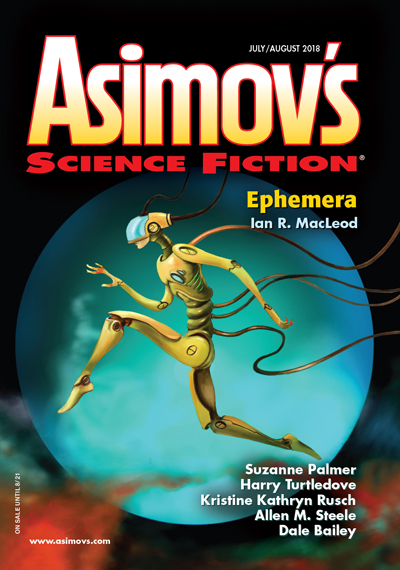
I’ve a new story out! “The Backward Lens of Compromise” is the third novelette of mine to appear in Asimov’s, and I’m really happy for it to be there. Like the other two, “Backward Lens” is about science history – this time, the history of telescopes and the astronomers who look through them. Interwoven with this is a modern day story of science education.

As a science communicator, I’m all for science ed. But science can be expensive to teach – it needs labs and equipment for hands-on work – and in impoverished communities, with underfunded public schools, it’s easy to cut. And in this story that’s what’s happening, except it’s going further than the classroom. An old observatory is being shut down, one that works with schools to teach students about the stars. The observatory doesn’t make money, and the kids from this disadvantaged community are deemed to be no-hopers anyway, so why throw good money after bad in getting them a proper education? Needless to say, the observatory’s astronomer has no truck with this… and neither do the kids themselves. And the observatory is changing around them, all magic and seeing and comprehension, and it turns out that what these no-hoper kids have already been taught about science and science history is an empowering thing…

Because it is. Because critical thought and objective methodology, the ability to discover new things, is a crucial aspect of education. Kids who lack it become citizens who lack it, and that’s what leads to poor schools in the first place.

Food, Horror, SFF, Short stories

Sharp and Sugar Tooth Kickstarter

So, the anthology that I’m editing for Upper Rubber Boot Books, The Sharp and Sugar Tooth, is getting closer! There’s a kickstarter on for it right now, so if you like short stories and horror and food, and feminism in your fiction, please take a look. There are all sorts of levels and rewards, including copies of Sugar Tooth and the other speculative anthologies in URB’s Women Up To No Good series, so it’s totally worth your while!

The anthology had its early genesis in the food and horror essays I did for The Book Smugglers a couple of years back. Once I’d finished that non-fiction collection, I was still interested in the food horror theme, and when I saw that URB was looking for new anthology pitches I thought I’d give it a go. The pitch was accepted, and last year I read through a heap of tasty slush, looking for the creepiest and most empowering horror stories I could find. There was a wide, wide range and it was really difficult to pick the best, as so many wonderful stories were submitted. But pick I did, and there are 22 fantastic stories from 22 wonderful, food-loving authors!

From Chikodili Emelumadu to Alyssa Wong and Catherynne M. Valente, as well as newer authors like Jasmyne J. Harris, H. Pueyo, and D.A. Xiaolin Spires, come stories of the sweet and the savoury and the scary, of apples and confectionary and strong meat, of little Wonderland cakes and post-apocalyptic nature preserves, of honey bees and hungry daughters and organ-eating. Please come back us, you won’t regret it!


Horror, SFF, Short stories

Gone to Earth

I’ve a new story out! “Gone to Earth” is free to read in the latest issue of Shimmer.

It’s a psychological horror story about Mars: the effect it has on astronauts, and their inability to adapt to it. “Gone to Earth” is also one of the earliest stories I ever wrote. It’s been sitting on my computer for close to a decade now, and most of the time it was lying fallow. New-writer me sent it out a couple of times, and it was promptly rejected, and I was disappointed but not all that surprised.

I knew the idea was good, but the execution was… lacking.

That’s why when you’re a writer it’s so very necessary to be a reader as well. Especially if you’re not a very good writer – and none of us are very good writers when we’re starting out. If you don’t read, and read widely, it’s all too easily to fall into an isolated creativity where you simply don’t have the tools to recognise that you’re producing sub-par material. But because I did read, I could assess that early version of “Gone to Earth” with some objectivity, and if I didn’t quite know why the writing sucked, I still knew that it did.

So I left it and left it and left it, and then late last year I pulled up that old file and started again. And I’m really glad I did, because I still love the ideas in this story. Take a look!

He’d thought the green would keep him from dreaming of the memory of arid sterility, the red and waterless horizon.

It didn’t.

His body was racked with chill and he hunched in his bed, trying to breathe with the rhythm of tides, to slow his heart to growing things. Yet even the warm night air of the Coromandel summer, straight from the coast and rustling through rātā trees, couldn’t dispel the cold. The nightmares still came regularly, suffocating waves of homesick regret. Strange that they hadn’t passed now that he was home again and anchored to the world of the living, and even stranger that they came from an adventure marking him a hero. He’d even felt heroic at the beginning, but all the bravery of heroism had come from ignorance, the assumption of a strength not yet tested because the testing was unimaginable.

An astronaut on the first manned mission to Mars! All the psychological tests he’d undergone had been for other things: socialization, conflict resolution in close quarters, the ability to cope with long-term and claustrophobic isolation. Alan had passed them all and felt himself stable enough, had never wavered either in ambition or explorer’s faith.

They’d never thought, none of them, that what brought him down would be a different sort of lack….


SFF, Short stories

The Huntsman’s Sequence

I’ve a new story out! “The Huntsman’s Sequence” is free to read (and to listen to) in the new issue of GlitterShip.

I tend to write a lot about the history of science, but never have I written about it in such a nerdy way. “The Huntsman’s Sequence” is a story about Alan Turing, who worked at Bletchley Park during WW2 and who broke the Enigma code there. His contribution to the war effort was enormous, and he was not rewarded for it. Persecuted for being gay, Turing took a leaf from his favourite movie – Snow White – and killed himself with a poison apple.

This story is a mash-up between the fairy tale and the facts. Turing, of course, is cast as the Huntsman, tracking down Enigma (Snow White). And – I warned you I was a nerd – the story’s structured in the form of a Turing machine programme.

Anyway, take a look!

The war is blank.

Not in its individual parts, but as a whole. It covers everything, smothers everything. It blows continents open with opportunity. Much of that opportunity is for death, for carcasses hung up and split open in massive consumption, a grind of bone and blood, but for some the opportunity is a tool for all that. Something to insert into the space between ribs, to lever open and dissect.

Not everyone dies in war. Not everyone sinks into blank nothingness, into unmarked graves and mass burials, into fields turned red and mud that stinks of iron. Some fight with symbols instead of flesh, their weapons heady and hidden, and it is in combination and in permutation that Turing finds his battleground.

He’s under no illusion that it keeps his hands clean. The information he extracts from the body of Enigma, the sweet little Snow White of his waking dreams, is used for murder as much as if he did the stabbing himself….

Horror, SFF, Short stories

Year’s Best Hardcore Horror

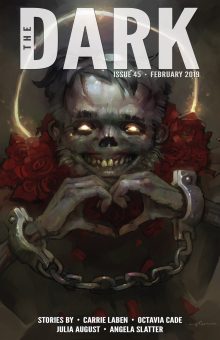
Last year I wrote a story, called “The Better Part of Drowning“, about carnivorous crabs and the girls who kill them. It was published in The Dark, and I’m happy to say it’s been reprinted this year as part of the Year’s Best Hardcore Horror series from Red Room Press! Volume 3 of the series, containing stories from 2017, has just been published. I can’t wait to get my hands on my own copy, because I love horror (as you would expect, writing so much of it) and I’m really looking forward to reading all the other creepy, bloody, lethal stories herein.

If you haven’t come across “The Better Part of Drowning” before, here’s a small excerpt:

Alix was never sure what kept the groaning rickety-spider of a dock up, unless it was the mussels that swarmed over the piles, turning them to hazards that could slice a swimmer open. The divers were all over scars from waves and mussels, always being pushed into shell sharp as knives and leaving their blood to scent the water.

“You kids be careful you don’t draw the crabs!” If she heard that once a day she heard it fifty times, and each time she had to smile over the slicing pain and wave up, because coins weren’t thrown to kids who wailed. Wailing made her choke if she tried to dive anyway, and there were always kids enough to squabble over coins so tears did nothing but anchor her to surface and starvation and blind her to the sudden scuttle of predation.

Don’t draw the crabs, they always said, and smiled as they said it, because it was entertaining to see kids dive in crab beds, and entertaining to see the bloodshed when they were slow enough for catching. Alix didn’t blame them for that. She’d never been able to look away either, no matter how much bile rose in her throat, the metal taste of panic.

Crabmeat, crabmeat. It was their own little circle of carnivorism, the smallest crabs providing one and the smaller kids the other. Not that the biggest of the scuttlers couldn’t take a man full-grown, but usually the bigger you got the more sense you had, and the more the habit of watching claws kept them away from bone.