Nonfiction, SFF, Uncategorized

Spring Again

I’ve a new academic chapter out! My paper “Spring Again: The Problem of Evil and the End of Winter in C.S. Lewis’ Narnia” is out in A Shadow Within: Evil in Fantasy and Science Fiction, edited by Francesca T. Barbini from Luna Press Publishing.

My love of fantasy began with Narnia. The first book I ever really remember reading was The Lion, the Witch and the Wardrobe, which my parents gave to me on the Christmas following my fourth birthday. I spent Christmas morning tucked in a chair and enraptured, while Mum vacuumed up tinsel around me. I’d finished by lunch, and my parents (untrusting souls that they were) were so disbelieving they actually quizzed me on the contents of the book. I passed, though for the life of me I couldn’t remember that the witch’s knife was made of stone.

As an adult I still enjoy Narnia, problematic though it sometimes is. (The Last Battle, I must admit, is one of my most hated books of all time.) So when I saw the Luna Press call for papers, I thought I’d write about evil in Narnia. Here’s the abstract:

In The Chronicles of Narnia by C.S. Lewis, evil is perceived as directly resulting from personal choice. Each individual is solely responsible for their own moral decisions, and these decisions both impact the continuing ethical development of the self and influence how the individual addresses the problem of evil. This is particularly well illustrated in the case of Edmund Pevensie, and this paper argues that it is his willingness to accept and atone for the evil within himself that directly leads to the end of the enchanted winter imposed on Narnia. In this sense, evil is not only present within the individual, but is externalised in the land that that individual inhabits.

Basically, it sums up as “prophecies are always dodgy”. The Beavers have no logic, poor things.

SFF, Short stories

The Feather Wall

I’ve a new story out! “The Feather Wall” is in Reckoning 3, which is free to read on their website. You can also buy the full anthology rather than waiting to read all the rest of their wonderful 2019 stories as they come out if you would prefer!

Anyway, “The Feather Wall” is about kakapo conservation after the apocalypse. Kakapo, if you don’t know of them, are an extremely endangered flightless parrot from New Zealand. They were getting along fine until humans came, but they’re a bit dopey and hopeless and were easily caught and eaten – not just by humans, but by the cats and ferrets and dogs and so on that humans brought with them. There are only a couple of hundred kakapo remaining, at time of writing, in their predator-free island sanctuaries. Fortunately their numbers are actually going up, thanks to the kakapo conservation programme run by NZ’s Department of Conservation (DOC). If you think about it, the world we live in today is actually post-apocalyptic from the perspective of the kakapo!

Be that as it may, “The Feather Wall” takes place in a time where plague has killed off most people on the planet. Martin, a DOC ranger on Resolution Island, is left trying to preserve his tiny population of kakapo, knowing as he does that when he dies they’ll likely be overrun by the predators he keeps away. It’s a hopeless task, he thinks, but he can’t make himself stop.

I love post-apocalyptic stories, but I’m really fed up with a) their insistence on humans falling into horrible brutish violent behaviour, and b) the rate of sexual assault that’s supposedly justified in the name of preserving the species. Here, the obsession with breeding after apocalypse is directed in a wholly positive way, in ensuring the continuation of the kakapo, and the people who survive the plague have no time for viciousness when there’s conservation to be done! Anyway, here’s a short taster, and please consider buying the antho. It’s full of environmentally-flavoured fiction, and is well worth reading.

“No, I’ll not leave you,” he said, stroking one of the big soft heads. “Don’t worry, I’m not going anywhere.” They were as good as quarantine, were kakapo. It was as if Resolution had a wall around it of feathers and expectation, a thin wall and a flexible one but one that kept him in regardless. And there was nowhere else for him to be, really. His biology had been ecology and conservation more than anything, his university experience a series of field trips punctuated by lectures, and if there was anyone left out there looking for a cure for plague he’d be pretty bloody useless. Better to stay with the birds and hope that Resolution was isolated enough to keep him healthy, hope that if he caught sick anyway the species barrier would protect them.

They were still, he thought, the more precious population.


Food, Horror, SFF, Short stories

The Sharp and Sugar Tooth

I’ve a new book out!

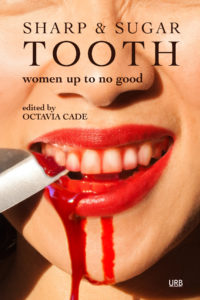
The Sharp and Sugar Tooth is a speculative fiction anthology of food and horror stories, edited by me and published by Upper Rubber Boot Books. Part of their Women Up To No Good series, it focuses on women’s experience with food and feeding. Because food is a necessity, something we can’t live without, there’s power in the managing of it, and power in the enjoyment of that management. Sometimes that’s a frightening thing, both for the women who cook and for the women who feed… but sometimes food needs to be frightening. There’s so much in it of temptation and of threat, and implicit in many forms of consumption is the tension between taking life from some so that others can live. This is fertile ground for a horror anthology, and the 22 stories in The Sharp and Sugar Tooth explore what that tension means for individuals, communities, and ecosystems.

The Sharp and Sugar Tooth features stories by Kathleen Alcalá, Betsy Aoki, Joyce Chng, Katharine Duckett, Anahita Eftekhari, Chikodili Emelumadu, Amelia Gorman, Jasmyne J. Harris, A.R. Henle, Crystal Lynn Hilbert, Erin Horáková, Kathryn McMahon, H. Pueyo, D.A. Xiaolin Spires, Rachael Sterling, Penny Stirling, Catherynne M. Valente, Sabrina Vourvoulias, Damien Angelica Walters, Rem Wigmore, Alyssa Wong, and Caroline M. Yoachim.

You can buy print and electronic copies at Amazon, Barnes & Noble, Kobo, Indiebound, and Wordery.


Horror, SFF, Short stories

The Little Beast

I’ve a new story out!

Well, it isn’t really new. “The Little Beast” was originally published back in 2017, in the anthology Respectable Horror from Fox Spirit Books. It was a great anthology to be a part of, but I’m happy to say that the story has been reprinted in this month’s issue of The Dark, making it free to read online for the first time.

“The Little Beast” is inspired by my least favourite fairy tale. Come at me, all you Beauty and Beast fans, but Beauty creeps me out. She always has. There’s something so unrelentingly good about her. Now I’ve nothing against good characters usually, in fact I tend to like and admire them. But sometimes goodness is so ostentatious you start to wonder if it’s a put on – like a politician kissing babies – and not to be trusted.

It’s the rose bit that always made me suspicious. “Oh, I just want a rose, Daddy!” At which point I bet the poor man cringed in himself, because over long distances a rose is the worst of presents. Can you imagine trying to keep a cut flower in good condition after several days of an overland trip, taken on a horse and cart most likely? It doesn’t bear thinking about. And there’s Beauty, smirking in the background like butter wouldn’t melt, getting all the credit for wanting this simple little gift that ensures her poor bloody father has to think about her every single second of that trip back, lest that simple little rose gets bruised or dry or the petals start to fall…

Horrible girl. There’s something extremely disturbing about her.

Papers, SFF

Sacrifice in Susan Cooper’s “The Dark Is Rising” Sequence

I’ve a new paper out! And it’s on a book series that is close to my heart: The Dark Is Rising series by Susan Cooper, which was the fantasy staple of my childhood. I don’t know how many times I read The Grey King as a kid, but it was a lot. I think as an adult it’s been replaced by The Dark Is Rising volume as my favourite of the series, but it’s a close thing. I still read through all five books at least once a year, generally around Christmas, and I always get something new out of them.

You can imagine, then, just how thrilled I am to have a paper out on it. Cooper’s got some really interesting examples of sacrifice that pop up over and over again in the series, all of them quite distinct from the others, and that’s what I look at in my paper. “Sacrifice in Susan Cooper’s The Dark Is Rising Sequence” is out in issue #19 of BFS Journal. It focuses on what exactly makes a sacrifice: how knowledge and intent work together (or don’t) to form different types of sacrifice, and how the sacrifices made differ between mortal and immortal figures.

We’re used to seeing grand sacrifices in fantasy literature, but so much of the story Cooper tells hinges on the small quiet choices of characters like Jane Drew and John Rowlands, and for me these are often more compelling. These two characters are particularly small and mortal compared to the more supernatural, the more mythological, figures in the text, and it stands to reason that their actions are comparatively small and human, but they’re no less effective – and no less crucial – for all that.